
Supported by Enterprise Estonia Development program

HomeOn-Site Disinfection Applications for Water Treatment and Process HygieneOn-Site Water Disinfection Systems with Anolyte

On-Site Water Disinfection Systems with Anolyte

Envirolyte on-site water disinfection systems generate anolyte close to the point of use for controlled treatment of municipal drinking water, commercial water systems, process water and selected industrial applications. The technology can be integrated into both new and existing treatment installations where continuous or demand-based disinfection is required.

A typical Envirolyte water disinfection system combines one or more anolyte generators with brine preparation, solution storage, dosing equipment and process controls. Dosing can be linked to water flow, free available chlorine (FAC), oxidation-reduction potential (ORP) or another validated control strategy selected for the source water and treatment objective.

System capacity, anolyte concentration, target residual and monitoring requirements must be evaluated for each project. Learn more about electrochemical activation technology, compare the ELA, ANW and HD anolyte generator ranges, and review the available approvals and compliance information.

Water Disinfection Applications

Envirolyte systems can be evaluated for water treatment projects across municipal, commercial, food-processing, hospitality, recreational and maritime environments.

  • Municipal drinking water and residential distribution systems
  • Rural and decentralised drinking water supplies
  • Breweries, beverage plants and food-production facilities
  • Dairies and other process-water installations
  • Hotels, restaurants, hospitals and schools
  • Swimming pools and recreational water systems
  • Golf-course and landscape water systems
  • Ships, offshore facilities and other maritime installations
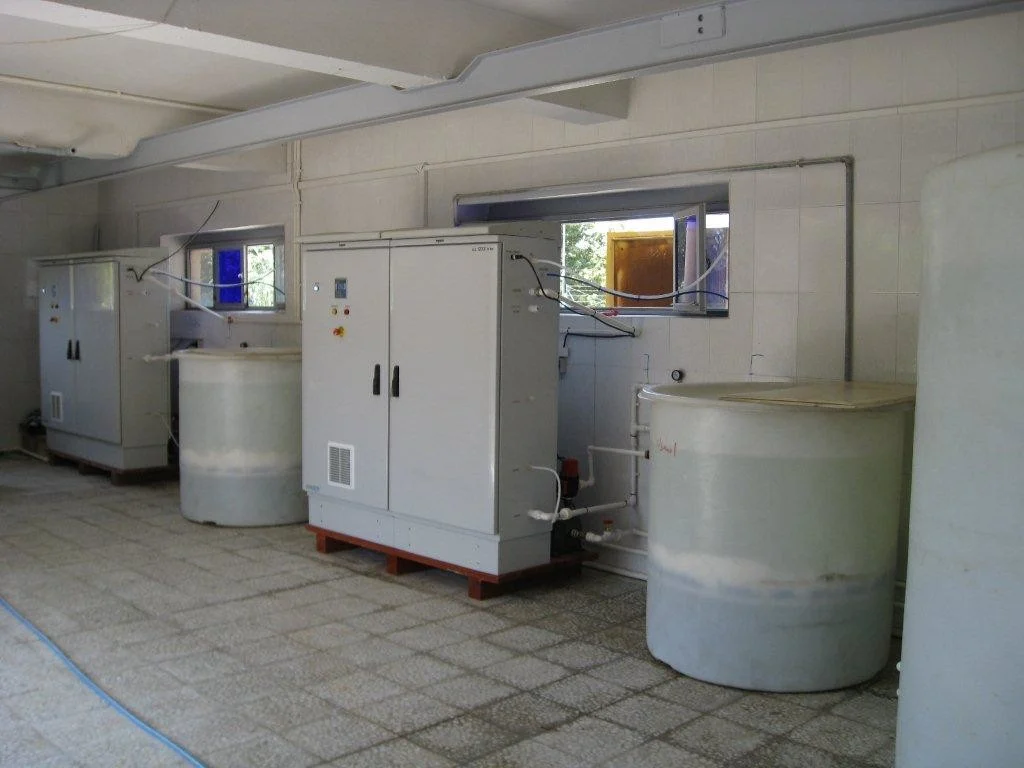
Envirolyte ELA anolyte generators with brine and solution storage tanks at a municipal water disinfection installation in Iran
Envirolyte anolyte generation and storage equipment installed for municipal water disinfection in Iran.

How an Envirolyte Water Disinfection System Works
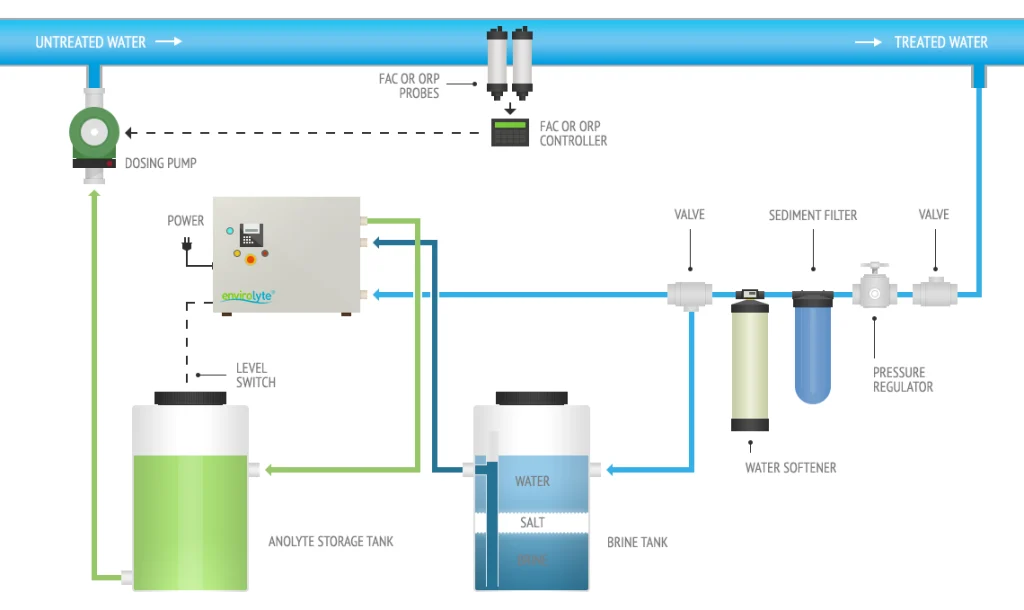
Diagram of an Envirolyte water disinfection system showing untreated water, filtration, water softener, brine tank, anolyte generator, storage tank, dosing pump and FAC or ORP control
Typical Envirolyte water disinfection system layout. The final configuration and monitoring points are determined by source-water quality, flow and project requirements.

Filtered or conditioned water and sodium chloride brine are supplied to the Envirolyte generator. The electrochemical cell produces an oxidising anolyte solution, which is transferred to a storage tank and metered into the water line by a dosing pump. A flow meter or FAC/ORP control loop can be used to adjust dosing according to operating conditions.

Core System Components

  • One or more Envirolyte anolyte generators selected for the required output and operating regime
  • Water filtration, pressure regulation or softening where required by source-water quality
  • Brine preparation or sodium chloride solution storage
  • Anolyte storage tank with suitable level controls
  • Dosing pump or pumps selected for the required injection rate and pressure
  • Flow, FAC, ORP or other project-specific monitoring and control equipment
  • Injection point, sampling points and integration with the existing water-treatment process

Dosing and Residual Control

The required dosing rate depends on water flow, temperature, pH, organic load, turbidity, microbial challenge, contact time and the required residual at the monitoring point. A commissioning programme should establish operating setpoints and confirm performance through appropriate chemical and microbiological testing.

Anolyte for Water Disinfection

Anolyte is the oxidising solution generated in the anodic chamber of an electrochemical cell. Depending on generator configuration, pH and operating conditions, the free available chlorine fraction can include hypochlorous acid and hypochlorite species. The relative distribution of these species and their performance are influenced by solution pH and the characteristics of the treated water.

Across different Envirolyte system families, equipment-level operating ranges may extend from approximately pH 2.0 to 8.5 and from about 100 to 6,000 mg/L of active chlorine. These figures do not apply to every generator and must not be confused with the required residual concentration in finished drinking water.

Operational Benefits of On-Site Generation

  • Generation of active solution close to the point of use
  • Reduced dependence on delivery and storage of concentrated disinfectant products
  • Automated production and controlled metering into the water line
  • Integration with flow, FAC or ORP monitoring
  • Scalable configurations for small, medium and high-capacity installations
  • Potential support for microbial, algae and biofilm control when the complete treatment programme is correctly designed and validated
  • Project-specific integration with tanks, pumps, filters, controllers and remote monitoring

Performance data should be interpreted in relation to the applicable test conditions and the specific water-treatment application. Supporting materials are available in the sections covering microbiological testing, disinfection by-products testing and ECHA and BPR information.

Comparison with Conventional Water Disinfection Methods

The manufacturer comparison chart below provides a general overview. It should not be interpreted as a universal performance guarantee because the suitability of chlorine gas, hypochlorite, chloramination, chlorine dioxide, anolyte and other treatment methods depends on source water, required residual, contact time, by-product limits, site safety and regulatory requirements. See the detailed water disinfectant comparison for additional context.

Comparison of Water Disinfection Methods

The following manufacturer comparison provides a general overview of selected operational characteristics of gas chlorine, delivered hypochlorite, calcium hypochlorite, chloramination, chlorine dioxide and on-site generated anolyte. Actual performance depends on source-water quality, treatment objectives, system design, operating conditions and applicable regulations.

Scroll horizontally to compare all water disinfection methods.

Manufacturer comparison of selected water disinfection methods
Criterion Gas chlorine Delivered hypochlorite Calcium hypochlorite Chloramination Chlorine dioxide Anolyte
Effective Yes Yes Yes Yes Yes Yes
Safety No No No No No Yes
Chlorine residual Yes Yes Yes Yes No Yes
TTHM and HAA5 reduction No No No Yes Yes Yes
Chlorine and bromate reduction Yes Yes Yes Yes No Yes
Biofilm removal No No No No Yes Yes
Algae elimination No No No No Yes Yes
Microflocculation No No No No Yes Yes
Taste and odour control No No No No No Yes
Easy to maintain Yes No No No No Yes
Low lifecycle costs No No No No No Yes

Check marks and crosses summarise selected operational characteristics of the compared water disinfection methods. They are a general overview rather than a universal performance guarantee. Method selection should be based on water analysis, required residual, contact time, by-product limits, site conditions, safety requirements and applicable regulations.

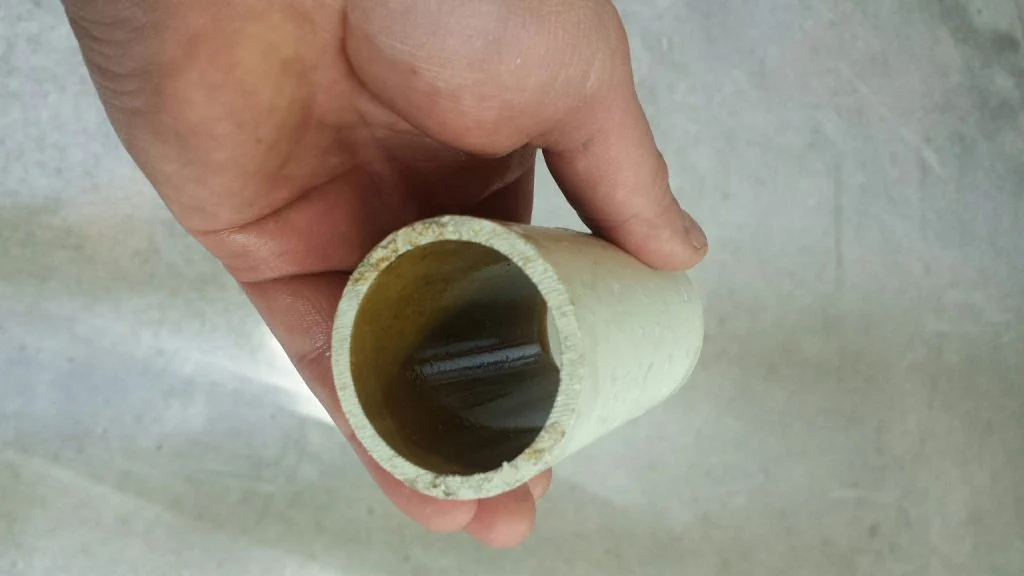
Example of Pipe Condition Before and After Anolyte Dosing

The photographs below show a pipe sample documented before and after anolyte dosing under the conditions of the referenced installation. They show a pipe sample documented before and after anolyte dosing. The result represents the conditions of the referenced installation and should not be treated as a guaranteed result for every water system.
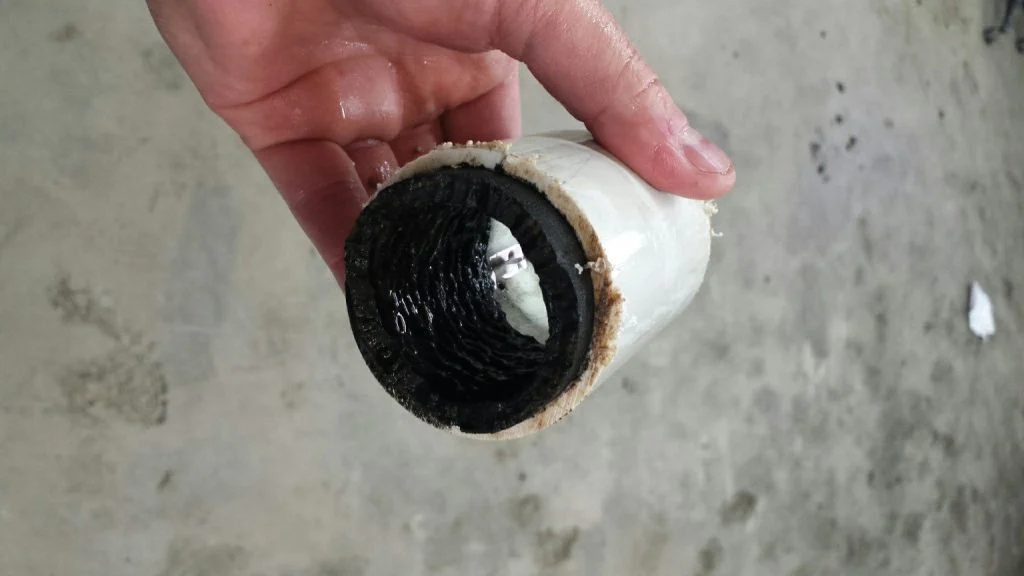
Interior of a water pipe shown before anolyte dosing with visible dark deposits
Pipe sample before anolyte dosing.
Interior of the same water pipe shown after anolyte dosing with reduced visible deposits
Pipe sample after anolyte dosing.

Water Disinfection Project Videos

The project videos below document Envirolyte water disinfection installations in Colombia, Indonesia and Turkey. 

Envirolyte Water Disinfection System in Colombia

Envirolyte Water Disinfection System in Indonesia

Envirolyte Water Disinfection System in Turkey

Envirolyte Water Disinfection Project in Colombia

Envirolyte Water Disinfection Project in Indonesia

Reference Water Disinfection Projects

The following PDF case studies document municipal, commercial, community and maritime water disinfection installations. The documents include project locations, water-consumption figures, equipment configurations, installation photographs, system diagrams and reported operating experience.

View Envirolyte water disinfection case studies
Envirolyte water disinfection reference projects and PDF documents
Country or regionInstallationCase study
TurkeyMunicipal drinking water treatment in Ünye CityÜnye City project PDF
ArgentinaMunicipal drinking water treatment in Catamarca ProvinceCatamarca Province project PDF
GeorgiaMunicipal drinking water treatment in Sartichala CitySartichala City project PDF
GeorgiaMunicipal drinking water treatment in Surami CitySurami City project PDF
RussiaMunicipal drinking water treatment in Breitovo CityBreitovo City project PDF
IranMunicipal drinking water treatment in Ardbil CityArdbil City project PDF
IranMunicipal drinking water treatment in Arsanjan CityArsanjan City project PDF
IranMunicipal drinking water treatment in Hashtgerd CityHashtgerd City project PDF
IranRural water treatment in the Iranshahr areaIranshahr rural project PDF
IranUrban water treatment in Iranshahr CityIranshahr urban project PDF
IranMunicipal drinking water treatment in Semnan CitySemnan City project PDF
IranMunicipal drinking water treatment in Zahedan CityZahedan City project PDF
RussiaLarge municipal installation in Voronezh CityVoronezh City project PDF
AlgeriaMunicipal drinking water treatment in Oran ProvinceAlgeria project PDF
BelgiumCold and hot water treatment at a restaurant in WevelgemBelgium restaurant project PDF
CanadaPublic water system at Mayfair Colony, ManitobaMayfair Colony project PDF
SwedenWater disinfection project in RiddarhyttanRiddarhyttan project PDF
CanadaCommunity water system at Bently Colony, AlbertaBently Colony project PDF
MaritimeOn-board water treatment aboard the Viking XPRSViking XPRS project PDF

The case studies describe installation-specific configurations and operating conditions. Equipment specifications, regulatory requirements and operating parameters should be confirmed separately for any new project.

Water Disinfection System Selection

An Envirolyte water disinfection project should begin with a review of source-water quality, treatment objectives and operating conditions rather than selection by generator model alone.

  • Maximum, minimum and average water flow
  • Source-water pH, temperature, turbidity and organic load
  • Microbiological challenge and treatment objective
  • Required contact time and target residual
  • Available water pressure, power supply and installation space
  • Required generator redundancy and storage capacity
  • FAC, ORP, flow or other monitoring requirements
  • Pre-treatment, dosing-pump and injection-point requirements
  • Applicable drinking-water, biocidal and workplace-safety regulations
  • Commissioning, sampling and ongoing verification procedures

Frequently Asked Questions

What inputs are required to generate anolyte?

Most Envirolyte water disinfection configurations use water, sodium chloride and electricity. Additional filtration, softening, pressure control or brine preparation may be required depending on the generator and source-water quality.

What is the Envirolyte ECO series used for?
The Envirolyte ECO series is designed for on-site generation of electrochemically activated solutions for water disinfection, sanitation, cleaning and related treatment applications. The appropriate configuration depends on the required output, solution parameters and intended use.
Should dosing be controlled by FAC or ORP?

The appropriate control method depends on the application, water chemistry and regulatory requirements. FAC provides a direct measurement of free available chlorine, while ORP can support process control under validated and stable operating conditions. Some projects also use flow-proportional dosing with residual verification.

Does one operating specification apply to every installation?

No. Generator output, solution pH, active chlorine concentration, dosing rate, contact time and residual targets vary by product configuration and project. Current product documentation and project-specific validation should always be used.

Can an Envirolyte system be integrated into an existing water treatment installation?
Yes, subject to an engineering review. Integration normally includes an injection point, dosing equipment, solution storage, monitoring, electrical connections and suitable interlocks with the existing treatment process.

Discuss Your Water Disinfection Project

Provide the Envirolyte technical team with your project location, source-water analysis, flow rate, treatment objective, required residual, available utilities and documentation requirements.

  • Products
  • Technology
  • Performance
  • Applications