Cleaning-in-place systems clean and sanitise the internal product-contact surfaces of tanks, pipelines, fillers, pumps and other processing equipment without routine dismantling. An effective processing equipment CIP programme must remove product residues, control microorganisms and prevent allergen or product cross-contact before production resumes.
Envirolyte CIP systems generate anolyte and catholyte on site from conditioned water, sodium chloride and electricity. Catholyte is an alkaline solution that can support selected washing and soil-removal stages, while anolyte is an oxidising solution used for authorised disinfection or sanitising applications. Learn more about electrochemical activation and electrolysed water technology.
Every CIP cycle must be validated for the processed product, soil type, equipment design, materials, flow velocity, temperature, solution concentration, contact time, rinse requirements and microbiological or residue limits. On-site generation does not remove the need for documented procedures, food-safety controls, worker protection or post-cleaning verification.
How Anolyte and Catholyte Support CIP
Envirolyte CIP equipment produces separate anolyte and catholyte streams. The solutions may be generated independently or simultaneously and supplied to dedicated storage tanks according to process demand.
- Product recovery and pre-rinse: remove recoverable product and loose residues using the procedure established for the processing line.
- Alkaline washing: circulate catholyte where its concentration and cleaning performance are suitable for the identified soil.
- Intermediate rinse: rinse where required to remove loosened residues, control carryover or prepare the system for the disinfection stage.
- Disinfection or sanitising: circulate anolyte at the validated FAC, pH, temperature, flow and contact time.
- Final rinse, drainage or drying: complete the authorised post-treatment procedure and verify that the equipment is ready for production.
Cycle design: a four-step or low-temperature CIP cycle may be possible in a validated installation, but it is not a universal replacement for every conventional programme. Intermediate rinsing, final rinsing, heating and additional detergents depend on the product soil, authorised use and verified cleaning result.
CIP Design and Validation Parameters
Swipe horizontally to view the full table.
| Parameter | Why it matters | Information to document |
|---|---|---|
| Product and soil | Fat, protein, carbohydrate, mineral scale, biofilm and burnt-on residues require different cleaning conditions. | Processed products, residue composition, allergen profile, holding time and previous cleaning results. |
| Equipment design | Dead legs, valves, seals, spray devices and poorly drained sections can prevent complete cleaning. | Tank and pipeline drawings, surface finish, dimensions, spray coverage, drainability and difficult-to-clean areas. |
| Materials | Anolyte, catholyte, temperature and exposure time can affect metals, elastomers, plastics and coatings differently. | Construction materials, gasket types, corrosion history and equipment-manufacturer restrictions. |
| Flow and mechanical action | Flow velocity and turbulence help remove soil and distribute cleaning solutions across internal surfaces. | Pump capacity, line diameter, flow rate, pressure, return flow and spray-device performance. |
| Solution specification | Cleaning and microbial performance depend on the generated solution at the point of use. | Anolyte FAC and pH; catholyte alkalinity and pH; temperature, solution age and quality-control method. |
| Contact conditions | Concentration, temperature and contact time work together and cannot be evaluated independently. | Cycle time, temperature profile, circulation time, minimum concentration and operating limits. |
| Rinsing | Rinse requirements depend on soil removal, chemical carryover, authorised food-contact use and product-quality limits. | Intermediate and final rinse steps, potable-water quality, conductivity endpoint and residue acceptance criteria. |
| Verification | Recorded operating parameters alone do not prove that the equipment is acceptably clean. | Visual inspection, conductivity, ATP, allergen testing, microbiological sampling, rinse-water analysis or other validated methods. |
Envirolyte CIP Generator Range
Envirolyte CIP generators are designed to produce matching volumes of anolyte and catholyte for food, beverage and other processing applications. The model should be selected from the required solution volume per cycle, cycle frequency, storage capacity, peak demand and required redundancy.
Swipe horizontally to view the full table.
| Model | Nominal anolyte output | Nominal catholyte output | Typical selection consideration |
|---|---|---|---|
| CIP 20/20 | Approximately 20 L/h | Approximately 20 L/h | Smaller CIP circuits, pilot installations or lower daily solution demand. |
| CIP 100/100 | Approximately 100 L/h | Approximately 100 L/h | Food and beverage lines requiring moderate solution production. |
| CIP 200/200 | Approximately 200 L/h | Approximately 200 L/h | Larger processing facilities or multiple daily CIP cycles. |
| CIP 300/300 | Approximately 300 L/h | Approximately 300 L/h | High-capacity processing facilities with larger storage and circulation requirements. |
Generators with other output capacities can be specified according to the required solution concentration, storage volume and processing schedule. Review the current Envirolyte CIP equipment range and specifications before selecting a model.
Published Standard CIP Characteristics
- Anolyte output at approximately 500–550 ppm FAC, depending on the selected configuration and operating settings.
- Catholyte output at approximately 0.8–1.0 g/L NaOH and pH above 12.
- Separated anolyte and catholyte reactor-cell technology.
- Independent or simultaneous solution production controlled by tank levels.
- Low-salt configuration intended to limit chloride contribution to the CIP process.
- Published chloride value of approximately 28–34 ppm in final CIP solutions, plus chloride already present in the makeup water.
- Published waste-stream generation below 0.5% of generator capacity.
- Optional remote monitoring through GSM, Ethernet or Modbus, depending on the ordered configuration.
Specification note: solution concentration, pH, chloride, output and waste values must be confirmed from the current datasheet and commissioning results for the selected generator. Low chloride does not remove the need for material-compatibility and corrosion assessment.
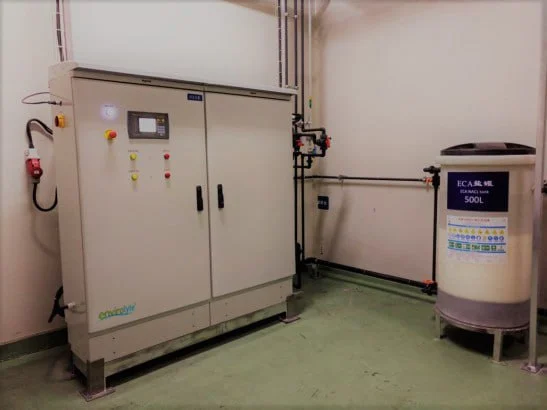
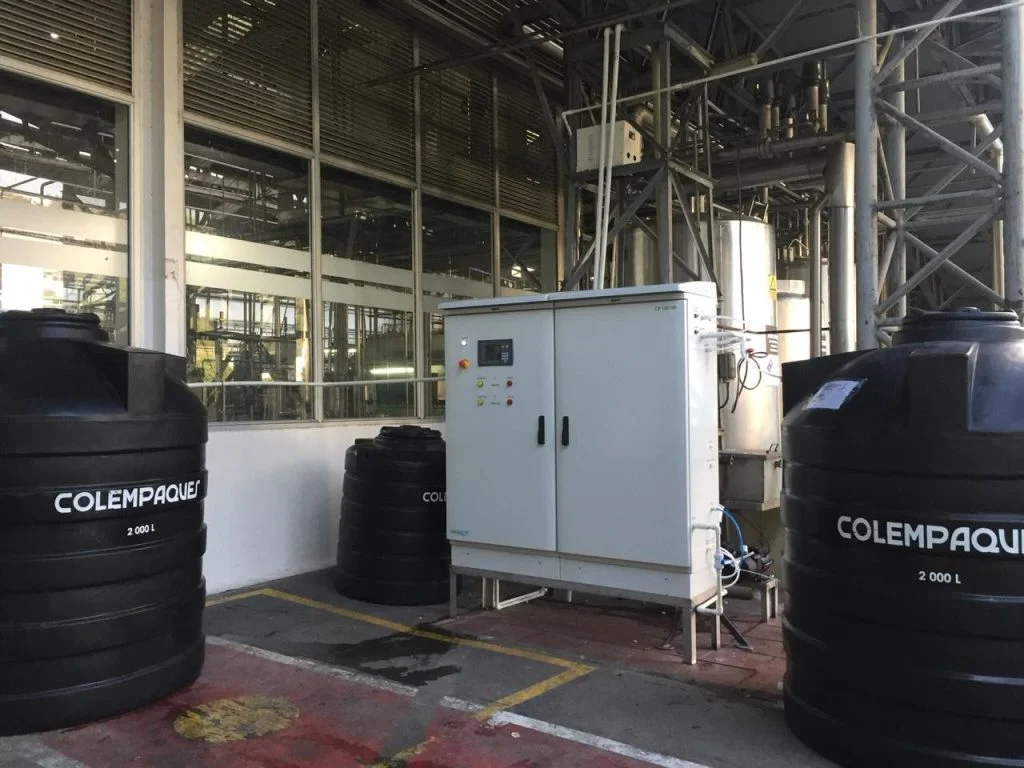
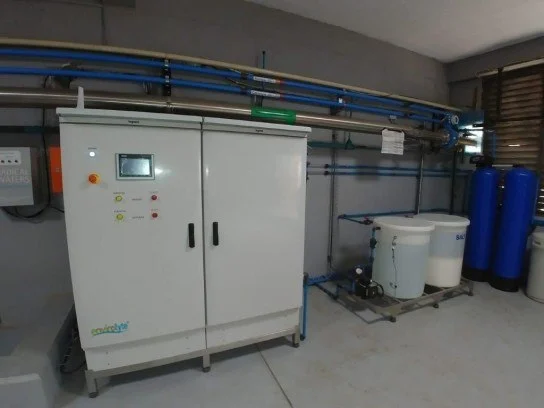
Processing Equipment CIP Installations
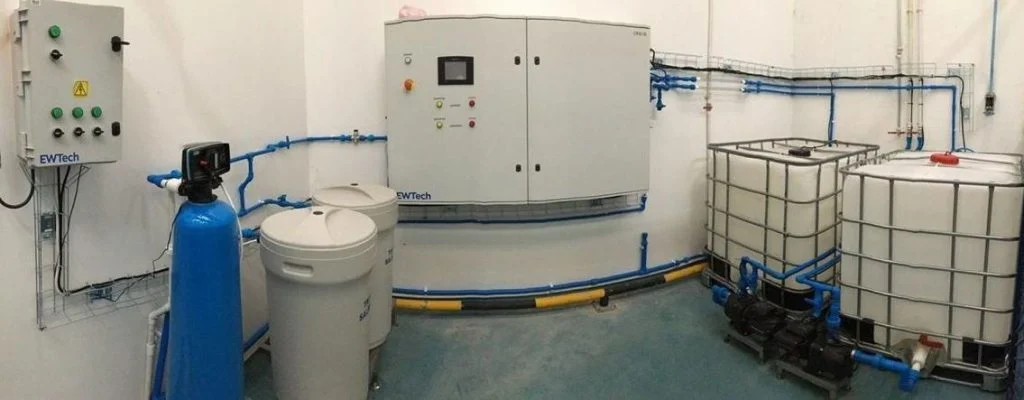
Potential Operational Benefits
- On-demand generation of washing and disinfection solutions close to the point of use.
- Independent or simultaneous production of anolyte and catholyte.
- Potential reduction in transported and stored concentrated cleaning products.
- Potential reductions in temperature, water consumption or cycle duration after process validation.
- Integration with storage tanks, level switches, pumps, process controls and remote monitoring.
- Consistent solution production when operating parameters and quality-control checks are maintained.
- Scalable generator output for different processing capacities and CIP schedules.
Production-time, water, energy, chemical and total-cost savings must be calculated against a defined baseline. Results depend on the existing CIP programme, product soil, utilities, heating requirements, water quality, cycle frequency and verification criteria.
Food Safety, Rinsing and Worker Protection
Food-contact equipment must be cleaned and, where necessary, disinfected at a frequency that prevents contamination. The CIP procedure should be included in the facility sanitation programme and connected to HACCP, allergen-control and product-changeover requirements.
A final potable-water rinse must not be removed solely because anolyte is near neutral pH. The required rinse procedure depends on the authorised product use, applied concentration, food-contact classification, local regulation and validated residue limits.
Near-neutral anolyte and alkaline catholyte are process chemicals. Operators should follow the applicable safety data sheet, product authorisation, chemical-handling procedure and equipment lockout requirements. Protective gloves, eye protection, ventilation or other controls may still be necessary.
Performance Evidence and Compliance
Review the available microbiological testing of Envirolyte anolyte together with the tested concentration, organism, organic load, temperature and contact time. Laboratory suspension tests do not prove that a complete CIP circuit has been effectively cleaned.
Validation should demonstrate soil removal, microbial control, allergen removal where relevant, acceptable residues and repeatable cycle performance at the most difficult locations in the equipment.
Before implementation, review the applicable BPR and customer compliance requirements. Related hygiene applications are described on the food-processing page.
Frequently Asked Questions
Cleaning-in-place is a controlled process for cleaning the internal product-contact surfaces of tanks, pipelines, fillers, pumps and related equipment without routine dismantling.
Catholyte is an alkaline solution that may support selected washing and soil-removal stages. Anolyte is an oxidising solution used for authorised disinfection or sanitising stages after adequate cleaning.
No universal replacement claim can be made. Additional detergents, acids, enzymes or specialist cleaners may still be required depending on the product residue, mineral scale, allergen and equipment design.
No. Rinse requirements depend on the authorised use, product soil, chemical carryover, food-contact requirements, residue limits and validated cleaning procedure.
No. Lower-temperature operation may be possible for selected validated applications, but the required temperature depends on the soil, solution concentration, flow, contact time and hygiene target.
Safety requirements cannot be determined from pH alone. Operators must follow the applicable safety data sheet, product instructions, concentration limits and site risk assessment.
Model selection depends on the required anolyte and catholyte volume per cycle, production time, cycle frequency, storage capacity, peak demand, solution concentration and redundancy requirements.
A preliminary assessment requires the processed products, equipment drawings, soil and allergen information, line volumes, flow requirements, current CIP sequence, temperatures, water analysis, verification methods and country of installation.
Discuss a Processing Equipment CIP Project
Provide the processed products, equipment layout, line and tank volumes, current CIP programme, soil types, temperatures, required cycle frequency, water analysis and verification requirements so that the generator and process configuration can be assessed.