
Successful silage preservation depends on harvesting forage at a suitable moisture level, excluding oxygen quickly, packing the material evenly, sealing the storage structure and maintaining controlled anaerobic fermentation. Any preservation treatment should support these established ensiling practices rather than replace them.
Envirolyte systems generate anolyte on site from conditioned water, sodium chloride and electricity. Depending on the operating regime, anolyte contains active chlorine species and may be evaluated as part of a validated green fodder or silage preservation process. Learn more about electrochemical activation and on-site anolyte generation.
Suitability must be established for the crop, moisture or dry-matter content, storage method, solution specification, dosage, distribution system, fermentation profile, feed analysis and applicable feed regulations. Anolyte should not be promoted as an authorised silage additive until its classification and permitted conditions of use have been confirmed for the target market.
Green Fodder and Silage Preservation
Silage preservation aims to limit undesirable aerobic activity and support stable fermentation after harvested forage is placed in a bunker, clamp, bag, tower silo or other storage system. The crop should be filled and compacted efficiently so that oxygen is removed and the storage structure can be sealed without unnecessary delay.
Anolyte may be evaluated as a preservation or microbial-control support treatment applied during filling. A complete process must still control crop maturity, chop length, moisture, packing density, sealing, drainage, storage time and feed-out management.
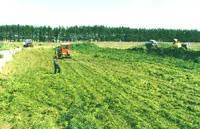
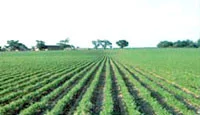
How Anolyte Can Be Evaluated in an Ensiling Process
- Characterise the crop: identify the forage species, maturity, chop length, moisture, dry matter, sugar content and expected storage conditions.
- Define the treatment objective: determine whether the process is intended to support preservation, control selected microorganisms or improve hygiene during handling.
- Confirm regulatory status: establish whether the proposed use requires authorisation as a silage additive, feed additive, processing aid or another regulated category.
- Specify the anolyte: document free available chlorine, pH, temperature, solution age and generated volume.
- Set the application rate: determine litres of solution per tonne of forage through application-specific trials rather than applying a universal dosage.
- Verify distribution: calibrate tanks, pumps, hoses or spray nozzles to distribute the solution evenly without untreated areas or local over-wetting.
- Maintain good ensiling practice: fill efficiently, apply the forage in suitable layers, pack thoroughly and seal the storage structure promptly.
- Validate the result: measure fermentation profile, pH, dry-matter loss, aerobic stability, feed composition, microbiological quality and animal-performance outcomes where relevant.
Critical Validation Parameters
Swipe horizontally to view the full table.
| Parameter | Why it matters | What should be documented |
|---|---|---|
| Crop and maturity | Different forage crops and harvest stages have different sugar, buffering and fermentation characteristics. | Crop species, variety, harvest date, maturity, chop length and initial composition. |
| Moisture and dry matter | Excess moisture can increase effluent and undesirable fermentation, while material that is too dry can be difficult to compact. | Moisture or dry matter at harvest, test method and acceptable operating range. |
| Anolyte specification | The activity of the generated solution depends on its condition at the point of application. | FAC, pH, temperature, solution age and generator operating parameters. |
| Application rate | Insufficient treatment may not meet the process objective, while excessive liquid can affect local moisture. | Litres per tonne, pump calibration, forage throughput and total applied volume. |
| Spray distribution | Uneven application can leave untreated material or create locally wet areas. | Nozzle or hose arrangement, pressure, spray pattern, layer thickness and uniformity checks. |
| Packing and sealing | Preservation depends on rapid oxygen exclusion and maintenance of anaerobic conditions. | Filling rate, layer thickness, packing procedure, storage type, cover and sealing inspection. |
| Fermentation and storage | pH alone does not fully describe preservation quality or aerobic stability. | pH, fermentation acids, temperature, dry-matter loss, storage period and feed-out observations. |
| Feed safety and quality | The completed silage must remain suitable for the intended animal species and production system. | Nutrient analysis, microbiological results, residues where applicable, intake and animal-health observations. |
Regulatory note: where anolyte is added directly to forage for a preservative function, confirm whether it is authorised for that use under the applicable feed-additive legislation. For EU projects, only authorised feed additives may be used under their specified conditions. Review the EU rules for feed additives and the relevant Envirolyte customer compliance requirements.
Anolyte Application Methods
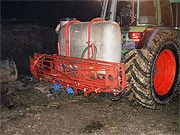
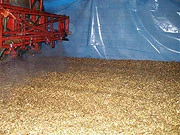
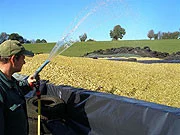
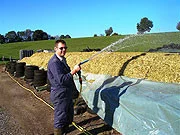
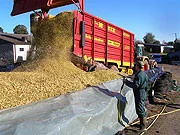
The photographs below show two practical application approaches: mechanical spraying from a tractor-mounted container and manual spraying with a hose. They are provided as illustrative examples and do not define a validated dosage, solution specification, spray pattern or regulatory approval.Mechanical Application During Silo Filling
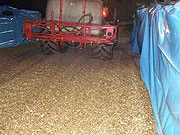
Manual Application During Filling
Illustrative Cost Calculation
The following values form an undated illustrative calculation. They are not current quotations and should not be used for procurement or return-on-investment decisions without a new site-specific calculation.Swipe horizontally to view the full table.
| Preservative | Illustrative unit-price assumption | Illustrative application rate | Calculated product cost per tonne of silage |
|---|---|---|---|
| Anolyte | €2.50/tonne of solution or €0.0025/L | 15 L/tonne of silage | €0.0375/tonne of silage |
| Mixed-organic-acid preservative | €800/tonne of product or €0.80/L | 5 L/tonne of silage | €4.00/tonne of silage |
Cost limitation: this calculation includes only an assumed solution or product price. It does not include the anolyte generator, water conditioning, storage tanks, salt, electricity, maintenance, labour, dosing equipment, calibration, testing, depreciation or financing. Current preservative pricing and application rates must be obtained for each project.
Performance Figures Requiring Verification
Figures of 19% higher milk production, 42% higher average daily weight gain and preservation of 95–100% of the forage have been reported. Effective preservation regardless of crop moisture, composition or weather conditions has also been claimed. No supporting study or project report is provided for these figures.
These values should remain unpublished as performance claims unless the original records identify the farm, crop, harvest conditions, control treatment, animal groups, ration, trial period, analytical methods and statistical results. They must not be presented as guaranteed outcomes for a new silage project.
Potential Operational Considerations
- Active solution can be generated close to the silage preparation area.
- Metered spraying may be integrated with existing filling or conveying operations.
- Mechanical application can support more consistent distribution than uncontrolled manual spraying.
- On-site generation may reduce the need to transport and store selected concentrated preservative products.
- Solution production and dosing can be monitored as part of a documented preservation process.
- Application-specific validation can connect solution data with fermentation, feed-quality and storage results.
Anolyte treatment should complement crop management, moisture control, packing, sealing and feed-out procedures. Related information is available for feed-material decontamination, farm hygiene and biosecurity and dairy-farm water and process hygiene.
Testing and Project Validation
General microbiological testing of Envirolyte anolyte can support an assessment of the technology, but suspension-test results do not establish performance in a forage matrix. Silage contains organic material that can affect active-solution demand, distribution and contact with microorganisms.
A field trial should compare treated and control material under representative conditions. The validation plan should define sampling, fermentation analysis, nutrient composition, microbial testing, dry-matter recovery, aerobic stability, feed intake and any animal-performance measurements before application-specific performance conclusions are drawn.
Frequently Asked Questions
Silage preservation is the controlled storage of moist forage under anaerobic conditions. Effective preservation depends on suitable crop moisture, efficient filling, thorough packing, rapid sealing and stable fermentation.
Anolyte may be evaluated as part of a validated preservation or microbial-control process applied during silo filling. The trial should define the solution specification, dosage, spray distribution, crop conditions, storage method and required feed-quality results.
No. Anolyte should not be presented as a treatment to accelerate recovery after castration. Castration, wound care, pain management and infection prevention must follow applicable animal-welfare requirements and the herd veterinarian’s procedure.
No. A treatment solution cannot compensate for unsuitable moisture, poor compaction, slow filling, damaged covers or continued oxygen entry. Established ensiling practices remain essential.
No. Application rate depends on crop type, maturity, moisture, dry matter, organic load, storage method, solution specification, distribution efficiency and the intended preservation objective.
No universal application rate can be recommended. A suitable rate must be established for the specific crop, moisture conditions, solution specification, application method and applicable regulatory requirements.
No. The regulatory classification and authorisation must be confirmed. Feed additives used in the EU must be authorised for their intended function, target animals and specified conditions of use.
A preliminary assessment requires the crop type, harvest maturity, moisture or dry matter, daily filling capacity, storage method, current preservative programme, proposed dosage, application equipment, feed-analysis requirements and country of use.
Discuss a Silage Preservation Project
Provide the crop type, moisture or dry matter, expected silage volume, filling rate, storage method, current preservative process, available utilities and country of use so that the application and validation requirements can be assessed.