Supported by Enterprise Estonia Development program

HomeAnolyte, Hypochlorous Acid and Catholyte GeneratorsSea Water Anolyte Generators for Maritime and Offshore Disinfection

Sea Water Anolyte Generators for Maritime and Offshore Disinfection

Envirolyte sea water anolyte generators are on-site electrochemical systems designed to produce ANK-neutral anolyte directly from seawater or brackish water. The technology uses the natural sodium chloride content of sea water as the feed source, reducing the need for mains water and prepared brine in selected coastal, maritime and aquaculture applications.

Sea water anolyte generation is suitable where operators need compact disinfectant production near the point of use: ships, offshore facilities, coastal installations, swimming pools using sea water, fish and shrimp farming, hatcheries and process water treatment. The generated anolyte provides active chlorine for water disinfection, sanitation and microbial control while simplifying logistics and chemical handling.

Envirolyte sea water units are designed to generate ANK-neutral anolyte and, if required, catholyte from feed water with salinity from 5–7 PSU for brackish water up to 33–35 PSU for ocean water. The active chlorine concentration is typically configured in the range of 500–1000 ppm, depending on model, feed water and project requirements.

New Opportunities for Seawater-Based Anolyte Production

The use of seawater as feed brine for Envirolyte generators creates new opportunities for disinfection, sterilisation and water purification where access to mains water or prepared brine is limited. Since seawater is predominantly a sodium chloride solution with additional dissolved salts, it can provide sufficient chloride content for the electrochemical generation of active chlorine in the final anolyte solution.

This approach extends Envirolyte technology into maritime, offshore, coastal and aquaculture applications where seawater is readily available. It is especially relevant for on-board water hygiene, seawater swimming pools, fish farming, shrimp farming, hatchery water treatment and coastal process water disinfection.
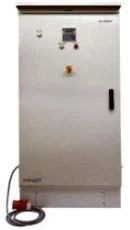
Envirolyte ELA-850SW sea water anolyte generator for on-site seawater disinfection
ELA-850SW sea water anolyte generator for producing ANK-neutral anolyte from seawater.

How Envirolyte Sea Water Generators Work

Envirolyte sea water machines are a further development of Envirolyte electrochemical activation technology. Instead of preparing a separate salt brine, the system uses seawater or brackish water as the main feed source. For background on the process, see electrochemical activation technology, diaphragmatic cells and electrolysed water solutions.
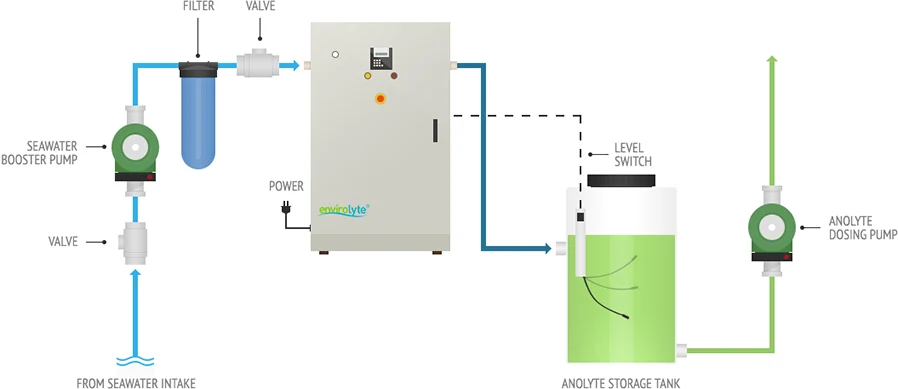
General layout of Envirolyte seawater anolyte generator with seawater intake, filter, generator, storage tank and dosing pump
General layout of an Envirolyte seawater anolyte generator with seawater intake, filtration, anolyte storage and dosing.

Key Technical Specifications

Envirolyte sea water anolyte generator specifications
ParameterSpecification or project note
Generated solutionANK-neutral anolyte and, if required, catholyte.
Feed waterSeawater or brackish water used as the main feed source.
Salinity rangeFrom 5–7 PSU for brackish water up to 33–35 PSU for ocean water.
Active chlorine concentrationTypically 500–1000 ppm, preset during manufacturing and adjustable according to customer requirements.
Anolyte output capacityFrom 40 LPH up to 6000 LPH of ANK-neutral anolyte, depending on model and configuration.
Power source380 / 230 / 110 VAC ±10%, depending on project requirements.
Power consumptionModel-dependent; approximately 740 W to 10.5 kW according to the current specification. Confirm final value for the selected unit.
EnclosuresPolycarbonate, stainless steel, powder-coated steel, reinforced polyester or chromate aluminium enclosures can be supplied depending on demand.
Tubes and connectorsEPDM / PVDF plastics selected for resistance to aggressive solutions.
AutomationManual on/off control, level switches or ORP meter for automatic operation, built-in alarm and optional PC/Internet monitoring.

Key Features of Envirolyte Seawater Units

Operational features of Envirolyte seawater anolyte generators
FeatureCustomer value
Full automationSupports rapid delivery of safe, fast-acting ANK-neutral anolyte with simple operating procedures.
Adjustable active chlorine strengthThe active chlorine concentration is preset during manufacturing and can be adjusted for specific project requirements.
Simple control systemThe control system can be adapted to different applications, site conditions and operating procedures.
Flow and pressure protectionFlow and pressure controllers stop the unit if feed water supply is interrupted and restart it when water flow resumes.
Variable dosingA variable brine or feed-control pump helps maintain the required dosage at any given time.
Corrosion-resistant constructionNon-corrosive enclosures and EPDM/PVDF tubing support operation in marine and coastal environments.
Wall-mountable designInput and output connectors are positioned on the sides of the boxes to support compact installation.
Remote monitoring optionOptional PC/Internet control allows operation to be monitored and diagnosed from a control room or remote site.
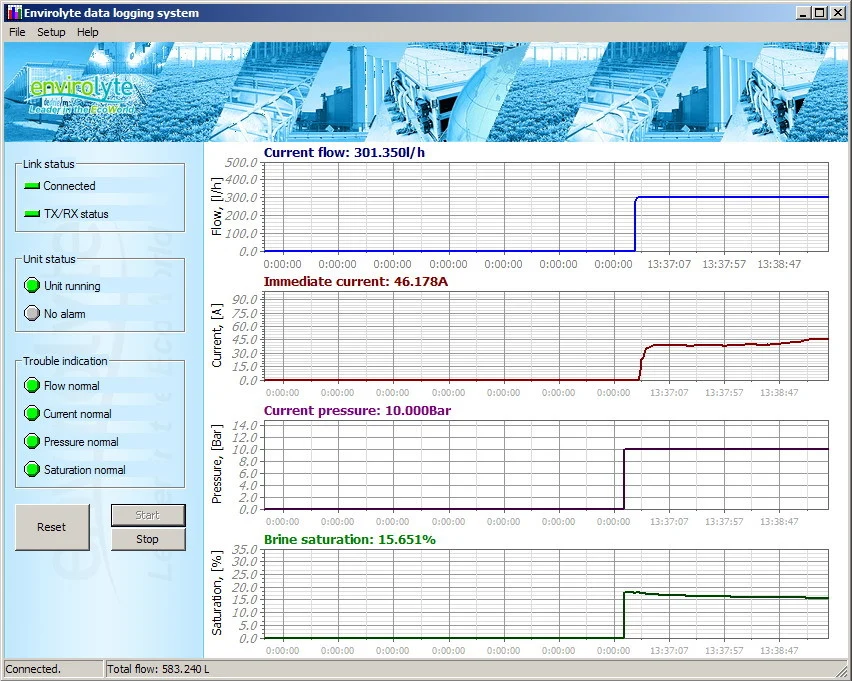
Envirolyte data logging system showing flow, current, pressure and brine saturation for seawater anolyte generation
Envirolyte data logging interface for monitoring flow, current, pressure and brine saturation during generator operation.

Typical Applications

Sea water anolyte generators are relevant for coastal and marine applications where seawater can be used as the input source for on-site disinfectant generation. Related Envirolyte application areas include maritime on-board water treatment, shrimp farming and aquaculture water hygiene, swimming pool water disinfection, on-site water disinfection and industrial applications.

Application fit for sea water anolyte generation
ApplicationHow sea water anolyte generation can help
Ships and offshore facilitiesOn-board disinfectant generation for water hygiene, storage tanks, technical water and selected sanitation tasks.
Aquaculture and shrimp farmingWater treatment and microbial control support in hatcheries, ponds, intake water and selected feed or hygiene applications.
Coastal swimming poolsOn-site generation of disinfectant from available seawater for pool water treatment and dosing.
Coastal process waterLocal disinfectant generation where seawater or brackish water is already available as part of the process.
Remote marine installationsReduced dependence on delivered disinfectant chemicals and prepared brine in sites with logistical limitations.

Reference Installation

Envirolyte provides a reference installation of an ELA-850/SW unit in a coastal area for generating anolyte from natural seawater and treating or disinfecting seawater in a swimming pool.
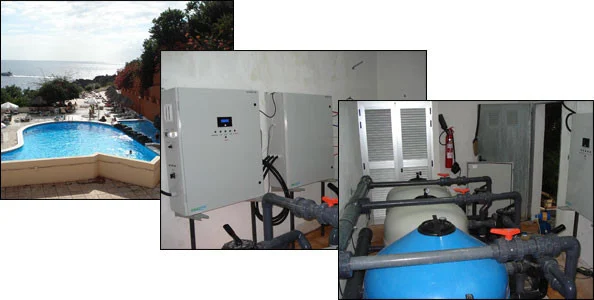
Reference installation of Envirolyte ELA-850SW seawater anolyte generator for swimming pool seawater treatment
Reference installation of an ELA-850/SW unit for generating anolyte from natural seawater and treating seawater in a swimming pool.

Technical Documents and Related Evidence

Project engineers and operators can review additional Envirolyte resources for equipment selection, microbiological evidence and regulatory context. Relevant pages include downloads and datasheets, the Envirolyte Corporate Brochure PDF, microbiological testing of anolyte, Legionella prevention evidence, by-products testing and ECHA / BPR information.

Frequently Asked Questions

What is a sea water anolyte generator?

A sea water anolyte generator is an on-site electrochemical system that uses seawater or brackish water as the feed source to produce ANK-neutral anolyte for disinfection, sanitation and water treatment applications.

What salinity range can Envirolyte sea water units use?

Envirolyte sea water units are designed for feed water with salinity from 5–7 PSU for brackish water up to 33–35 PSU for ocean water.

What active chlorine concentration is produced?

The active chlorine concentration is generally in the range of 500–1000 ppm. The final setting depends on the model, feed water quality, operating parameters and project requirements.

Where are sea water anolyte generators used?

Typical use cases include maritime and offshore water treatment, coastal installations, seawater swimming pools, aquaculture, shrimp farming, hatchery water treatment and remote sites where seawater is available.

Do these generators eliminate the need for prepared brine?

In suitable projects, seawater can be used as the main feed source, reducing or eliminating the need to prepare a separate salt brine. Final system design should always be confirmed according to salinity, water quality and required anolyte concentration.

Request Sea Water Anolyte Generator Support

For technical guidance, application evaluation or model selection, send your enquiry to Envirolyte Industries International Ltd. Envirolyte can help assess seawater salinity, required anolyte concentration, output volume, dosing control, installation conditions and integration with maritime, offshore, aquaculture or coastal water treatment systems.

  • Products
  • Technology
  • Performance
  • Applications