
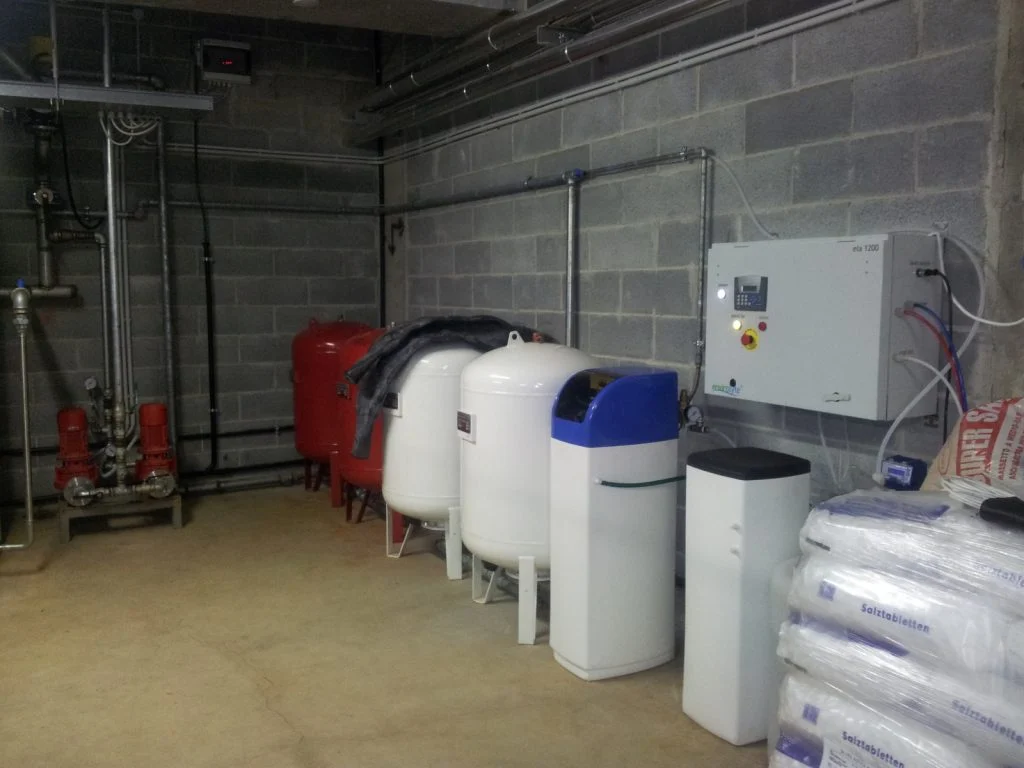
Envirolyte Legionella prevention systems generate anolyte on site for controlled disinfection of hot and cold water systems in hospitals, care homes, hotels, schools, offices, residential buildings and maritime installations. The generated solution can be dosed continuously or according to water flow and monitored disinfectant residual.
An Envirolyte installation can support a building water management programme by maintaining a controlled disinfectant residual throughout selected parts of the distribution system. System design must consider water temperature, water age, flow, pH, biofilm, storage tanks, dead legs, outlet use, materials compatibility and applicable local regulations.
On-site anolyte dosing is not a replacement for Legionella risk assessment, temperature management, flushing, cleaning, sampling or corrective maintenance. Review the available Legionella prevention evidence, learn about electrochemical activation technology, and explore the broader water disinfection application before selecting equipment.
Why Legionella Control Is Important in Building Water Systems
Legionella bacteria can multiply in engineered water systems when conditions support their growth. Important risk factors include water temperatures within a favourable growth range, stagnation, long water residence time, low disinfectant residual, sediment, scale, corrosion and established biofilm.
Exposure can occur when contaminated water is dispersed as inhalable droplets from showers, spray outlets and other aerosol-producing equipment. Hospitals, care facilities and buildings occupied by older or medically vulnerable people require particularly careful risk management.
Authoritative guidance is available from the CDC water management programme resources and the HSE guidance for hot and cold water systems. Local legislation, drinking-water rules and facility-specific procedures take precedence.
Scroll horizontally to view the complete table.
| Risk or control factor | Why it matters | Management response |
|---|---|---|
| Water temperature | Water held within a favourable temperature range can support Legionella growth. | Define and monitor appropriate hot- and cold-water temperature limits according to local guidance and system design. |
| Water age and stagnation | Low-use outlets, oversized storage and poor circulation can increase water residence time. | Review hydraulic balance, storage volume, circulation, flushing schedules and outlet usage. |
| Biofilm, sediment and scale | Deposits can provide protection, surfaces and nutrients that support microbial persistence. | Maintain tanks, heaters, pipework, outlets and treatment equipment through inspection, cleaning and corrective maintenance. |
| Disinfectant residual | An inadequate or inconsistent residual can reduce control within the distribution system. | Establish validated dosing targets, monitoring points, alarm limits and corrective actions. |
| Dead legs and low-flow sections | Unused pipework can create local stagnation and temperature-control problems. | Remove unnecessary pipework where practicable and include remaining low-use sections in the flushing programme. |
| Aerosol-producing outlets | Showers and spray devices can disperse contaminated droplets into the air. | Include these outlets in risk assessment, cleaning, sampling and maintenance procedures. |
| Monitoring and verification | Operating data are required to confirm that control measures remain effective. | Document temperatures, residual disinfectant, flushing, maintenance, sampling results and responses to deviations. |

How an Envirolyte Legionella Prevention System Works
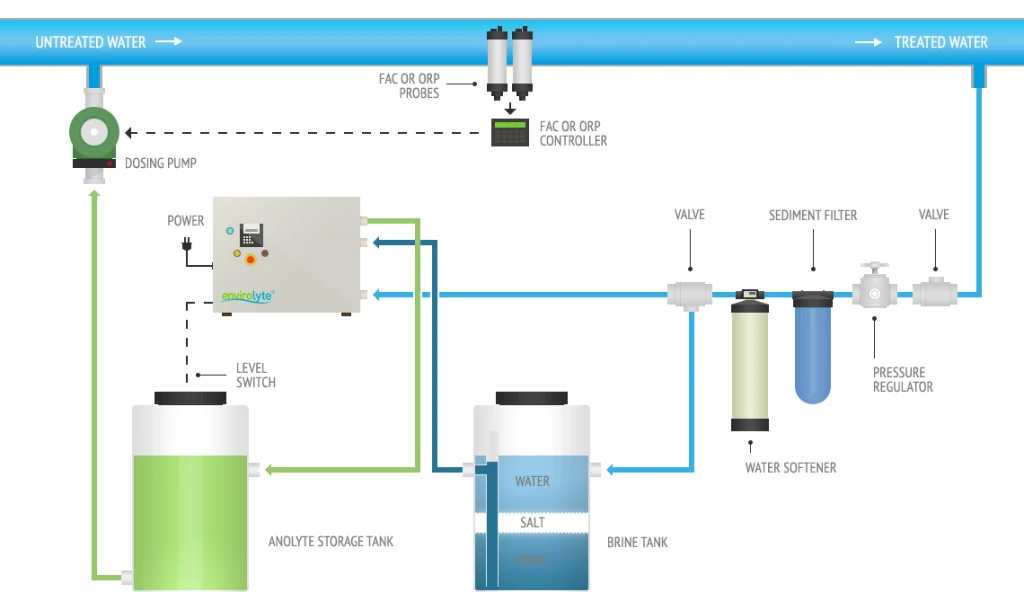
A typical installation generates anolyte from conditioned water, sodium chloride brine and electricity. The generated solution is stored where required and injected into the building water line through a controlled dosing pump.
Dosing may be proportional to water flow or adjusted using a validated free available chlorine or oxidation-reduction potential control strategy. The selected method must provide sufficient control at representative points without exceeding applicable drinking-water, materials-compatibility or regulatory limits.
Typical System Components
- Envirolyte anolyte generator selected for the required production capacity
- Sediment filtration, pressure regulation and water softening where required
- Brine preparation or sodium chloride solution tank
- Anolyte storage tank with level monitoring where storage is used
- Dosing pump selected for the required flow and injection pressure
- Water meter or flow signal for proportional dosing
- FAC, ORP or another validated monitoring and control method
- Injection, mixing and representative sampling points
- Alarm outputs and integration with the building management system where required
Laboratory Evidence Against Legionella
The Envirolyte Legionella prevention evidence page summarises independent IPROMA testing of anolyte against Legionella pneumophila and other waterborne microorganisms. The reported laboratory results include reduction of Legionella pneumophila to 0 CFU/100 mL under the defined test conditions.
Laboratory results do not guarantee equivalent performance in a building. Field results depend on water chemistry, system cleanliness, hydraulic conditions, contact time, biofilm, dosing control, residual disinfectant, sampling methods and the effectiveness of the complete management programme.
Additional supporting information is available in the sections covering microbiological testing, disinfection by-products testing and ECHA and BPR information.
Facilities That May Require Legionella Risk Management
- Hospitals and healthcare facilities
- Nursing homes and assisted-living facilities
- Hotels, hostels and other accommodation
- Schools, universities and childcare facilities
- Apartment buildings and residential complexes
- Office, military and institutional buildings
- Sports facilities and changing rooms
- Ships and other maritime installations
Healthcare projects can also be reviewed together with the broader Envirolyte healthcare application. The system configuration and permitted disinfectant use must be confirmed for the installation country and intended application.
Legionella Prevention Project Videos
The videos below document Envirolyte installations aboard passenger vessels and at Düren Hospital in Germany.
Envirolyte ELA-200 on Board the Seawind Ferry
Envirolyte ELA-3000ANW at Düren Hospital, Germany
Envirolyte ELA-400 HOCl Generator on Board the Viking XPRS
Reference Legionella Prevention Projects
The following historical PDF case studies document Envirolyte installations in European hospitals, care facilities, a hotel and other building water systems. They include site information, equipment configurations, dosing arrangements, photographs and reported project results.
View Legionella prevention project documents
| Country | Facility or project | PDF document |
|---|---|---|
| Hungary | Buda Hospital of the Hospitaller Order of Saint John of God, Budapest | Buda Hospital project PDF |
| Czech Republic | FNKV University Hospital Královské Vinohrady, Prague | FNKV University Hospital project PDF |
| Belgium | Maison de Repos et de Soins – Résidence Préhyr, Rochefort | Résidence Préhyr project PDF |
| Belgium | Hospital Center EpiCURA de Baudour | EpiCURA de Baudour project PDF |
| Germany | IntercityHotel Heidelberg | Heidelberg hotel project PDF |
| Ireland | Beaumont Hospital | Beaumont Hospital project PDF |
| Italy | Fondazione Soldi care facility, Cremona | Fondazione Soldi project PDF |
| Italy | KOS Group healthcare project | KOS Group project PDF |
| Spain | Guipúzcoa project | Guipúzcoa project PDF |
| Spain | Marbella project | Marbella project PDF |
| Sweden | Libo project | Libo project PDF |
| Netherlands | Senior home De Anloop | De Anloop project PDF |
| Netherlands | Senior home Leveste | Leveste project PDF |
| Netherlands | Senior home Ter Eyck | Ter Eyck project PDF |
Project-document note: These PDFs describe particular installations and historical operating conditions. Equipment names, dosing targets, project results, regulations and technical claims must be checked before they are reused for a new project, tender or regulatory submission.
Information Required for System Selection
Selection should be based on the complete building water system rather than only the nominal output of the anolyte generator.
- Installation country and applicable Legionella and drinking-water requirements
- Facility type, occupancy and vulnerable-user profile
- Hot- and cold-water system diagrams
- Daily, average and peak water consumption
- Storage-tank volumes and hot-water circulation details
- Water temperature profile and identified problem areas
- Current Legionella sampling results and sampling locations
- Water pH, hardness, conductivity and other relevant analytical data
- Pipe materials, system age, corrosion, scale and biofilm condition
- Current treatment method and disinfectant residual
- Available injection, mixing and monitoring points
- Required alarms, remote monitoring and building-management integration
- Commissioning, verification and ongoing maintenance requirements
Depending on required capacity and solution parameters, a project may use equipment from the ELA generator range or the ANW generator range. Final model selection requires technical review.
Frequently Asked Questions
No universal claim can be made. Temperature management remains an important Legionella control measure in many regulatory frameworks. Any alternative or supplementary disinfection programme must be validated and accepted under the applicable local requirements.
An oxidising disinfectant may contribute to biofilm control, but results depend on biofilm condition, pipe materials, hydraulic conditions, concentration, contact time and maintenance. Mechanical cleaning or other corrective work may still be required.
The appropriate control method depends on water chemistry, the required residual, system stability and regulatory requirements. Direct FAC measurement may be required even when ORP is used as an operational control parameter.
No. A sampling result represents defined locations and conditions at a particular time. Continued control requires ongoing monitoring, maintenance, flushing, corrective action and periodic review of the water-management programme.
Integration into an existing building may be possible following an engineering and infection-control review. Installation planning should address continuity of water service, commissioning, sampling, staff responsibilities and temporary control measures.
Discuss a Legionella Prevention Project
Provide the Envirolyte technical team with the facility type, country, water-system diagram, consumption data, water analysis, temperature profile, sampling results, current treatment method and required regulatory documentation.