
Commercial mushroom cultivation requires coordinated hygiene across growing rooms, compost and casing operations, water systems, tools, harvesting equipment, entrances and personnel. Cleaning and disinfection procedures should reduce contamination without damaging mushroom mycelium, affecting crop development or introducing unauthorised residues.
Envirolyte systems generate anolyte on site from conditioned water, sodium chloride and electricity. Depending on the operating regime, anolyte may contain active chlorine species including hypochlorous acid and can be evaluated for authorised water, surface and equipment-disinfection applications. Learn more about electrochemical activation and on-site anolyte generation.
Each mushroom-farm application must define the target area, solution specification, FAC, pH, application volume, contact time, organic load, ventilation, rinse requirement and verification method. Direct contact with compost, casing material, spawn, irrigation water or harvested mushrooms requires separate crop-compatibility, food-safety and regulatory assessment.
Hygiene Across the Mushroom Production Cycle
Contamination can move between growing rooms through compost and casing materials, spawn, workers, footwear, tools, harvesting containers, water, insects, doors and air movement. Effective mushroom cultivation hygiene therefore depends on zoning, removal of organic material, controlled personnel movement and consistent cleaning procedures throughout the crop cycle.
Growing rooms should be emptied and cleaned before a disinfectant is applied. Spent compost, casing material, crop debris, dust and visible soil can consume active disinfectant and prevent complete contact with the underlying surface.
Contamination risk can return during later flushes through harvesting activities, equipment movement, personnel and airborne particles. Entry controls, tool hygiene, room separation and routine inspection remain necessary after the first harvest.
Potential Mushroom-Farm Applications
Swipe horizontally to view the full table.
| Application area | Potential role | Key requirements |
|---|---|---|
| Empty growing rooms | Disinfection of compatible floors, walls, doors, shelving and other cleaned hard surfaces before loading. | Complete removal of organic material, defined FAC and contact time, surface coverage, material compatibility, ventilation and any required rinse. |
| Tools and equipment | Controlled sanitation of compatible tools, carts, trays, harvesting equipment and non-porous production surfaces. | Classification as food-contact or general-sanitation equipment, prior cleaning, equipment compatibility, rinse requirements and protection from recontamination. |
| Entrance hygiene | Use in an authorised footbath, boot-wash or hygiene-mat procedure. | Removal of visible soil, solution replacement schedule, concentration monitoring, sufficient contact and prevention of cross-contamination between clean and dirty zones. |
| Floors and lower wall surfaces | Routine environmental hygiene between production activities or at the end of a work period. | Application only to suitable cleaned surfaces, controlled overspray, worker protection, ventilation and avoidance of unintended crop contact. |
| Process and irrigation water | Controlled treatment of suitable source water, tanks, pipelines or distribution equipment. | Water analysis, intended use, dosing method, target residual, crop compatibility, monitoring and applicable food-production requirements. |
| Straw and compost materials | Application-specific trials may evaluate microbial-control support during material preparation. | Regulatory classification, organic demand, solution distribution, compost microbiology, fermentation or pasteurisation process, mycelial colonisation and yield assessment. |
| Casing material | Possible treatment before application or during a validated casing-management process. | Confirmation of the casing composition, authorised use, moisture effects, microbial ecology, mycelial development, pinning and crop-quality results. |
| Spawn grain | No routine treatment should be recommended without product-specific trials. | Spawn contains living mushroom mycelium. Testing must confirm contamination control without reducing mycelial viability, colonisation rate, crop uniformity or yield. |
| Fogging or misting | Room or environmental treatment only where supported by an authorised and validated procedure. | Droplet distribution, concentration, exposure assessment, ventilation, corrosion review and confirmation of whether people, crop or exposed materials may remain in the room. |
Food-safety and regulatory note: a disinfectant authorised for floors or walls is not automatically authorised for surfaces that contact compost, casing material, harvested mushrooms or packaging. Confirm the intended product type, label conditions, rinse requirements and local authorisation before use. Review the Envirolyte customer compliance requirements.
Practical Cleaning and Disinfection Workflow
- Define hygiene zones: separate dirty material reception, compost and casing operations, growing rooms, harvesting areas, packaging zones and clean equipment storage.
- Remove organic material: clear spent substrate, casing, mushroom debris, soil and dust before washing or disinfecting.
- Clean the surfaces: use the appropriate mechanical and detergent-based cleaning procedure, then rinse where required.
- Verify the generated solution: record FAC, pH, temperature, solution age and generator operating condition before use.
- Apply the solution evenly: define spray equipment, application volume, surface coverage and contact time for the target process.
- Complete the post-treatment procedure: follow the authorised rinse, drying, ventilation and room re-entry requirements instead of assuming that no rinse is necessary.
- Verify performance: use visual inspection, solution records, surface sampling or microbiological testing appropriate to the hygiene objective.
Spawn, Compost and Casing Material
Spawn grain is not ordinary raw grain: it carries the living mushroom mycelium used to colonise the compost. Direct disinfection can therefore affect the intended organism as well as unwanted contamination. No universal application rate or three-hour contact time should be recommended without viability, colonisation and yield trials.
Compost and casing material also contain complex microbial communities that influence crop development. Any direct anolyte application should be assessed against an untreated control under representative production conditions.
A useful trial should document the material composition, initial microbial condition, anolyte specification, litres applied per tonne or square metre, distribution uniformity, moisture change, spawn-run time, casing colonisation, pinning, crop quality and total yield.
Personnel and Airborne Contamination Control
Personnel hygiene should include clean protective clothing, controlled room entry, hand hygiene, footwear procedures and separation of tools between production zones. Footbaths or hygiene mats must be maintained at the defined concentration and replaced when contaminated with organic material.
Fogging should not be treated as a substitute for cleaning or as a guaranteed method of controlling airborne contamination. A fogging procedure requires validation of room volume, droplet distribution, concentration, exposure time, ventilation, occupational safety and compatibility with the crop and equipment.
ELA-2000 Installation in Liaoning Province
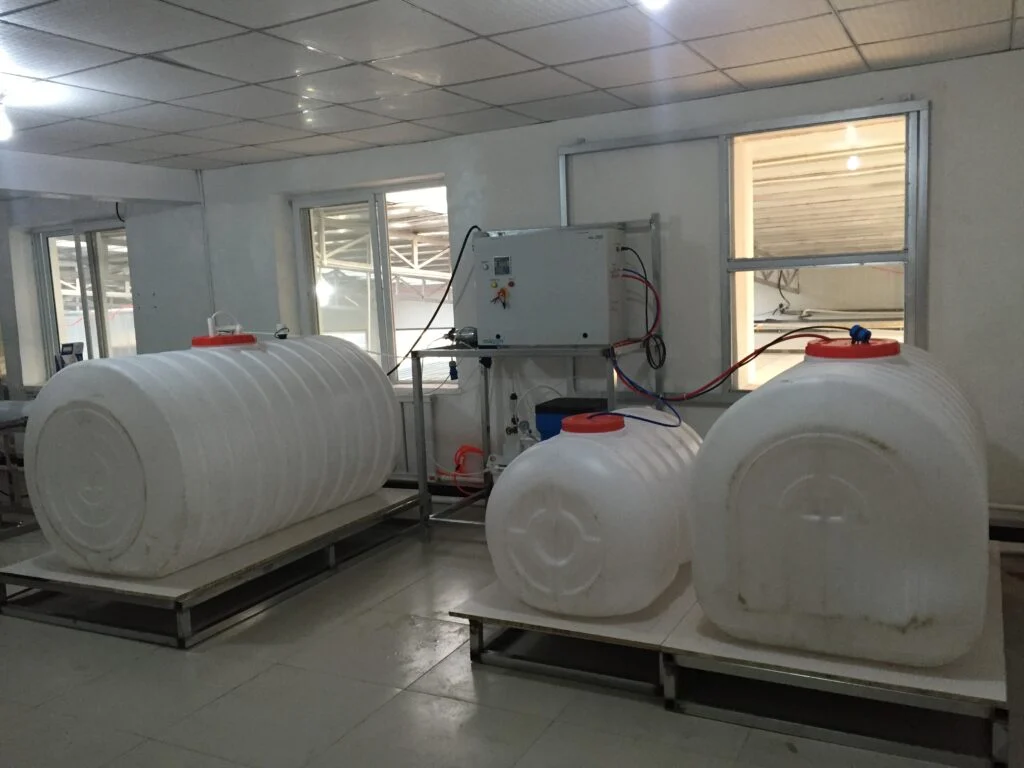
The photograph identifies the generator model and general installation location but does not provide the production capacity, mushroom species, treatment points, FAC targets, dosing rates or microbiological results. These details should be confirmed before the installation is used as a technical reference.
Testing and Process Validation
General microbiological testing of Envirolyte anolyte can support a technical assessment, but laboratory suspension tests do not establish performance in compost, casing material or an occupied growing room. Organic material, surface condition, solution distribution and the target mushroom-production process can change the result.
Validation should compare treated and control areas or materials under representative conditions. The plan should define target microorganisms, sampling points, solution parameters, contact time, crop observations, product-quality measurements and corrective actions.
Related requirements for equipment and surfaces associated with harvested mushrooms are described on the food-processing hygiene page.
Frequently Asked Questions
Mushroom cultivation hygiene is the coordinated control of contamination in growing rooms, compost and casing operations, water systems, tools, equipment, harvesting areas and personnel movement.
Anolyte may be evaluated for authorised treatment of cleaned growing-room surfaces, compatible equipment, entrance hygiene systems and suitable process water. Crop-contact applications require separate validation and regulatory review.
No. Replacement requires a comparison under defined operating conditions, including target microorganisms, concentration, contact time, surface type, organic load, worker safety and regulatory authorisation.
Yes. Spent compost, casing material, mushroom debris, dust and other organic contamination should be removed so that the disinfectant can contact the underlying surface.
Only after application-specific evaluation. Trials should confirm regulatory suitability, microbial-control performance, moisture effects, mycelial development, pinning, crop quality and yield.
Spawn grain contains living mushroom mycelium, so routine disinfection should not be recommended without evidence that the treatment controls contamination without reducing mycelial viability, colonisation or yield.
Only where an authorised and validated procedure permits it. The assessment must address crop exposure, people in the room, solution concentration, droplet distribution, contact time, ventilation and equipment compatibility.
A preliminary assessment requires the mushroom species, production cycle, room volumes, water analysis, hygiene zones, current cleaning programme, intended treatment points, target microorganisms, required solution capacity and country of use.
Discuss a Mushroom Cultivation Hygiene Project
Provide the mushroom species, production cycle, room dimensions, water analysis, current cleaning programme, intended application areas, required capacity and country of installation so that the system and validation requirements can be assessed.