
Supported by Enterprise Estonia Development program

HomeOn-Site Disinfection Applications for Water Treatment and Process HygieneMaritime and Offshore Water Disinfection Systems

Maritime and Offshore Water Disinfection Systems

Maritime and offshore water treatment systems must support the hygienic management of potable water, storage tanks, distribution networks and recreational water facilities under changing operating conditions. Water may be bunkered in port or produced on board through reverse osmosis or evaporation, and its quality can change during loading, storage and distribution.

Envirolyte systems generate anolyte on site for controlled water disinfection and sanitation applications. Anolyte is an oxidising electrolysed water solution containing active chlorine species, including hypochlorous acid, with its final composition and performance determined by the generator configuration, water quality, concentration, pH, contact time and dosing conditions.

This page explains the main design considerations for on-board anolyte generation. Seven maritime case studies cover water-treatment installations on Tallink, Stena Line and Viking Line vessels. The documents describe installation-specific configurations and reported operating conditions.

Offshore Water Disinfection Systems

Offshore water disinfection systems may be required for potable-water storage and distribution, vessel water systems, recreational water and selected process-water duties. Envirolyte systems can be configured for on-site anolyte generation using prepared brine or, for suitable applications, seawater or brackish water as the feed source.

System selection should be based on source-water quality, treatment flow, required disinfectant residual, contact conditions, material compatibility, monitoring requirements and the regulations applicable to the vessel or offshore installation. For suitable seawater-fed projects, see Envirolyte Sea Water Anolyte Generators.

Shipboard Water Hygiene Challenges

Potable and recreational water systems on ships require controls that address water quality from the point of loading or production through storage, distribution and use. Factors identified in ship sanitation guidance include:

  • contaminated bunkered water or unsuitable loading procedures;
  • cross-connections between potable and non-potable systems;
  • inadequate design, cleaning or disinfection of storage tanks;
  • long water age, low turnover and periods of stagnation;
  • loss of disinfectant residual during storage and distribution;
  • biofilm formation in tanks, pipes, fittings and low-flow sections;
  • changes in microbiological quality during storage and transport;
  • different requirements for potable water, pools, spas and technical water.

Biofilm can shelter microorganisms and make routine sanitation more difficult. Anolyte dosing may form part of a broader water-safety programme, but it should be combined with system inspection, flushing, cleaning, residual monitoring, sampling and corrective procedures.

How On-board Anolyte Generation Works

Envirolyte equipment uses electrochemical activation to produce anolyte close to the point of use. A typical brine-fed installation uses water, sodium chloride and electricity, together with the necessary filtration, water conditioning, storage, dosing and control equipment. Selected maritime and offshore configurations may instead use suitable seawater or brackish water as the feed source.
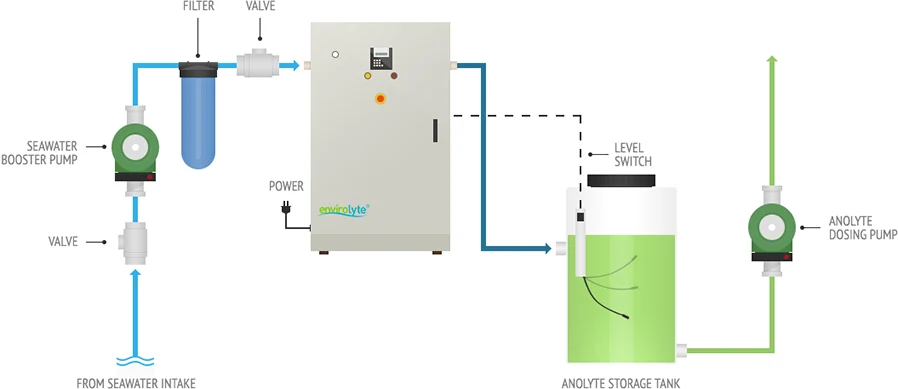
General layout of an Envirolyte seawater anolyte system with seawater intake, filter, generator, storage tank and dosing pump
General layout of a seawater-fed Envirolyte system. The final arrangement, monitoring points and dosing controls must be selected for the vessel and water-treatment objective.

Typical system elements

  • source-water or seawater intake;
  • filtration, pressure control and water conditioning where required;
  • prepared brine or suitable seawater feed;
  • Envirolyte anolyte generator;
  • anolyte storage or buffer tank sized for the operating demand;
  • dosing pump and injection point;
  • flow, free available chlorine, ORP or another validated control method;
  • sampling points, alarms and operational records.

Brine-fed and seawater-fed configurations

The historical projects on this page primarily document ELA installations supplied with prepared brine. Envirolyte also provides sea water anolyte generators for maritime and offshore applications. Selection between these configurations depends on feed-water salinity and quality, required output, available space, utilities, material compatibility, control strategy and the intended use of the generated solution.

More information about the underlying process is available on the electrochemical activation technology and electrolysed water solutions pages.

On-site Generation and Delivered Disinfectants

On-site generation can reduce routine dependence on the transport, storage and disposal of containers of concentrated disinfectant. It can also allow fresh solution to be produced near the point of use and dosed according to the operating requirements of the vessel.

These operational benefits do not remove the need for chemical hazard assessment, safe handling procedures, ventilation, compatible materials, secondary containment, monitoring, maintenance and crew training. Chlorate and other disinfection by-products can be influenced by solution chemistry, storage time, temperature, source-water quality and operating conditions.

Operational and Regulatory Considerations

Directive (EU) 2020/2184 on water intended for human consumption establishes drinking-water requirements within the European Union. Ship operators may also need to consider flag-state, port-state, vessel-class, route-specific and public-health requirements. The WHO Guide to Ship Sanitation provides a wider framework for managing public-health risks on ships.

A generator installation does not by itself establish compliance. Project design and operation should address:

  • source-water analysis and expected variability;
  • maximum, minimum and average water flow;
  • storage-tank volume, turnover and peak demand;
  • treatment objective, target organisms and required contact time;
  • target residual and the selected dosing-control method;
  • sampling locations and microbiological monitoring procedures;
  • disinfection by-products and applicable parameter limits;
  • materials, corrosion risk and compatibility with seals and piping;
  • generator redundancy, buffer capacity and alarm requirements;
  • available space, pressure, drainage, ventilation and electrical supply;
  • crew procedures, maintenance, recordkeeping and emergency response;
  • current product authorisation and permitted use in the relevant jurisdiction.

Technical note: Model selection, anolyte concentration, dosing rate and residual targets must be confirmed for the actual vessel and water system. Values reported in historical case studies should not be copied into a new installation without engineering review and validation.

Historical Maritime Reference Projects

The following table summarises the project information stated in the available Envirolyte PDFs. Water volumes, equipment capacities and outcomes are reproduced as historical project data rather than current specifications or guaranteed results.

Swipe horizontally to view the full table.

Historical Envirolyte maritime project data reported in the available case-study PDFs
VesselOperatorInstallationWater-system dataInstalled unitDosing or controlReported case-study information
M/S Regal StarTallink GroupNovember 2019, TallinnFresh-water tank approximately 60 m³ELA-400ANW; stated output 40 L of anolyte per hour1 L of anolyte per 1,000 L of intake water; dosing into the intake pipe; controller shown in the documentThe installation and system layout are documented. No microbiological outcome is stated in the PDF.
M/S SeaWindTallink GroupDate not stated in the PDFFresh-water tank approximately 60 m³ELA-200; stated output 20 L of anolyte per hour1 L of anolyte per 1,000 L of intake water; dosing into the intake pipeThe generator, tank, dosing equipment and injection point are documented. No microbiological outcome is stated.
M/S Silja EuropaTallink GroupDate not stated in the PDFFresh-water tank approximately 270 m³; daily consumption up to 150 m³ELA-400; stated output 40 L of anolyte per hourProject setting not stated; the document includes a general FAC or ORP-controlled layoutThe PDF states an accepted count below 1 CFU/100 mL and adds “in practice = 0 CFU/100 mL.” It does not provide a test method or laboratory-report identifier.
Stena VisionStena Line11 January 2013Fresh-water tank approximately 300 m³; daily consumption up to 90 m³ELA-1200; stated output 120 L of anolyte per hourProject dosing value not statedThe historical table reports no bacteria at all listed sampling points on 21 February 2013. The test method and detection limit are not included in the PDF.
Viking GabriellaViking LineJune 2013Fresh-water tank approximately 250 m³; daily consumption up to 50 m³ELA-400; stated output 40 L of anolyte per hourProject dosing value not statedThe PDF states that the vessel was declared free from bacteria two weeks after installation. The laboratory name, report identifier, test method and detection limit are not provided.
Viking MariellaViking LineJuly 2013Fresh-water tank approximately 270 m³; daily consumption up to 65 m³ELA-400; stated output 40 L of anolyte per hourProject dosing value not statedThe PDF states that the vessel was declared free from bacteria two weeks after installation. It also documents an installation divided by a doorway. Supporting laboratory details are not provided.
Viking XPRSViking LineSeptember 2013Fresh-water tank approximately 270 m³; daily consumption up to 150 m³ELA-400; stated output 40 L of anolyte per hourProject setting not stated; the document includes a general FAC or ORP-controlled layoutThe PDF states that the vessel was declared free from bacteria two weeks after installation. Supporting laboratory details are not provided.

Stena Vision historical bacterial test table

The following accessible table transcribes the values shown in the Stena Vision case-study image. “No bacteria reported” reproduces the document’s qualitative result; it should not be interpreted as an absolute zero without the original test method and detection limit.

Swipe horizontally to view the full table.

Sampling results reproduced from the Stena Vision historical case study
Sampling location9 January 201330 January 201321 February 2013
Cabin 2222, Deck 2No bacteria reportedNo bacteria reportedNo bacteria reported
Cabin 7321, Deck 715 CFU/100 mLNo bacteria reportedNo bacteria reported
Cabin 8148, Deck 8No bacteria reportedNo bacteria reportedNo bacteria reported
Cabin 1001–1002, Deck 1050 CFU/100 mL10 CFU/100 mLNo bacteria reported
Cabin 1153, Deck 11No bacteria reportedNo bacteria reportedNo bacteria reported
Large pool and spa20 CFU/100 mLNo bacteria reportedNo bacteria reported
Small pool and spa10 CFU/100 mL1 CFU/100 mLNo bacteria reported

Historical-results note: The case studies describe specific vessels, sampling dates and operating conditions. They do not establish a universal reduction rate, treatment time or guaranteed microbiological result for another vessel.

Historical Maritime Project Documents

The following PDFs contain vessel information, installation photographs, generator configurations, dosing arrangements, technical schematics and reported operating or microbiological data. They describe individual historical installations and must not be treated as current vessel specifications, universal design parameters, guaranteed performance or regulatory approval.

View project documents

Swipe horizontally to view the full table.

Historical project-specific information reported in Envirolyte maritime PDFs
Vessel and operatorReported applicationReported equipment and operating dataDocument
M/S Regal Star, Tallink GroupTreatment of water entering the vessel’s fresh-water storage system.ELA-400ANW with a stated anolyte output of 40 L/h; fresh-water tank approximately 60 m³; dosing ratio 1 L of anolyte per 1,000 L of intake water; injection into the intake-water pipe. The installation was completed in Tallinn in November 2019. The PDF does not provide microbiological test results.M/S Regal Star water-disinfection project with ELA-400ANW (PDF)
M/S SeaWind, Tallink GroupTreatment of water entering the vessel’s fresh-water storage system.ELA-200 with a stated anolyte output of 20 L/h; fresh-water tank approximately 60 m³; dosing ratio 1 L of anolyte per 1,000 L of intake water; injection into the intake-water pipe. The installation date and microbiological results are not stated in the PDF.M/S SeaWind water-disinfection project with ELA-200 (PDF)
M/S Silja Europa, Tallink GroupContinuous treatment of the vessel’s fresh-water system.ELA-400 with a stated anolyte output of 40 L/h; fresh-water tank approximately 270 m³; daily water consumption reported as up to 150 m³. The PDF states an accepted bacterial count below 1 CFU/100 mL and adds “in practice = 0 CFU/100 mL,” but it does not identify the sampling dates, laboratory, analytical method, detection limit or report number.M/S Silja Europa water-disinfection project with ELA-400 (PDF)
Stena Vision, Stena LineTreatment of the vessel’s fresh-water system, with historical sampling from cabins, pools and spas.ELA-1200 with a stated anolyte output of 120 L/h; fresh-water tank approximately 300 m³; daily water consumption reported as up to 90 m³; installation completed on 11 January 2013. The PDF reports “no bacteria” at every listed sampling point on 21 February 2013. The laboratory, method, detection limit and original analytical reports are not identified.Stena Vision water-disinfection project with ELA-1200 (PDF)
Viking Gabriella, Viking LineTreatment of the vessel’s fresh-water system.ELA-400 with a stated anolyte output of 40 L/h; fresh-water tank approximately 250 m³; daily water consumption reported as up to 50 m³; installation completed in June 2013. The PDF reports that the vessel was declared free from bacteria two weeks after installation following earlier shipboard trials. It does not provide the laboratory name, analytical method, detection limit or report number.Viking Gabriella water-disinfection project with ELA-400 (PDF)
Viking Mariella, Viking LineTreatment of the vessel’s fresh-water system.ELA-400 with a stated anolyte output of 40 L/h; fresh-water tank approximately 270 m³; daily water consumption reported as up to 65 m³; installation completed in July 2013. The equipment and storage tank were installed on opposite sides of a doorway. The PDF reports that the vessel was declared free from bacteria two weeks after installation, but supporting analytical details are not included.Viking Mariella water-disinfection project with ELA-400 (PDF)
Viking XPRS, Viking LineTreatment of the vessel’s fresh-water system.ELA-400 with a stated anolyte output of 40 L/h; fresh-water tank approximately 270 m³; daily water consumption reported as up to 150 m³; installation completed in September 2013. The PDF reports that the vessel was declared free from bacteria two weeks after installation, but the laboratory, method, detection limit and report number are not provided.Viking XPRS water-disinfection project with ELA-400 (PDF)

Document-use note: Verify equipment names, installation dates, tank volumes, water consumption, dosing parameters, sampling procedures, analytical results, current vessel configuration, applicable regulations and performance statements before using these historical documents in a new project, tender, advertisement or regulatory submission.

Supporting Evidence and Compliance Information

Project evaluation should distinguish between laboratory evidence, historical installation reports and current regulatory authorisation. Relevant Envirolyte resources include Legionella prevention testing, chlorite and chlorate by-products testing and ECHA and Biocidal Products Regulation information.

The cited by-products study reports that chlorite and chlorate were not detected under its stated analytical conditions and detection capability. This should not be presented as proof of zero by-products under every water chemistry, storage condition or installation.

Information Required for System Selection

A maritime water-treatment proposal should be based on operating data rather than generator model alone. Useful project information includes:

  • vessel type, flag, routes and intended ports of operation;
  • intended use of the treated water;
  • source-water analysis and whether water is bunkered or produced on board;
  • fresh-water tank volumes and normal turnover;
  • minimum, average and peak flow rates;
  • existing treatment, dosing and monitoring equipment;
  • required residual, sampling plan and treatment objective;
  • available installation space, electrical supply, pressure and drainage;
  • preferred automation, alarms and remote-monitoring requirements;
  • material specifications and corrosion constraints;
  • required technical, regulatory and classification documentation.

Frequently Asked Questions

What is on-board anolyte generation?

On-board anolyte generation uses an electrochemical system to produce an oxidising disinfectant solution near the point of use. Depending on the selected equipment, the feed may be prepared brine or suitable seawater or brackish water.

What water disinfection systems can be used for offshore applications?

Envirolyte offshore configurations can use on-site electrochemical generation to produce anolyte for suitable water-disinfection duties. Depending on the project, the system may use prepared brine or suitable seawater or brackish water as the feed source. The required generator, dosing arrangement, monitoring strategy and treatment conditions must be selected for the specific water system and applicable regulatory requirements.

What inputs are required for a brine-fed Envirolyte system?

A typical brine-fed configuration uses water, sodium chloride and electricity. Filtration, water softening, pressure control, storage, dosing and monitoring equipment may also be required.

Can one system serve potable water, pools and spas?

A system may be engineered to support more than one water-treatment duty, but each circuit requires appropriate capacity, dosing, contact time, residual control, monitoring and regulatory review.

Does installing an anolyte generator guarantee regulatory compliance?

No. Compliance depends on permitted use, system design, validated operation, monitoring, sampling, disinfection by-products, documentation and the requirements applicable to the vessel and its operating area.

How can anolyte dosing be controlled on board?

Dosing may be linked to water flow, free available chlorine, ORP or another validated control strategy. The correct method and setpoints must be selected for the water system and treatment objective.

What information is needed to prepare a maritime water-treatment proposal?

Provide the water source and analysis, tank volumes, flow rates, intended applications, treatment objectives, available utilities, installation space, monitoring requirements and applicable regulatory or classification requirements.

Discuss Your Maritime Water Treatment Project

Send Envirolyte your vessel details, source-water information, tank volumes, flow rates, treatment objectives, available utilities and documentation requirements for a project-specific review.

  • Products
  • Technology
  • Performance
  • Applications