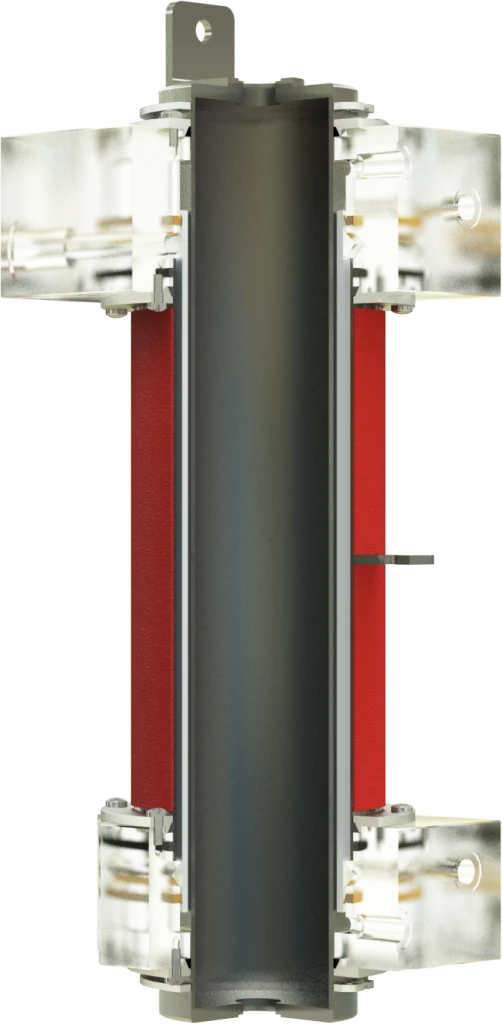
Envirolyte diaphragmatic cells are the core technology inside Envirolyte systems for electrochemical activation and on-site generation of electrochemically activated solutions: Anolyte and Catholyte.
The cells are designed to process a 1–4% aqueous sodium chloride solution (NaCl) and generate two separated streams: oxidising Anolyte from the anodic chamber and alkaline Catholyte from the cathodic chamber.
Unlike many conventional electrolytic cells, Envirolyte diaphragmatic cells use a diaphragm to separate the Anolyte and Catholyte streams. This separation helps prevent the two streams from mixing and inter-reacting to form a simple sodium hypochlorite solution.
A Unique Design for a Unique Process
At the core of the Envirolyte process are patented diaphragmatic cells designed to effectively deliver electrochemically activated solutions using water, salt and electricity.
The diaphragm separates the electrode chambers and allows Anolyte and Catholyte to be produced as two different functional solutions. Anolyte is mainly used as an oxidising disinfectant solution, while Catholyte can be used as an alkaline cleaning or pH-adjusting solution where required.
For a wider explanation of the process, see Electrochemical Activation and Electrolysed Water Solutions.
Unique and Innovative Cell Design
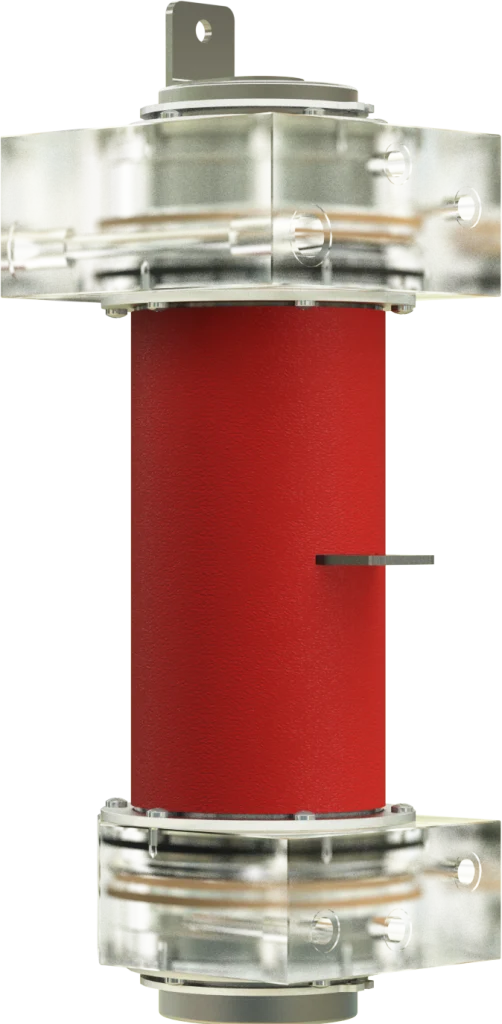
Envirolyte’s diaphragmatic cell design has been assessed through patent-search work by the National Industrial Fuel Efficiency Service Ltd. (NIFES), Scotland, UK, and described as unique and innovative.
The purpose of this design is to support a stable and controllable electrochemical activation process, producing functional Anolyte and Catholyte streams for use in Envirolyte equipment.
Easy Handling and Robust Construction
The Envirolyte diaphragmatic cell is a round-shaped electrolyser constructed from titanium and rare-metal components. The electrodes are separated by a polymer or ceramic diaphragm.
The robust construction is designed to reduce the risk of mechanical damage under demanding operating conditions and to support reliable use in industrial and water-treatment installations.
Valuable Catholyte By-product
Where required, Catholyte production can be a valuable addition to the electrochemical activation process. Catholyte can be used for washing, alkaline cleaning support or increasing the pH of treated water, depending on the application and validation requirements.
For dedicated catholyte generation equipment, see CG Catholyte Generators.
How the Diaphragmatic Cell Separates Anolyte and Catholyte
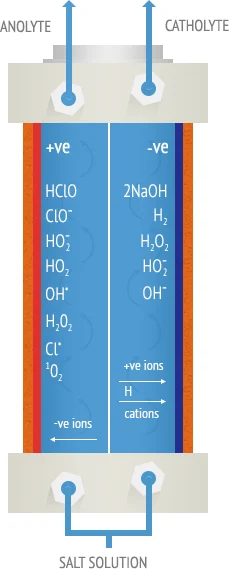
Inside the cell, the anodic and cathodic chambers are separated by a polymer or ceramic diaphragm. This design allows different electrochemical reactions to take place in each chamber while keeping the resulting streams separated.
In the anodic chamber, the process forms oxidising species associated with Anolyte. In the cathodic chamber, the process forms an alkaline reducing stream known as Catholyte.
Key Advantages of Envirolyte Diaphragmatic Cells
| Feature | Customer value |
|---|---|
| Separated anodic and cathodic chambers | Helps generate Anolyte and Catholyte as separate streams instead of mixing them into a simple hypochlorite solution. |
| Round-shaped electrolyser construction | Compact and mechanically robust design suitable for integration into Envirolyte generators. |
| Titanium and rare-metal components | Durable construction for demanding operating conditions and long service life. |
| Polymer or ceramic diaphragm | Separates electrode chambers and supports controlled generation of different electrochemically activated solutions. |
| Scalable production capacity | Individual cells are used in different generator models, and combinations of cells can be used for higher-capacity systems. |
Small Size and High Capacity
Envirolyte cells are manufactured with variable Anolyte output capacities from approximately 20 L/h to 1200 L/h per cell, depending on the cell type and required operating parameters. Combinations of cells allow Envirolyte units to be configured for output capacities up to approximately 6000 LPH.
Output capacity depends on the required active chlorine concentration, pH, ORP, water quality, salt solution, hydraulic design and application requirements. Capacity should therefore be confirmed for each project.
For the product range and available cell models, see Envirolyte Electrolysis Cells.
Envirolyte Cell Types and Output Range
Envirolyte offers ANK, ANE and HD types of electrolysis cells for different generator platforms and output capacities. Cell output is usually indicated for neutral Anolyte or acidic Anolyte/Catholyte production under defined conditions.
| Cell group | Example models | Indicative output range | Notes |
|---|---|---|---|
| ANK cell types | R-20, RT-40, RT-90, RT-120, RT-200, RT-300, RT-400S, RT-600S, RT-1000S, RT-1200S | Approx. 20–1200 L/h | Used for different anolyte generator capacities, depending on required operating parameters. |
| ANE and HD cell types | RT-40ANE, RT-60ANE, RT-90ANE, RT-120ANE, RT-200ANE, RT-300ANE, RT-400S ANE, RT-600S ANE, RT-1000S ANE, RT-1200S ANE, RT-2000ANE, RT-4000ANE, RT-6000ANE | Approx. 20–6000 L/h | Higher-capacity models and multi-cell configurations are used for industrial installations. |
Output capacity must be confirmed according to active chlorine concentration, pH, ORP and application requirements.
Diaphragmatic Cell Performance
In addition to the principal electrochemical reactions taking place at the electrodes, the electrical field at the electrode surface changes the physicochemical properties of the water and dissolved salts in each stream. Envirolyte systems can produce solutions with different pH and ORP parameters. The pH of synthesised solutions can be controlled within a wide range, typically from approximately pH 2.0 to pH 13.0, and can be adjusted according to specific application requirements. The Anolyte stream is associated with high positive ORP and oxidising activity, while the Catholyte stream is associated with alkaline reducing properties. Actual parameters depend on power supply settings, flow rate, water quality, salt solution and system configuration. Solution stability and useful activity depend on storage conditions, concentration, temperature, contamination risk and quality control procedures. For applications requiring documented disinfectant performance, storage stability should be validated for the specific solution and use case.Envirolyte Units Using Diaphragmatic Cells
The diaphragmatic cell is the heart of Envirolyte equipment for treatment of diluted and concentrated aqueous solutions. Different cell types are used across Envirolyte generator families depending on output capacity and application.- ELA Anolyte Generators
- ANW Anolyte Generators
- HD Anolyte Generators
- Sea Water Anolyte Generators
- Electrolysis Cells
Applications Supported by Diaphragmatic Cell Technology
Envirolyte diaphragmatic cell technology can be used in equipment for a wide range of water treatment, hygiene and industrial applications.- On-site Water Disinfection
- Rural Drinking Water Disinfection
- Legionella Prevention
- Cooling Towers
- Food Processing
- CIP Solutions for Processing Equipment
- Industrial Applications
Performance and Compliance Evidence
Customers evaluating Envirolyte systems should review cell technology together with microbiological performance, by-products testing, toxicity data and relevant approval or customer-requirement documentation.Frequently Asked Questions
A diaphragmatic electrolysis cell is an electrochemical cell where the anodic and cathodic chambers are separated by a diaphragm. This allows the system to generate different streams, such as Anolyte and Catholyte, without immediately mixing them.
The diaphragm helps separate the Anolyte and Catholyte streams. This supports controlled production of oxidising and alkaline reducing solutions instead of producing only a mixed hypochlorite solution.
Envirolyte diaphragmatic cells are constructed using titanium, rare-metal components and a polymer or ceramic diaphragm.
Individual Envirolyte cells are available in different capacities, with Anolyte output ranging from approximately 20 L/h to 1200 L/h per cell. Multi-cell systems can be configured for higher output capacities.
Yes. In a diaphragmatic cell, Anolyte is produced in the anodic chamber and Catholyte is produced in the cathodic chamber. The exact output depends on the generator configuration and operating parameters.
Yes. Envirolyte can help customers, distributors and OEM partners evaluate output capacity, water quality, active chlorine concentration, pH, ORP, dosing strategy and application-specific requirements.
Request Diaphragmatic Cell Technology Support
Envirolyte can support your project with cell selection, generator configuration, technical documentation and application-specific recommendations for Anolyte and Catholyte generation.