
Supported by Enterprise Estonia Development program

HomeOn-Site Disinfection Applications for Water Treatment and Process HygieneIndustrial Water Treatment and Process Hygiene with On-Site Electrolyzed Water

Industrial Water Treatment and Process Hygiene with On-Site Electrolyzed Water

Envirolyte systems generate anolyte and catholyte on site for selected industrial water treatment, process hygiene, cleaning and disinfection applications. Potential uses include compatible premises and equipment, processing lines, water-storage systems, cooling circuits and project-specific wastewater treatment stages.

Anolyte is an oxidizing electrolyzed water solution containing active chlorine species under suitable generation conditions. Catholyte is an alkaline reducing solution that may support selected washing, cleaning and process-conditioning steps. Both solutions must be produced, monitored and applied to a defined technical specification.

Every industrial application requires an assessment of water or effluent quality, treatment objective, target microorganisms or contaminants, material compatibility, flow, concentration, pH, contact time, downstream processes and local requirements. Review the electrochemical activation process and the available approvals and compliance information before defining a project.

Industrial Application Areas

Industrial sites have different hygiene, water-quality and process requirements. The following areas may be evaluated where the generated solution, equipment configuration and operating procedure are technically and legally suitable.

Manufacturing premises and process equipment

Anolyte can be evaluated for controlled disinfection of compatible work surfaces, manufacturing areas, tanks, pipework and processing equipment after the required cleaning step. Catholyte may support selected washing or soil-removal procedures where its alkalinity and cleaning performance are appropriate.

  • Manufacturing and processing areas.
  • Compatible work surfaces, tools and equipment.
  • Tanks, pipelines, pumps and distribution systems.
  • Selected cleaning and sanitation procedures for industrial premises.

Food, beverage and brewery operations

Food and beverage applications may include equipment hygiene, bottle and container washing, processing lines and selected cleaning-in-place procedures. Food-contact status, soil type, rinse requirements and microbiological acceptance criteria must be confirmed for each use. See the dedicated pages for food processing sanitation and processing equipment CIP.

No universal shelf-life, sterilization or product-quality result should be inferred. Produce treatment and direct food contact require a documented procedure, applicable authorization and application-specific validation.

Transport and on-board water systems

Transport-related projects may involve storage tanks, water-distribution lines and hygiene systems on vessels or other mobile facilities. Potable water, recreational water, process water and ballast water are separate applications with different engineering, monitoring and regulatory requirements. Review the dedicated maritime and offshore water treatment information.

Printing, paper, photographic and dyeing processes

Selected process-water and wastewater streams from printing, paper, photographic or dyeing operations may be assessed for oxidizing treatment, microbial control, cleaning support or pH-related process conditioning. Suitability cannot be determined from the industry name alone and requires analysis of the actual stream and its downstream treatment.

Industrial effluent and metal-containing wastewater

Anolyte or catholyte may be evaluated as one stage within a broader industrial wastewater treatment process. The required treatment train depends on suspended solids, organic load, pH, dissolved metals, oxidant demand, target discharge limits and the intended reuse or disposal route.

Claims for heavy-metal removal, neutralization, flocculation or contaminant reduction must be demonstrated by representative laboratory, bench or pilot testing. Disinfection does not replace clarification, filtration, precipitation, biological treatment or other processes required for the particular effluent. See the dedicated wastewater treatment application.

Cooling towers, air-conditioning circuits and humidifiers

On-site anolyte generation can be evaluated for controlled microbial treatment of recirculating cooling water and related systems. A complete programme must separately manage disinfectant residual, pH, conductivity, blowdown, suspended solids, deposits, scale, corrosion, cleaning and Legionella-related risk.

Anolyte dosing does not by itself guarantee prevention of corrosion, scaling, algae, biofilm or Legionella. Equipment selection and monitoring should be based on the complete water chemistry and operating regime. See the detailed cooling tower water treatment information.

Industrial Reference Images

The available images illustrate two types of industrial infrastructure associated with the application topics. They do not include project names, locations, operating data or documented treatment results.
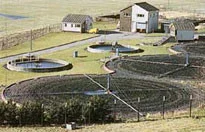
The image files are 205 × 132 pixels and should remain at or below their natural dimensions to avoid visible loss of quality.

Factors to Confirm Before Selecting an Industrial System

The project specification should be based on representative operating information rather than a generic application label.

Swipe horizontally to view the full table.

Industrial application evaluation factors
Factor Why it matters Information to confirm
Treatment objective Cleaning, disinfection, microbial control, oxidation, pH adjustment and water reuse are different engineering objectives. Define the required outcome, acceptance criteria and verification method.
Water or effluent quality Organic matter, suspended solids, salinity, hardness, metals and oxidant demand can affect treatment and equipment selection. Provide a representative laboratory analysis and expected variation over time.
Solution parameters FAC, pH, temperature, solution age and production conditions influence anolyte chemistry and performance. Establish production, storage, dosing, monitoring and alarm limits.
Contact conditions Concentration alone does not define a process result. Validate contact time, coverage, mixing, flow, temperature and application method.
Process integration Oxidizing or alkaline solutions can affect biological treatment, downstream chemistry and product-contact operations. Map the dosing point, upstream treatment, downstream stages, interlocks and drainage route.
Material compatibility Metals, elastomers, plastics, coatings, seals and sensors may respond differently to repeated exposure. Confirm compatibility at the proposed concentration, pH, temperature and exposure frequency.
Regulatory requirements Potable water, food contact, workplace hygiene, wastewater discharge and maritime uses are regulated separately. Confirm the jurisdiction, authorized use, documentation, monitoring and responsible approval route.
Verification and maintenance A stable process requires calibrated instruments, preventive maintenance and documented corrective action. Define sampling, calibration, cleaning, consumables, alarms, record keeping and operator responsibilities.

Potential Operational Advantages

Depending on the validated application and the system being replaced, on-site generation may offer practical operational benefits.

  • Production of active solution close to the point of use.
  • Controlled generation and dosing for the defined process.
  • Reduced dependence on deliveries and storage of some concentrated treatment products.
  • Availability of separate oxidizing and alkaline solution streams where both are required.
  • Integration with storage tanks, dosing equipment, probes, alarms and facility control systems.
  • Scalable equipment selection based on required capacity and operating conditions.

Any claim concerning cost, energy use, chemical consumption, corrosion, product quality, wastewater reuse or treatment performance must be supported by data from the relevant installation.

Information Required for an Industrial Application Review

  • Industry, facility and exact proposed application.
  • Required flow, daily volume and operating schedule.
  • Representative source-water or effluent analysis.
  • Target microorganisms, contaminants or cleaning objective.
  • Current treatment, chemicals, equipment and process sequence.
  • Materials of construction and available injection or application points.
  • Required concentration, contact time and monitoring method, where already defined.
  • Applicable discharge, workplace, product-contact, water-quality or maritime requirements.
  • Available water pressure, electrical supply, installation space and control-system connections.

Frequently Asked Questions

What industrial applications can Envirolyte systems be evaluated for?

Envirolyte systems may be evaluated for selected industrial water treatment, process hygiene, equipment sanitation, CIP, cooling-water microbial control, storage-tank hygiene and wastewater disinfection or conditioning stages. Suitability depends on the specific process and applicable requirements.

What is the difference between anolyte and catholyte?

Anolyte is an oxidizing electrolyzed water solution used or evaluated for controlled disinfection and microbial treatment. Catholyte is an alkaline reducing solution that may support selected washing, cleaning or pH-related process steps.

Can one dosing rate be used for every industrial application?

No. The required solution specification and dosing conditions depend on water quality, organic load, treatment objective, target microorganisms or contaminants, temperature, contact time, materials and regulatory limits.

Can anolyte replace scale and corrosion control in a cooling tower?

No. Anolyte may support microbial control, but scale, corrosion, suspended solids, pH, conductivity, blowdown, cleaning and Legionella risk must be managed within a complete water-treatment programme.

Can Envirolyte solutions remove heavy metals from any industrial effluent?

No universal heavy-metal removal result can be assumed. The wastewater must be characterized, and the complete treatment process must be demonstrated through representative treatability testing and verified against the required discharge or reuse limits.

Is on-site electrolyzed water generation chemical-free?

No. Water, sodium chloride and electricity are used to produce chemically active anolyte and catholyte solutions. On-site generation may reduce handling of some concentrated products, but it should not be described as chemical-free.

Discuss an Industrial Water Treatment Project

Provide the Envirolyte technical team with the application, water or effluent analysis, required capacity, operating conditions, existing treatment process, materials, monitoring requirements and applicable regulations.

  • Products
  • Technology
  • Performance
  • Applications