
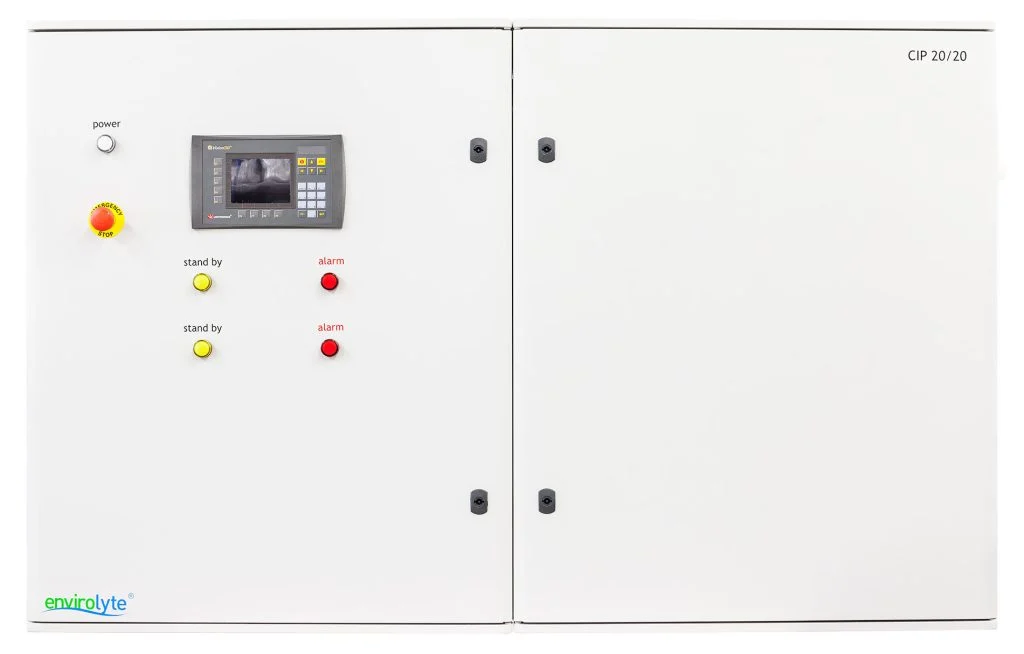
Envirolyte CIP equipment is designed for on-site production of electrolyzed water solutions for cleaning-in-place, food processing, beverage production and hygiene applications. The systems generate both anolyte for disinfection and catholyte as an alkaline washing fluid, allowing operators to support cleaning and sanitizing processes with solutions produced on demand.
The Envirolyte CIP range of anolyte/catholyte generators was developed for food processing and beverage markets and is supplied in a low-salt configuration. These generators are suitable for CIP applications where safety, simplified operation, reduced chemical handling and lower total cost of ownership are important selection factors.
CIP generators can be evaluated for beer and beverage facilities, food processing plants, hospitality facilities, schools, government facilities, military bases, prisons, cruise ships and janitorial services. For higher-strength applications where stronger anolyte or catholyte may be required, compare this page with Envirolyte CIP HD equipment.
How Envirolyte CIP Equipment Supports Cleaning-in-Place
Water processing with anolyte and catholyte, also known as electrolyzed water, is used in hygiene applications to help remove unwanted microorganisms from contact surfaces in food and beverage environments. In a typical Envirolyte CIP concept, anolyte is used as the oxidizing disinfectant solution and catholyte is used as the alkaline washing fluid.
Traditional non-ECA chemical CIP often requires a water rinse, detergent step, second water rinse, disinfectant step and final rinse. Envirolyte’s ECA approach can support a simplified process where alkaline catholyte assists washing and anolyte supports disinfection, helping facilities evaluate reductions in chemical use, heating demand, water consumption and production downtime.
| CIP function | Generated solution | Typical role in the process |
|---|---|---|
| Washing | Catholyte | Alkaline washing fluid for selected cleaning, soil removal and process-support tasks. |
| Disinfection | Anolyte | Oxidizing disinfectant solution for microbial control on compatible contact surfaces and equipment. |
| On-site production | Anolyte and catholyte | Solutions are generated on demand from water, salt and electricity, reducing reliance on stored chemicals. |
| Process integration | Independent or simultaneous output | Production can be controlled by level switches in anolyte and catholyte tanks. |
Key Features of Envirolyte CIP Generators
| Feature | Project value |
|---|---|
| Low-salt configuration | Designed to reduce chloride residue and support corrosion-sensitive CIP applications. |
| Anolyte 500 ppm FAC at approximately pH 6.5 | Provides a neutral-to-near-neutral disinfectant stream for selected food, beverage and hygiene applications. |
| Catholyte 1000 ppm NaOH at pH >12 | Provides alkaline washing support for selected cleaning and degreasing tasks. |
| Separated reactor cell technology | Individual anolyte and catholyte production platforms support stable output quality. |
| Extremely low waste generation | Waste generation is stated as less than 0.5% of device capacity. |
| Low chloride final CIP solutions | Current documentation states approximately 28–34 ppm chlorides in final CIP solutions, plus chlorides from the CIP makeup water. |
| Easy interface | Designed to keep anolyte and catholyte solutions within specified parameters during operation. |
| Remote monitoring | Remote monitoring can be specified by GSM, Ethernet or Modbus depending on project requirements. |
| European components and simplified operation | Supports easier installation, maintenance and daily use in industrial environments. |
CIP Generator Models and Specifications
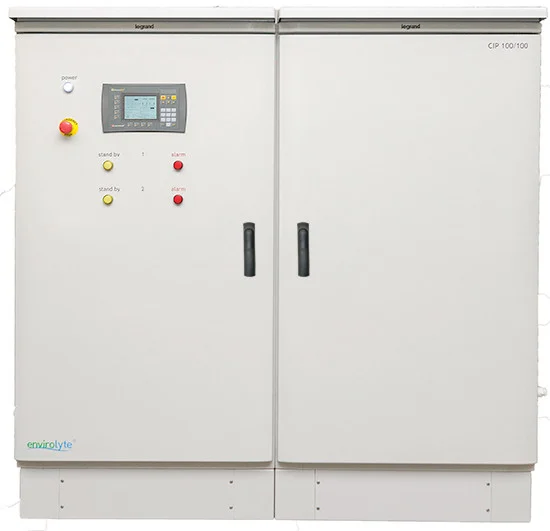
| Specification | CIP-20/20 | CIP-40/40 | CIP-100/100 | CIP-200/200 | CIP-300/300 |
|---|---|---|---|---|---|
| Anolyte output | ~20 LPH ANW anolyte | ~40 LPH ANW anolyte | ~100 LPH ANW anolyte | ~200 LPH ANW anolyte | ~300 LPH ANW anolyte |
| Anolyte parameters | pH ~6.0–7.0, can be regulated; ~500–550 ppm FAC | pH ~6.0–7.0, can be regulated; ~500–550 ppm FAC | pH ~6.0–7.0, can be regulated; ~500–550 ppm FAC | pH ~6.0–7.0, can be regulated; ~500–550 ppm FAC | pH ~6.0–7.0, can be regulated; ~500–550 ppm FAC |
| Catholyte output | ~20 LPH catholyte | ~40 LPH catholyte | ~100 LPH catholyte | ~200 LPH catholyte | ~300 LPH catholyte |
| Catholyte parameters | pH ~12.2–12.5; ~0.8–1.0 g/L NaOH | pH ~12.2–12.5; ~0.8–1.0 g/L NaOH | pH ~12.2–12.5; ~0.8–1.0 g/L NaOH | pH ~12.2–12.5; ~0.8–1.0 g/L NaOH | pH ~12.2–12.5; ~0.8–1.0 g/L NaOH |
| Production mode | Independent anolyte/catholyte production or simultaneous production controlled by level switches | Independent anolyte/catholyte production or simultaneous production controlled by level switches | Independent anolyte/catholyte production or simultaneous production controlled by level switches | Independent anolyte/catholyte production or simultaneous production controlled by level switches | Independent anolyte/catholyte production or simultaneous production controlled by level switches |
| Power supply | 220 VAC, one phase, 50–60 Hz | 220 VAC, one phase, 50–60 Hz | 220 VAC, one phase, 50–60 Hz | 380 VAC, three phase, 50–60 Hz | 380 VAC, three phase, 50–60 Hz |
| Salt consumption | ~1.5 g per 1 L anolyte and ~3.8 g per 1 L catholyte | ~1.5 g per 1 L anolyte and ~3.8 g per 1 L catholyte | ~1.5 g per 1 L anolyte and ~3.8 g per 1 L catholyte | ~1.5 g per 1 L anolyte and ~3.8 g per 1 L catholyte | ~1.5 g per 1 L anolyte and ~3.8 g per 1 L catholyte |
| Life expectancy of electrodes and membrane | ~5–7 years | ~5–7 years | ~5–7 years | ~5–7 years | ~5–7 years |
| PLC control | Unitronics Vision 130 or Vision 280 | Unitronics Vision 130 or Vision 280 | Unitronics Vision 130 or Vision 280 | Unitronics Vision 130 or Vision 280 | Unitronics Vision 130 or Vision 280 |
Standard Components and Options
| Component or function | Availability or note |
|---|---|
| Semi-automated flushing | Included across the CIP range. |
| Acid pump to flush the cells | Included across the CIP range. |
| Brine pump | Included across the CIP range. |
| Peristaltic control pumps | Used for anolyte and catholyte generator chamber control and pH regulation of anolyte. |
| Input valves | Included across the CIP range. |
| Flow and pressure switches/controllers | Separate protection can be specified for each platform. |
| Conductivity sensor | Used to control brine saturation and consumption. |
| Level switches | Independent level control for anolyte and catholyte tanks. |
| Overflow level switch and sound alarm | Optional. |
| Remote control | Ethernet, GSM or Modbus options should be specified when ordering. |
| Durability | Designed to withstand adverse conditions such as dust and high humidity. |
| Fittings | LLDPE tubing and Kynar fittings. |
Where CIP Equipment Is Used
Although Envirolyte CIP anolyte/catholyte generators were designed with beverage production in mind, they can be used in any situation where both anolyte and catholyte solutions are required for effective cleaning and sanitizing operations. Relevant Envirolyte application areas include CIP solutions for processing equipment, food processing, hospitality and industrial applications.
| Application | How CIP equipment can help |
|---|---|
| Beer and beverage production | Supports washing and disinfection operations where production uptime, chemical reduction and consistent solution quality are important. |
| Food processing | Supports cleaning and sanitizing of compatible processing equipment, tanks, lines and contact surfaces after validation. |
| Hospitality and institutional facilities | Provides on-site generation of cleaning and disinfection fluids for suitable hygiene-related operations. |
| Industrial hygiene | Can be evaluated where both alkaline washing support and oxidizing disinfection are required in one integrated system. |
Reference Installations and Project Photos
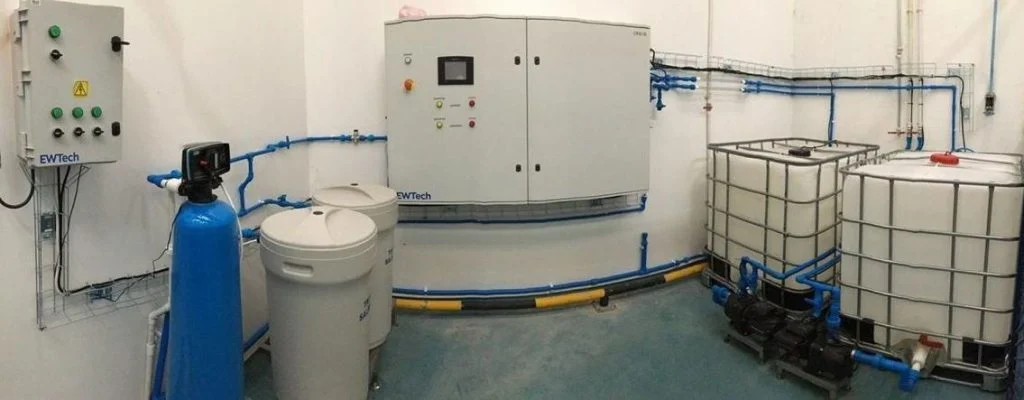
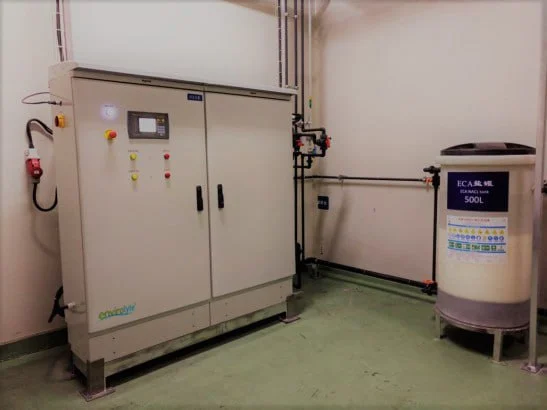
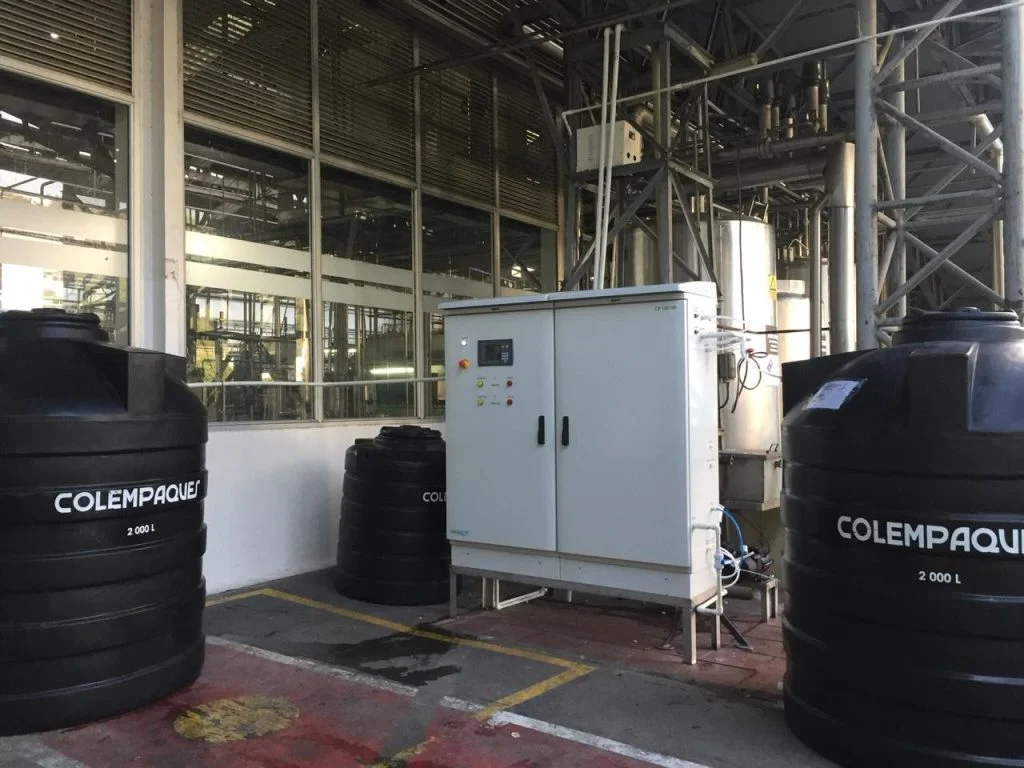
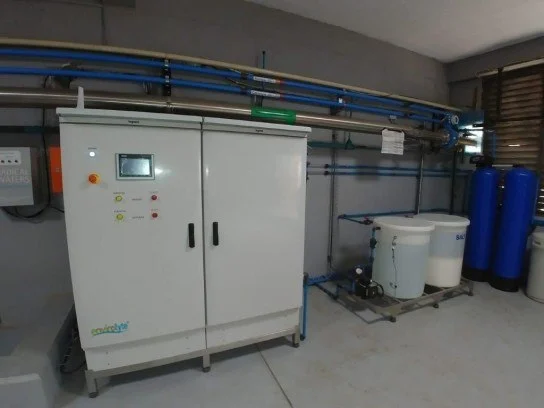
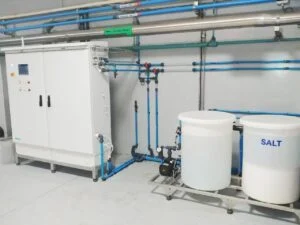
Envirolyte provides installation references showing CIP equipment in food processing and beverage environments, including units installed at a food processing company in Colombia, a beer/beverage producer’s facility and a Coca-Cola factory in South Africa.
CIP or CIP HD: Which System Should Be Selected?
Standard CIP generators are designed to produce fluids with precisely preset HClO/NaOH parameters, including concentration, pH and salt/chloride residue, with the purpose of supporting high efficacy and reducing corrosion risk during CIP operations. CIP HD generators are intended for projects where stronger fluids or broader washing and disinfection tasks may be required.
| Requirement | Recommended option |
|---|---|
| Low-salt CIP operations with preset anolyte and catholyte parameters | Envirolyte CIP equipment |
| Stronger anolyte/catholyte output for difficult washing, degreasing or disinfection tasks | Envirolyte CIP HD equipment |
| Neutral anolyte only, with lower salt consumption and no useful catholyte stream | ANW anolyte generators |
| Dedicated alkaline catholyte production for selected washing or process-support operations | CG catholyte generators |
Frequently Asked Questions
Envirolyte CIP equipment is an on-site anolyte/catholyte generation system designed to support cleaning-in-place, washing and disinfection operations in food, beverage, hospitality and selected industrial hygiene applications.
Envirolyte CIP generators produce ANW anolyte for disinfection and catholyte as an alkaline washing fluid. The systems can produce the fluids independently or simultaneously, depending on the selected configuration and tank level control.
The standard CIP range is designed to produce anolyte at approximately pH 6.0–7.0 with about 500–550 ppm FAC and catholyte at approximately pH 12.2–12.5 with about 0.8–1.0 g/L NaOH.
CIP equipment is generally selected for low-salt cleaning-in-place operations with preset solution parameters. CIP HD equipment is selected when stronger anolyte or catholyte concentrations are required for more difficult washing, degreasing or disinfection tasks.
Yes. Generators with other anolyte or catholyte output capacities are available upon request and should be specified according to the required HClO concentration, NaOH concentration, flow rate, storage volume and process conditions.
Request CIP Equipment Support
For technical guidance, application evaluation or model selection, send your enquiry to Envirolyte Industries International Ltd. Envirolyte can help assess the required anolyte and catholyte output, HClO and NaOH concentration, CIP process conditions, storage volume, dosing control, installation requirements and integration with food, beverage, hospitality or industrial hygiene systems.