
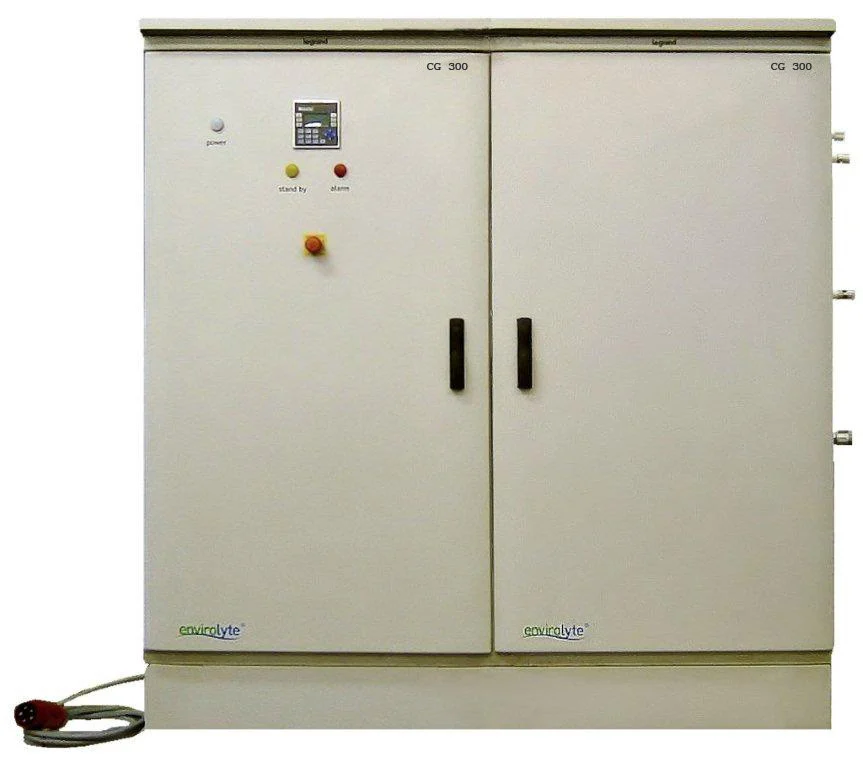
Envirolyte CG catholyte generators are on-site alkaline solution generation systems designed to produce catholyte from NaCl brine, water and electricity. The generated catholyte typically contains sodium hydroxide components with NaOH concentration from approximately 1 g/L up to 6 g/L and pH around 11.5–13.5.
CG catholyte generators are suitable for applications where facilities need an alkaline washing fluid, cleaning support, CIP process assistance, pH adjustment, heavy metal precipitation, organic matter precipitation or selected extraction processes. Catholyte can help reduce dependence on transported alkaline detergents and hazardous chemical storage when properly integrated into the process.
The CG range is especially relevant for industrial cleaning, food and beverage processing, CIP workflows, hospitality, horticulture, greenhouse operations, water purification support and selected oil and gas or biostimulation procedures where alkaline catholyte is technically suitable.
On-Site Catholyte Production for Alkaline Washing and Process Support
Envirolyte CG series catholyte generators are designed to produce catholyte on site and on demand. The process uses diluted NaCl brine and electrochemical activation technology to generate an alkaline cathode stream that can be evaluated as a practical alternative to conventional alkaline washing fluids in selected industrial and hygiene-related operations.
Production of catholyte as a cost-effective alkaline cleaning and process-support solution has a wide range of potential applications, especially in CIP solutions for processing equipment, food processing, farming and horticulture, hospitality, industrial applications and wastewater treatment.
What CG Catholyte Generators Produce
CG systems generate catholyte, an alkaline electrochemically activated solution produced in the cathode chamber of a diaphragmatic electrolysis cell. Catholyte is not positioned as the main disinfecting stream; it is primarily evaluated for washing, cleaning support, flocculation, coagulation, pH adjustment and selected industrial process-support applications.
| Parameter | Typical CG catholyte value | Application relevance |
|---|---|---|
| Feed input | Water, NaCl brine and electricity | Supports on-site generation and reduces dependence on transported alkaline chemicals. |
| Main output | Alkaline catholyte | Used for washing, cleaning support, pH adjustment and selected process applications. |
| NaOH concentration | Approximately 1–6 g/L | Selection depends on required washing strength, flow rate and process conditions. |
| pH range | Approximately pH 11.5–13.5 | Useful where alkaline conditions are required for washing, precipitation or extraction support. |
| Side product | Small acidic anolyte stream, approximately 0.4% of total flow | Safe disposal or controlled use of the acidic side stream should be considered during project design. |
How Catholyte Is Generated
In a diaphragmatic electrolysis cell, the cathode chamber receives positively charged ions and produces an alkaline stream. Under electrochemical conditions, water is reduced at the cathode and hydroxide ions are formed. Sodium ions from the brine combine with hydroxide ions, creating an alkaline sodium hydroxide-containing catholyte solution.
| Stage | Reaction or function | Result |
|---|---|---|
| Cathode reaction | 2H2O + 2e− → H2 + 2OH− | Hydroxide ions are generated in the cathode chamber. |
| Alkaline formation | Na+ + OH− → NaOH components in solution | The catholyte stream becomes strongly alkaline. |
| Stream separation | The diaphragmatic cell separates cathode and anode streams. | Catholyte is produced as the main output, while a small acidic anolyte stream is formed as a side product. |
For more technical background, see Envirolyte electrochemical activation technology, diaphragmatic electrolysis cells and electrolysed water solutions.
Typical Applications for CG Catholyte Generators
CG catholyte generators should be selected according to required catholyte concentration, pH, flow rate, washing process, material compatibility, discharge conditions, process validation and local regulatory requirements.
| Application area | Typical catholyte role | Recommended internal page |
|---|---|---|
| CIP and processing equipment | Alkaline washing fluid for selected cleaning-in-place workflows and equipment washing stages. | CIP solutions for processing equipment |
| Food and beverage processing | Cleaning support for selected food processing environments where alkaline washing is required before or alongside disinfection stages. | Food processing applications |
| CIP equipment selection | System evaluation where both cleaning and disinfection stages are required in food, beer and beverage processing. | Envirolyte CIP equipment |
| Industrial water purification | Support for precipitation of heavy metals and organic matter where alkaline treatment is technically suitable. | Industrial applications |
| Wastewater and effluent support | pH adjustment, precipitation support and process conditioning before downstream treatment stages. | Wastewater treatment applications |
| Horticulture and farming | Selected washing, water conditioning and process-support tasks in agricultural or horticultural environments. | Farming and horticulture applications |
| Hospitality and facility operations | Cleaning support for selected hotel, kitchen, laundry or service-area workflows where alkaline washing is required. | Hospitality applications |
| Oil and gas support | Selected cleaning, water conditioning or process-support applications where catholyte is suitable for the field conditions. | Oil and gas applications |
CG vs ELA and ANW Generators
The CG range is dedicated to catholyte production. This is different from standard ELA and ANW anolyte generators, where the main product is anolyte for disinfection and microbial control. If the project requires alkaline cleaning solution as the main output, a CG catholyte generator should be evaluated.
| Generator type | Main generated solution | Best suited for |
|---|---|---|
| CG Catholyte Generators | Alkaline catholyte | Washing, cleaning support, alkaline process support, precipitation and pH adjustment. |
| ELA Anolyte Generators | HOCl-rich anolyte with useful catholyte stream depending on configuration | Water disinfection, sanitation, microbial control and projects where both anolyte and catholyte may be useful. |
| ANW Anolyte Generators | Neutral HOCl-rich anolyte | Low-salt disinfection, reduced chloride residue and applications where catholyte is not required as a commercial output. |
Capacity and Installation Considerations
The output capacity of CG catholyte generators depends on the required NaOH concentration, flow rate and process conditions. In general, the CG product range follows the same project-selection logic as Envirolyte EL and ELA units, but final sizing should be confirmed according to the required catholyte strength and daily production volume.
Installation requirements for CG catholyte generators are generally similar to EL or ELA machines. Project design should consider brine preparation, water quality, electrical supply, ventilation, hydrogen management, catholyte storage, dosing or transfer pumps, side-stream handling, safety procedures and process integration.
Key Benefits of On-Site Catholyte Generation
- On-site and on-demand production of alkaline catholyte.
- NaOH concentration typically from approximately 1 g/L up to 6 g/L.
- High pH alkaline solution for selected washing and process-support applications.
- Reduced need to transport, store and handle some conventional alkaline chemicals.
- Useful for CIP support, industrial cleaning, pH adjustment and precipitation processes where technically suitable.
- Compatible with project-specific integration into tanks, pumps, dosing systems and process lines.
- Side-stream acidic anolyte production is low, approximately 0.4% of total flow, but should be included in safe handling and disposal planning.
Testing, Compliance and Project Evaluation
Before using catholyte in a regulated or process-critical application, customers should review water chemistry, target cleaning effect, material compatibility, wastewater discharge limits, operator safety, local regulations and validation requirements. Envirolyte can support technical evaluation, model selection and integration planning.
Frequently Asked Questions
What is a CG catholyte generator?
A CG catholyte generator is an Envirolyte on-site generation system designed to produce alkaline catholyte from NaCl brine, water and electricity for selected washing, cleaning support, precipitation and process-support applications.
What NaOH concentration can CG catholyte generators produce?
CG catholyte generators are designed to produce catholyte with NaOH concentration from approximately 1 g/L up to 6 g/L, depending on configuration and operating conditions.
What is the pH of CG catholyte?
The typical pH range of CG catholyte is approximately 11.5–13.5, depending on concentration, source water, brine quality and system configuration.
Can catholyte replace alkaline detergents?
Catholyte can be evaluated as an alkaline washing or cleaning-support solution in selected processes, but replacement of detergents should be validated against cleaning performance, soil type, material compatibility, hygiene requirements and discharge rules.
Does a CG generator produce anolyte?
During catholyte generation, a small acidic anolyte side stream is produced, typically around 0.4% of total flow. Safe disposal or controlled use of this side stream should be considered in the system design.
How should the correct CG model be selected?
The correct CG generator should be selected according to required catholyte concentration, daily volume, flow rate, pH target, process integration, water quality, brine preparation, installation conditions and local safety or discharge requirements.
Request CG Catholyte Generator Support
For technical guidance, application evaluation or model selection, send your enquiry to Envirolyte Industries International Ltd. Envirolyte can help assess the required catholyte concentration, output volume, pH range, process conditions, installation requirements and integration with existing cleaning or treatment systems.