
Supported by Enterprise Estonia Development program

HomeOn-Site Disinfection Applications for Water Treatment and Process HygieneHealthcare Disinfection with On-Site Anolyte

Healthcare Disinfection with On-Site Anolyte

Envirolyte healthcare disinfection systems generate anolyte on site from conditioned water, sodium chloride and electricity. Subject to local authorisation and facility procedures, the generated solution may be evaluated for selected healthcare water, environmental surface, laundry and utility-area hygiene applications.

Anolyte is an oxidising solution containing free available chlorine species, including hypochlorous acid under suitable operating conditions. It must not be described as chlorine-free, universally non-toxic or automatically suitable for medical-device sterilisation. Concentration, pH, contact time, application method and compatibility must be defined for the intended use.

Every healthcare application requires review by the facility’s infection prevention, occupational safety and engineering teams. Learn about electrochemical activation technology, examine the available microbiological testing information, and verify applicable ECHA and BPR requirements before equipment or treatment claims are selected.

Healthcare Hygiene Applications and Use Boundaries

On-site generated anolyte can only form one part of a documented infection prevention and control programme. It does not replace physical cleaning, hand-hygiene programmes, isolation precautions, equipment-specific reprocessing, water-system maintenance, staff training or verification of cleaning performance.

General healthcare guidance distinguishes environmental surfaces, non-critical patient-care equipment, semi-critical instruments and critical medical devices. Each category requires a different level of processing. See the CDC environmental infection-control guidance and the FDA guidance on reusable medical-device reprocessing.

Scroll horizontally to view the complete table.

Potential healthcare applications and requirements that must be confirmed before use
Potential application Possible role of anolyte Requirements before implementation
Hard, non-porous environmental surfaces Controlled cleaning and disinfection of selected floors, walls, furniture and high-touch surfaces. Approved product claim, prior removal of visible soil, defined concentration and contact time, surface compatibility and a documented environmental-cleaning procedure.
Non-critical patient-care equipment Disinfection of selected external equipment surfaces that contact intact skin. Equipment-manufacturer compatibility, an approved disinfectant claim, cleaning before disinfection and compliance with the equipment reprocessing instructions.
Beds and wheelchairs Integration into compatible automated washing or manual surface-hygiene procedures. Validation of spray coverage, contact time, rinsing requirements, drying, material compatibility and prevention of cross-contamination.
Healthcare water systems Controlled dosing into suitable building water systems for microbial management. Water-system assessment, validated residual control, representative sampling, compliance with drinking-water requirements and integration into the facility water-management programme.
Laundry pre-treatment Pre-treatment or hygiene support for selected textiles before the validated laundry cycle. Textile compatibility, dosing accuracy, organic-load assessment, laundering temperature and verification of the complete washing process.
Dental unit waterlines Controlled treatment of suitable dental water circuits and support for waterline biofilm management. Dental-unit compatibility, approved clinical protocol, water-quality targets, concentration control and compliance with local dental-water requirements. See dental unit waterline disinfection.
Hand hygiene Use should only be considered where the specific product is authorised and labelled for human-hygiene application. Required efficacy standards, skin-safety assessment, authorised formulation, application instructions and approval by the facility infection-prevention team.
Medical instruments and endoscopes No general-purpose claim should be made from this application page. A specifically authorised sterilant or high-level disinfectant, validated device-specific instructions, automated reprocessor compatibility where relevant, rinsing, drying and process monitoring.
Room fogging or misting Possible supplementary environmental treatment only where technically and legally permitted. Risk assessment, authorised application method, controlled droplet delivery, room sealing, absence of occupants, ventilation, exposure limits and confirmation that manual cleaning is not being replaced.
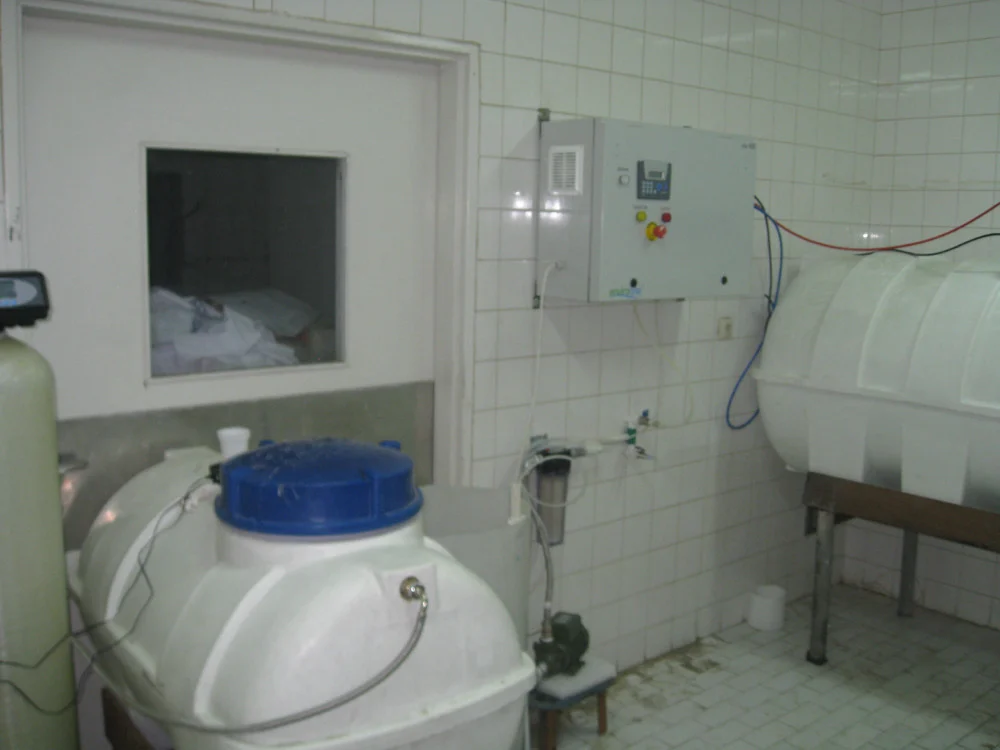
Envirolyte ELA-1200 anolyte generator, storage tanks and water-conditioning equipment installed in a hospital in Iran
Envirolyte ELA-1200 anolyte generator and associated solution-handling equipment installed at a hospital in Iran.

How an On-Site Healthcare Anolyte System Works

A typical system conditions the incoming water, prepares sodium chloride brine and supplies both streams to an Envirolyte electrochemical generator. The generated anolyte can then be transferred to a suitable storage or distribution tank and delivered to an approved application point.

  1. Water preparation: incoming water is filtered, pressure-regulated or softened where required by the selected generator.
  2. Brine preparation: sodium chloride solution is prepared and monitored according to the equipment specification.
  3. On-site generation: the electrochemical cell produces an oxidising anolyte solution under controlled flow and electrical conditions.
  4. Solution verification: free available chlorine, pH, temperature or other required parameters are checked using an appropriate measurement procedure.
  5. Storage or direct distribution: the solution is transferred to a compatible tank or controlled point-of-use system.
  6. Application: the solution is dosed, sprayed, circulated or otherwise applied according to the validated procedure.
  7. Monitoring: concentration, contact time, surface coverage, water residual or other critical parameters are recorded.
  8. Verification: the facility confirms performance using inspection, chemical measurements, microbiological testing or other approved methods.

Solution stability must be established for the actual generator, formulation, storage container, temperature and intended application. Anolyte should not be described as remaining suitable for up to 18 months unless this period is supported by product-specific stability data.

Depending on the required output and solution characteristics, a healthcare project may be evaluated using equipment from the ELA anolyte generator range or the ANW anolyte generator range.

Microbiological Testing of Envirolyte Anolyte

Envirolyte publishes independent test summaries covering bactericidal, yeasticidal and virucidal activity. Results apply only to the stated concentration, dilution, temperature, organic load, contact time and test method.

Scroll horizontally to view the complete table.

Summary of microbiological results
Activity Reported test conditions Reported result
Bactericidal activity EN 13727; 250 ppm hypochlorous acid; 60-second contact time; 20.1 °C; clean conditions. At least 5 log reduction against Pseudomonas aeruginosa, Staphylococcus aureus, Escherichia coli K12 and Enterococcus hirae.
Yeasticidal activity EN 13624; 250 ppm hypochlorous acid; 60-second contact time; 20.1 °C; clean conditions. At least 4 log reduction against Candida albicans.
Virucidal activity EN 14476; anolyte used at 1:1 dilution; 1-minute contact time; 20 °C; 0.3 g/L BSA. At least 4 log reduction of adenovirus type 5, 5.4 log reduction of poliovirus 1 and 4.2 log reduction of murine norovirus.

The complete context and additional organisms are presented on the Envirolyte microbiological testing page. A laboratory suspension test does not by itself authorise a healthcare product claim or demonstrate equivalent performance on a hospital surface, medical device, water system or occupied room.

View reported HIRL anolyte test results
Reported HIRL anolyte log-reduction results
Test category Test organism Clean conditions1 Dirty conditions2
SporicidalBacillus subtilis var. niger>6.32 log>6.28 log
Bactericidal, BS EN 1276Pseudomonas aeruginosa>5.00 log>5.00 log
Escherichia coli>5.00 log>5.00 log
Staphylococcus aureus>5.00 log>5.00 log
Salmonella Typhimurium>5.00 log>5.00 log
Klebsiella pneumoniae>5.00 log>5.00 log
Fungicidal, BS EN 1275Candida albicans>5.00 log<4.00 log

1 Clean conditions are defined as 0.03% horse serum.

2 The reported test conditions specify 1% horse serum for the sporicidal test and 0.3% horse serum for the BS EN 1275 and BS EN 1276 tests.

Available attribution information identifies HIRL, Dudley Road, Birmingham, and Don Whitley Scientific Ltd, Shipley, West Yorkshire, as the testing organisations. The full reports, solution specification, test dates and current standard status should be confirmed before these results are used in regulatory or sales documentation.

Cold-Disinfection Comparison

The following comparison presents manufacturer-reported information for general reference. It should not be treated as a current regulatory, safety, compatibility or procurement comparison. Commercial formulations can differ substantially in concentration, classification, shelf life and authorised use.

View comparison of cold-disinfection options
Manufacturer-reported comparison of cold-disinfection options
Disinfectant Health and safety risk Reported equipment risk Reported sporicidal shelf life Reported time for 6 log spore reduction under clean conditions
GlutaraldehydeHighAbsorption by plastics14–28 daysMore than 3 hours
Peracetic acidHighDamage to copper alloys1 dayLess than 5 minutes
Chlorine dioxideLowMedium7 daysLess than 2 minutes
Enzyme surfactantsLow to mediumLowNot statedNot stated
Electrolysed brineMinimalSome plastics require protectionHoursLess than 2 minutes
AnolyteMinimalLowMore than 10 weeks under “dirty” conditions and more than 12 months under “clean” conditionsLess than 2 minutes

Comparison note: The descriptions “high”, “low” and “minimal” are manufacturer-reported terms and are not independent hazard classifications. Current safety data sheets, product labels, regulatory authorisations, device-manufacturer instructions and compatibility testing must be used instead.

Safety, Toxicology and By-Product Information

The suitability of a generated solution cannot be established from antimicrobial results alone. A healthcare review should consider exposure route, intended users, solution concentration, aerosols, ventilation, surface residues, wastewater disposal and the characteristics of the treated materials.

Healthcare Project Planning

Before selecting an Envirolyte system, the healthcare facility and supplier should define the exact treatment objective and separate environmental hygiene, water treatment and medical-device reprocessing into distinct validated procedures.

  • Country of installation and applicable healthcare or biocidal regulations
  • Facility type, departments and patient-risk profile
  • Intended application and required regulatory claim
  • Target microorganisms and required efficacy standard
  • Required concentration, pH, contact time and application volume
  • Expected organic load and required pre-cleaning method
  • Surface, textile, pipework or equipment materials
  • Water quality, pressure, electrical supply and available installation space
  • Required production capacity and operating schedule
  • Storage, distribution, dosing or point-of-use requirements
  • Staff exposure, ventilation, personal protective equipment and spill procedures
  • Monitoring, calibration, sampling and microbiological verification
  • Training, record keeping and corrective-action procedures

For building hot- and cold-water systems, review the dedicated Legionella prevention application. Water treatment and environmental surface disinfection should be documented as separate processes with their own operating and verification requirements.

Frequently Asked Questions

Can anolyte be described as a hospital sterilant?

Not as a general claim. Sterilisation is a validated process intended to eliminate all forms of microbial life, including bacterial spores. The solution, equipment and process must be specifically authorised and validated for the relevant medical-device category and jurisdiction.

Can anolyte be used to reprocess endoscopes?

Only where the specific chemistry, automated endoscope reprocessor, endoscope model and complete cleaning and high-level disinfection procedure have been authorised and validated. A laboratory suspension test alone is not sufficient.

Can anolyte replace cleaning before surface disinfection?

No. Visible soil and organic material should be removed according to the healthcare cleaning protocol before the disinfectant is applied, unless a specifically validated combined cleaning-disinfection procedure states otherwise.

Can anolyte be used for healthcare hand hygiene?

Only where the exact product is legally authorised for human hygiene and its formulation, efficacy, skin compatibility, application volume and contact time meet the applicable requirements.

Is room fogging a replacement for manual cleaning?

No. Fogging or misting should only be considered as a supplementary, risk-assessed procedure where the application is authorised. It does not remove the need for physical cleaning of contaminated or high-touch surfaces.

Does one anolyte specification cover all healthcare applications?

No. Water-system dosing, surface disinfection, laundry treatment and medical-device processing have different efficacy, safety, compatibility and regulatory requirements.

Discuss a Healthcare Disinfection Project

Provide the Envirolyte technical team with the facility type, country, intended application, required efficacy standard, target microorganisms, operating procedure, material information and applicable approval requirements.

  • Products
  • Technology
  • Performance
  • Applications