
Envirolyte feed material decontamination systems generate anolyte on site for controlled treatment of raw and processed feed ingredients. The solution can be applied by spraying or fogging while the material is conveyed and mixed, helping feed producers integrate microbial control into an existing handling or processing line.
A typical Envirolyte Feedlyte system combines water conditioning, brine preparation, an anolyte generator, solution storage, a dosing pump, spray nozzles and a mixing or conveying zone. Application rate, droplet distribution and mixing must be selected to provide adequate contact without creating local areas of excessive moisture.
Every feed decontamination process requires application-specific trials and validation. Learn about electrochemical activation technology, review available microbiological testing information, and check the relevant approvals and compliance resources before selecting equipment or publishing performance claims.
Microbial Risks in Raw and Processed Feed Materials
Agricultural raw materials can be exposed to contamination during harvesting, transport, unloading, storage, conveying, grinding, mixing and final product handling. Processing equipment, storage bins, dust, personnel and contaminated material can also contribute to cross-contamination.
Depending on the material and the facility hazard analysis, organisms of concern may include Salmonella, Escherichia coli, Enterobacteriaceae, spoilage bacteria, yeasts and moulds, including toxin-producing fungal species. Uncontrolled microbial growth can affect feed quality, storage stability, product release, customer acceptance and downstream animal-production risks.
Conditions That Can Influence Microbial Development
- Initial microbial load and contamination distribution
- Material temperature and storage duration
- Moisture content and water activity
- Particle size, density and material flow characteristics
- Availability of oxygen and local condensation
- Storage-bin, conveyor and processing-equipment hygiene
- Cross-contamination after the treatment point
Feed Decontamination and Control Measures
Feed manufacturers may use several preventive and corrective controls. The appropriate combination depends on the feed material, identified hazards, process design, legal requirements and validated operating limits.
Scroll horizontally to view the complete table.
| Control measure | Typical role | Important considerations |
|---|---|---|
| Thermal treatment | Reduction of microbial contamination through a validated time-and-temperature process. | Energy demand, heat distribution, material characteristics, process capacity and possible recontamination after treatment. |
| Authorised preservatives or acidifiers | Support for microbial stability or inhibition during processing and storage. | Permitted use, dosing accuracy, worker handling, material compatibility, odour, residues and customer specifications. |
| Moisture and water-activity control | Reduction of conditions that support microbial growth during storage. | It does not necessarily provide a microbial kill step and must be monitored throughout storage and distribution. |
| Temperature and storage management | Limitation of condensation, self-heating and microbial development. | Bin design, aeration, ambient conditions, monitoring points, storage duration and material turnover. |
| On-site anolyte application | Controlled application of freshly generated active solution during material conveying and mixing. | Feed matrix, concentration, application rate, spray distribution, contact time, final moisture and microbiological validation. |
How the Envirolyte Feedlyte System Works
The diagram below illustrates a typical Envirolyte Feedlyte configuration. The final equipment arrangement must be adapted to the available water supply, feed-line capacity, conveyor layout, required application rate and control strategy.
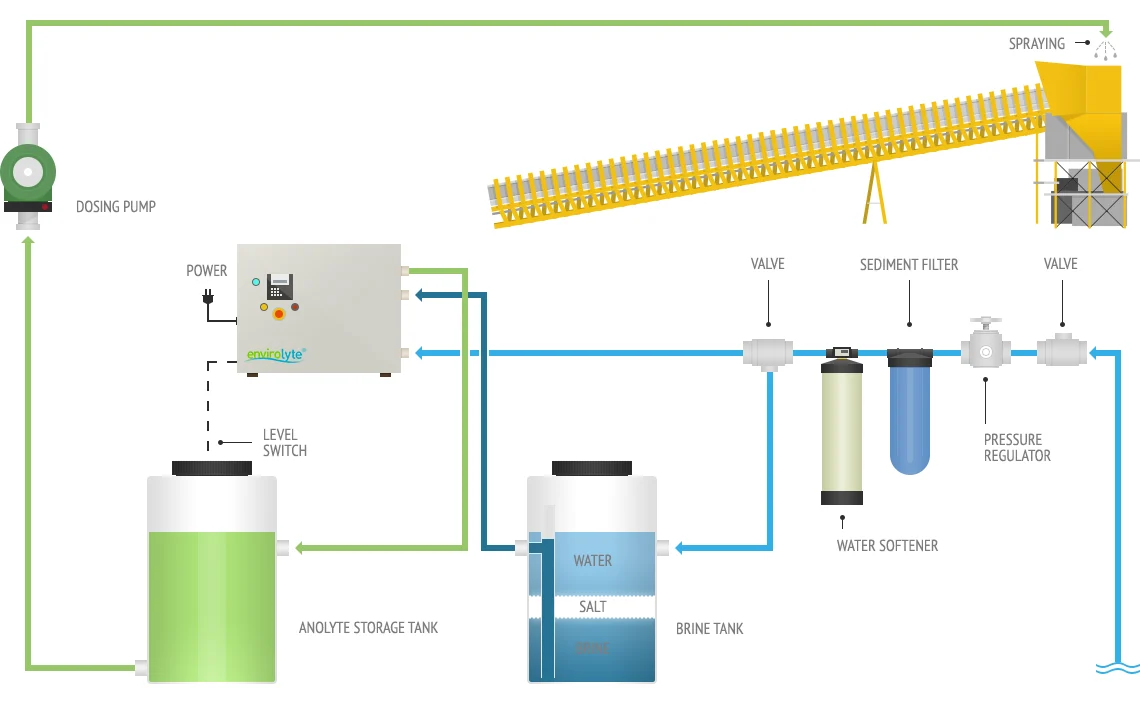
- Water conditioning: incoming water passes through the required sediment filtration, pressure regulation and softening stages.
- Brine preparation: sodium chloride solution is prepared in the brine tank at the concentration required by the generator.
- On-site generation: water and brine are supplied to the Envirolyte unit, which generates anolyte according to the selected operating parameters.
- Solution storage: generated anolyte is transferred to a suitable tank equipped with level monitoring.
- Metered dosing: a dosing pump supplies the solution to the feed-line spray assembly at a controlled rate.
- Uniform application: properly positioned nozzles distribute the solution over the moving material while avoiding untreated zones and local over-wetting.
- Mixing and contact: a conveyor, mixer or other handling stage supports distribution of the treatment through the feed material.
- Verification: operating parameters, final moisture and microbiological results are checked against the validated process specification.
Critical Feed Treatment Parameters
A single anolyte concentration or application rate cannot be applied to every feed material. Process settings must be determined through trials that represent the actual production line and product matrix.
Scroll horizontally to view the complete table.
| Parameter | Why it matters | What should be documented |
|---|---|---|
| Feed material and formulation | Different ingredients can absorb, neutralise or distribute the applied solution differently. | Material description, composition, particle size, bulk density and relevant processing aids. |
| Initial moisture content | The added solution must not move the material outside its acceptable moisture specification. | Moisture before treatment, solution addition and final moisture after mixing. |
| Water activity | Water activity influences the ability of microorganisms to grow during storage. | Initial and final aw, analytical method and sampling time. |
| Target microorganisms | Susceptibility can vary between organisms and feed matrices. | Organisms or indicator groups, starting load, target reduction and analytical method. |
| Anolyte parameters | Antimicrobial performance depends on the generated solution and its condition at the point of use. | Free available chlorine, pH, ORP where relevant, temperature and solution age. |
| Application rate | Insufficient addition may reduce treatment performance, while excess addition may increase moisture. | Litres or kilograms of solution per tonne of material and dosing-pump calibration. |
| Spray distribution | Uneven distribution can create untreated zones or local high-moisture areas. | Nozzle type, pressure, droplet pattern, nozzle position and inspection procedure. |
| Mixing intensity | Mixing affects the distribution of the treatment throughout the material. | Mixer or conveyor type, residence time, throughput and evidence of uniformity. |
| Contact time | Microbiological results depend on the time between application, sampling and subsequent processing. | Minimum contact time and the timing of laboratory samples. |
| Post-treatment controls | Successfully treated material can be recontaminated during storage or transfer. | Hygiene zoning, conveyor and bin sanitation, sampling points and storage controls. |
Potential Objectives of Anolyte Feed Treatment
When the complete process is properly designed and validated, on-site anolyte treatment may be evaluated as part of a feed-hygiene programme for the following objectives:
- Reducing selected microbial contamination in raw or processed feed materials
- Limiting microbial development during processing, shipment and storage
- Supporting control of yeasts, moulds and spoilage organisms
- Reducing the risk of cross-contamination at a defined process stage
- Supporting material flow where microbial activity and local moisture contribute to caking or deposits
- Reducing dependence on transported concentrated treatment chemicals where regulations and validation permit
- Integrating treatment into existing conveying, mixing and automated control systems
Anolyte application should complement rather than automatically replace receiving controls, supplier approval, moisture management, cleaning, pest control, thermal processing or other measures included in the facility feed-safety plan.
Performance Evidence and Claim Management
Envirolyte maintains microbiological testing information covering anolyte generated by its electrochemical systems. Results should always be interpreted according to the tested organism, solution concentration, pH, contact time, temperature, feed matrix and analytical method.
Regulatory status must also be reviewed for the intended market and use. For EU projects, see the Envirolyte ECHA and BPR information, including references related to Product Type 4 for food and feed areas. Listing or active-substance status does not by itself constitute a universal product authorisation for every country or feed application.
Operational Features of On-Site Generation
- Generation of active solution close to the application point
- Automated production and controlled metering
- Integration with level switches, dosing controls and line interlocks
- Adjustment of system capacity to production-line throughput
- Reduced need to transport and store concentrated disinfectant products
- Ability to monitor solution and application parameters as part of process verification
Depending on the required output and generated-solution parameters, a project may be evaluated with ELA, ANW or HD anolyte generators. The selected generator is only one component of the complete Feedlyte installation.
Information Required for System Selection
- Country of installation and intended regulatory use
- Feed material types and formulations
- Minimum, average and maximum production-line capacity
- Initial and maximum acceptable moisture content
- Initial and target water-activity values
- Target microorganisms and required microbiological result
- Existing conveyors, mixers, bins and available application points
- Available water quality, pressure, electricity and installation space
- Required anolyte storage and generator redundancy
- Existing control system and required automation or remote monitoring
- Sampling plan, laboratory methods and acceptance criteria
Related application information is available in the sections covering food-processing hygiene and broader farming applications.
Frequently Asked Questions
No. The required application rate depends on the feed matrix, initial contamination, moisture, water activity, target organisms, anolyte parameters, spray distribution and mixing efficiency.
Not automatically. Anolyte may be evaluated as an additional or alternative control step, but its role must be defined by the facility hazard analysis and supported by process-specific validation.
The system should use suitable nozzles, controlled pressure, calibrated dosing, adequate conveyor coverage and sufficient mixing. Final moisture and water activity should be included in the validation and routine monitoring programme.
Verification can include solution measurements, dosing-pump checks, moisture and water-activity testing, microbiological sampling and confirmation that treated material is protected from recontamination.
Discuss a Feed Material Decontamination Project
Provide the Envirolyte technical team with the feed-material specification, production capacity, moisture limits, target microorganisms, process diagram, available utilities and required regulatory documentation.