
The Role of Anolyte in Wastewater Treatment
Anolyte can be evaluated as a disinfection stage after the wastewater has received sufficient upstream treatment. Lower suspended solids, turbidity and organic loading generally support more predictable disinfectant demand and contact between the active solution and target microorganisms.
Potential integration points include:
- Final effluent disinfection before authorised discharge.
- Disinfection before reclaimed-water storage or distribution.
- Tertiary treatment following clarification, filtration or other polishing processes.
- Industrial process-water recovery where the treated water meets the required quality.
- Controlled microbial treatment of selected wastewater storage tanks and distribution systems.
Process limitation: dosing an oxidising disinfectant into untreated wastewater or before a biological treatment stage can increase chemical demand and may affect the biological process. Any upstream dosing point requires a separate engineering and biological-treatment assessment.
Typical On-Site Generation and Dosing Arrangement
The system diagram shows conditioned inlet water passing through filtration, pressure regulation and a water softener before entering the generator. Sodium chloride brine is supplied from a separate tank. Generated anolyte is stored and delivered by a dosing pump into the wastewater line, with FAC or ORP probes providing process-control information.
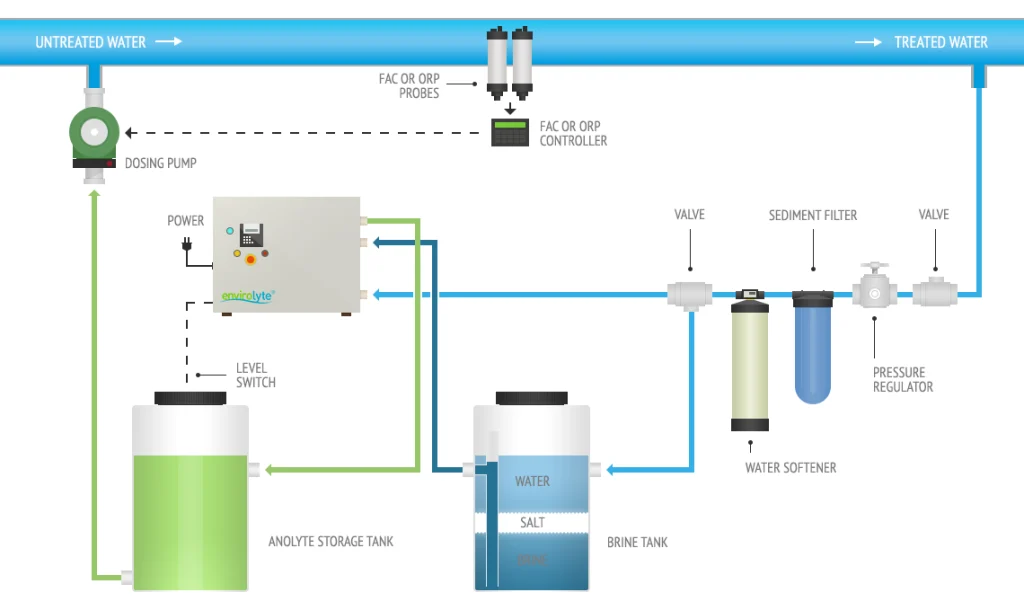
The required generator output, tank volume, dosing-pump capacity and contact system depend on the peak flow, average flow, disinfectant demand, target residual, operating schedule and required redundancy.
Wastewater Design and Validation Parameters
Example Wastewater Installations
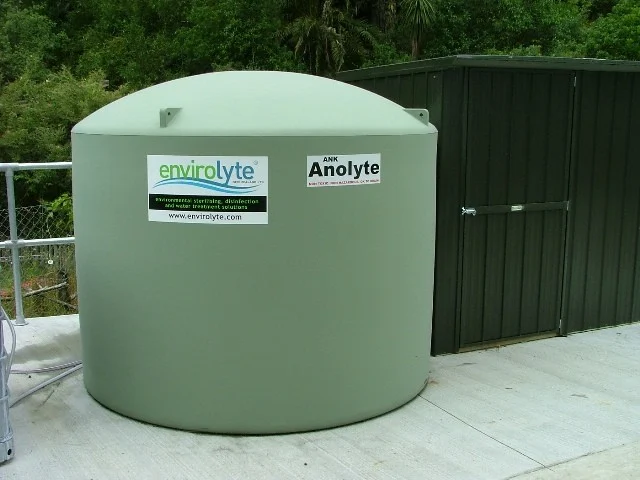
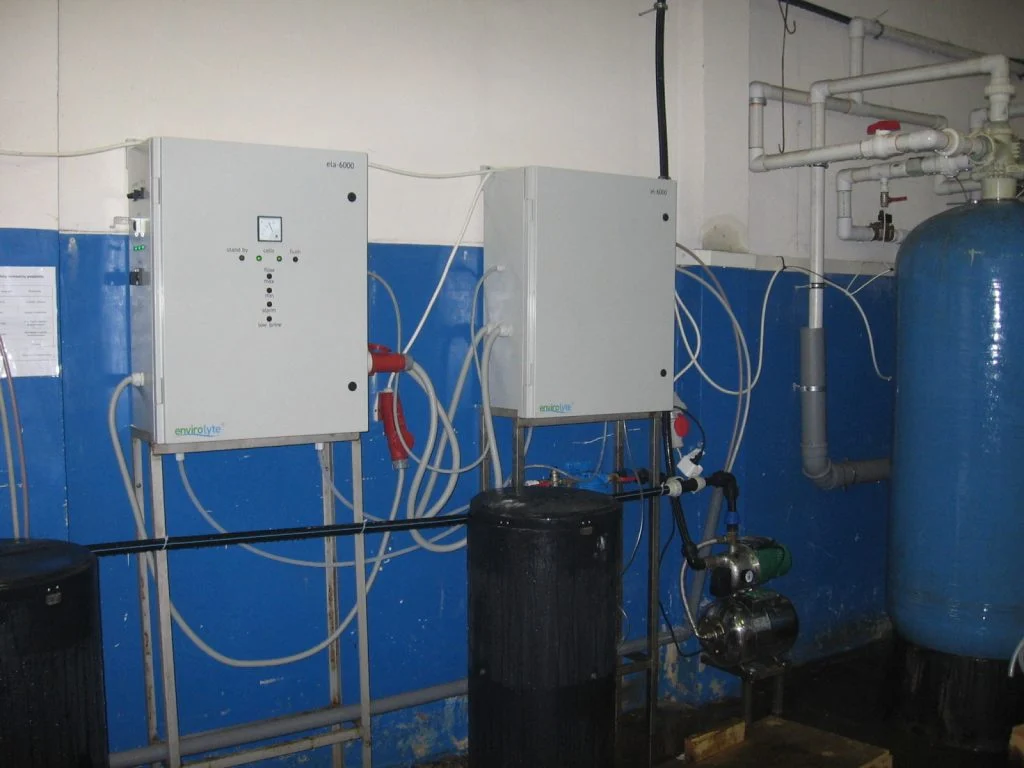
The photographs identify the equipment models and installation countries but do not provide flow rates, influent characteristics, dosing targets, treated-water results or current operating status. These details should be confirmed before either installation is used as a technical design reference.
Disinfection By-Products and Residual Chlorine
Testing of freshly generated anolyte is not equivalent to testing wastewater after disinfection. Envirolyte’s by-products testing information reports that chlorite and chlorate were not detected in selected fresh anolyte samples under the stated analytical conditions. This does not establish that haloforms, haloacetic acids or other by-products cannot form after the solution contacts wastewater.
The final effluent should be assessed according to its organic matter, ammonia, bromide, active-chlorine dose, pH, temperature and contact time. Where residual chlorine could affect the receiving environment, a controlled dechlorination stage and final residual measurement may be required.
Environmental discharge: residual chlorine can be harmful to aquatic organisms. Discharge limits, toxicity requirements and any dechlorination process must be confirmed through the applicable wastewater permit and local environmental authority. See the US EPA wastewater dechlorination guidance for general technical context.
Treated Wastewater Reuse
Reclaimed water can support irrigation, industrial processes, environmental uses and other non-potable applications where the water meets the required quality. Disinfection alone does not make wastewater suitable for every reuse purpose.
A reuse programme should identify the exposure routes, crop or industrial use, storage conditions, distribution system, aerosol generation, worker protection, public access, microbiological targets and chemical-quality requirements.
For agricultural irrigation in the European Union, Regulation (EU) 2020/741 on water reuse defines water-quality classes, monitoring and risk-management requirements. The WHO wastewater-reuse guidance also uses a risk-based approach supported by monitoring and exposure controls.
Wastewater Treatment Project Workflow
- Define the treatment objective: establish whether the water will be discharged, stored, irrigated, reused in a process or treated for another authorised purpose.
- Characterise the wastewater: analyse flow variation, pH, temperature, turbidity, suspended solids, organic loading, ammonia and relevant contaminants.
- Review upstream treatment: confirm that clarification, biological treatment, filtration or other processes provide suitable effluent for disinfection.
- Establish microbiological targets: identify the required indicator organisms, sampling method and compliance limits.
- Conduct bench or pilot testing: determine disinfectant demand, effective dose, residual, contact time and potential by-products under representative conditions.
- Design generation and dosing: select generator capacity, solution storage, dosing pumps, injection point, mixing and contact volume.
- Define monitoring and alarms: establish FAC or total residual measurement, pH, ORP where useful, flow interlocks, calibration and corrective actions.
- Validate the treated effluent: verify microbiological results, residual limits, by-products, toxicity and the final discharge or reuse requirements.
Potential Operational Benefits
- Fresh active solution can be generated close to the point of use.
- Generation and dosing can be matched to wastewater flow and process demand.
- Automated controls can integrate flow measurement, dosing pumps, FAC monitoring and alarms.
- On-site generation may reduce transport and storage of selected concentrated disinfectants.
- The system can be configured for municipal, industrial or decentralised wastewater projects.
- Water reuse may reduce freshwater demand or discharge volumes where the complete treatment process meets the required standard.
Cost, energy, carbon, water and civil-engineering savings must be calculated against a defined baseline. They depend on wastewater quality, treatment capacity, existing infrastructure, electricity, salt, water conditioning, maintenance, monitoring, dechlorination and local disposal or reuse costs.
Performance Evidence and Compliance
Review the available microbiological testing of Envirolyte anolyte together with the tested concentration, organisms, organic load, temperature and contact time. Laboratory suspension tests do not establish the required dose in actual wastewater.
Review the available chlorite and chlorate testing information, but plan additional analyses where the wastewater composition or reuse standard requires testing of treated effluent.
Before implementation, confirm the applicable BPR and customer compliance requirements. Article 95 supplier status, equipment documentation or general efficacy testing does not automatically provide authorisation for every wastewater application or country.