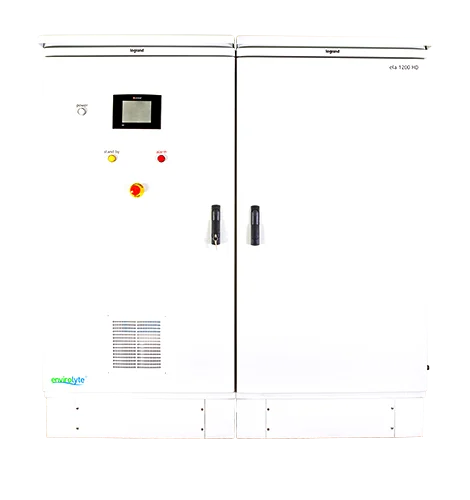
Anolyte and Catholyte Generators for Water Treatment and Process Hygiene
Envirolyte designs and manufactures electrochemical activation systems for the on-site generation of anolyte and catholyte solutions.
Envirolyte systems are used in water disinfection, process hygiene, cleaning-in-place, agriculture, food processing, maritime and industrial water-treatment applications.
Depending on the selected generator and operating configuration, Envirolyte equipment produces oxidizing anolyte for disinfection and microbial control, alkaline catholyte for selected washing and process-support applications, or both solutions as part of an integrated treatment process.
On-site generation uses water, salt and electricity and can reduce dependence on transported treatment chemicals while giving operators direct control over solution production, dosing and integration with the treatment process.
Envirolyte Anolyte and Catholyte Generation Systems
Envirolyte product families cover different production capacities, generated-solution parameters and application requirements. System selection should be based on the required output, water quality, target solution parameters, dosing method, process conditions and applicable regulatory requirements.
ELA Anolyte Generators
On-site generators for producing anolyte for water disinfection, sanitation and process-hygiene applications.Â
CIP Equipment
Anolyte and catholyte generation equipment developed for cleaning-in-place and hygiene processes in food, beverage and related processing environments.
ANW Anolyte Generators
Low-salt anolyte generation systems designed for applications where controlled disinfectant production and reduced salt consumption are important project requirements.
CIP HD Equipment
Envirolyte CIP HD generators are designed for high-capacity cleaning-in-place and disinfection in food processing, beverage and hospitality applications.
Â
HD Anolyte Generators
High-FAC anolyte generation systems for industrial applications requiring higher active-chlorine concentrations or compact high-capacity disinfectant production.
CG Catholyte Generators
Dedicated systems for producing alkaline catholyte for selected washing, cleaning and process-support applications.
Generators
Countries
About Envirolyte Industries International
Envirolyte Industries International Ltd. is based in Tallinn, Estonia and develops and manufactures electrochemical activation equipment and related systems for on-site generation of activated solutions.
The product portfolio includes anolyte generators, catholyte generators, CIP systems, seawater electrolysis equipment, industrial water-treatment equipment, modular systems and electrolysis cells. Projects are supported through an international distributor and technical-partner network.
Performance, Testing and Compliance Information
Independent Testing
Envirolyte systems and generated solutions (anolyte and catholyte) have been put through extensive series of independent tests and on-site trials including hospitals, breweries, water systems and agricultural environments.
Safer World
Being environmentally friendly, completely safe, non-toxic and non-irritant Anolyte is welcome where traditional chemicals fail to produce the desired results or can’t be applied at all.
Better Alternative
The conclusions prove that Anolyte being a low-cost and powerful disinfectant is set to become the preferred solution for many sterilisation, disinfecting and water purification procedures.

View how Envirolyte’s technology enhances environmental sustainability and operational efficiency across the globe
Farming
Electrolysed water in agriculture (Australia)
Poultry farming
Some anolyte applications for poultry farming (Algeria)
Green houses
Flowers green houses in South America
Seafood processing
Seafood processing in Vietnam
Public water treatment
Envirolyte water disinfection system in Columbia
Legionella prevention
Envirolyte ELA-3000ANW at Düren hospital, Germany
Maritime water treatment
Envirolyte ELA-400 on board of The Viking XPRS
Marketing Envirolyte
Envirolyte anolyte generators in South Korea
How Envirolyte Electrochemical Activation Technology Works
Envirolyte systems use electrochemical activation in diaphragmatic electrolysis cells. In typical fresh-water systems, conditioned water, sodium chloride and electricity are used to generate activated solution streams close to the point of use.


The anodic stream forms oxidising anolyte containing active chlorine species. Depending on pH and operating conditions, hypochlorous acid can represent an important part of the free available chlorine chemistry. The cathodic stream forms alkaline catholyte, which can support selected cleaning, washing and process applications.
Required solution characteristics are project-specific. Generator configuration and operating parameters should be selected according to water chemistry, required free available chlorine concentration, pH, flow rate, contact time, dosing strategy and process-control requirements.
For a detailed explanation of the process, see Envirolyte electrochemical activation technology.
Water Treatment, Disinfection and Process Hygiene Applications
Envirolyte systems can be integrated into water-treatment and hygiene programmes where on-site production of anolyte, catholyte or both solutions is technically appropriate. Each installation should be designed around the actual water source, treatment objective, process conditions and applicable regulatory requirements.
Envirolyte Water Disinfecting Systems are designed to disinfect:
- drinking water for municipalities and city residential areas
- water for brewing and beverage industries
- dairy factories and food production facilities
- water in swimming pools and for golf courses
- drinking water offshore for airports and shipping companies
- drinking water for restaurants, hotels, hospitals, schools etc.Â
Envirolyte Water Disinfecting Systems
Swimming Pools
Poultry Farming
Legionella Prevention
Pig Farming
CIP Solutions for Processing Equipment
Greenhouses and Horticulture
Maritime On-board Water Treatment
Dairy Farming
We are installed at