
Supported by Enterprise Estonia Development program

HomeOn-Site Disinfection Applications for Water Treatment and Process HygieneSwimming Pool Water Disinfection with On-Site Anolyte

Swimming Pool Water Disinfection with On-Site Anolyte

Envirolyte swimming pool water disinfection systems generate anolyte on site for controlled dosing into indoor and outdoor pool-water recirculation systems. A complete installation can combine an anolyte generator, conditioned water and brine supply, solution storage, dosing equipment and automated free available chlorine control.

The generated solution contains free available chlorine, including hypochlorous acid under suitable operating conditions. It must therefore be applied as a controlled pool-water disinfectant rather than described as a chlorine-free treatment. Required residual, pH, circulation, filtration and monitoring parameters must comply with the regulations applicable to the installation.

System selection depends on pool volume, recirculation flow, bather load, water temperature, source-water quality and the existing filtration plant. Learn about electrochemical activation technology, review the broader water disinfection application, and check the available approvals and compliance information.

Pool-Water Disinfection and Operational Control

Effective swimming-pool treatment requires more than the addition of a disinfectant. Filtration, hydraulic circulation, pH control, disinfectant residual, bather hygiene, ventilation and routine verification all affect water quality and swimmer comfort.

An Envirolyte system can produce active solution close to the point of use and meter it into the recirculation line. It does not remove the need for trained operation, water testing, filter maintenance, incident-response procedures or compliance with local public-health requirements.

Important factors in swimming pool water disinfection and operation
Control factor Why it matters Recommended project response
Free available chlorine A sufficient and stable disinfectant residual is required throughout the pool. Define operating and alarm limits according to local regulations, pool type, stabiliser use and the selected control method.
pH pH influences disinfectant chemistry, swimmer comfort, corrosion and scaling. Use suitable pH measurement and correction equipment and verify readings with an approved test method.
Combined chlorine Elevated combined chlorine can be associated with odour, air-quality concerns and swimmer discomfort. Monitor combined chlorine and manage contamination, ventilation, water replacement and corrective treatment.
Recirculation and mixing Poor hydraulic distribution can create areas with insufficient residual or reduced water clarity. Confirm circulation flow, inlet arrangement, turnover, mixing and representative sampling locations.
Filtration Disinfection does not replace the physical removal of suspended material. Operate and maintain filters according to the pool design, pressure readings and backwashing requirements.
Bather load Swimmers introduce microorganisms, organic material, sweat and personal-care products. Allow the dosing and monitoring system to respond to peak use and maintain appropriate hygiene procedures.
Water temperature Temperature can influence microbial development, disinfectant demand and chemical reactions. Include operating temperature in equipment selection, validation and routine records.
Automated interlocks Chemical dosing without recirculation flow can create unsafe local concentrations. Stop dosing automatically during low-flow, pump-failure or other defined alarm conditions.
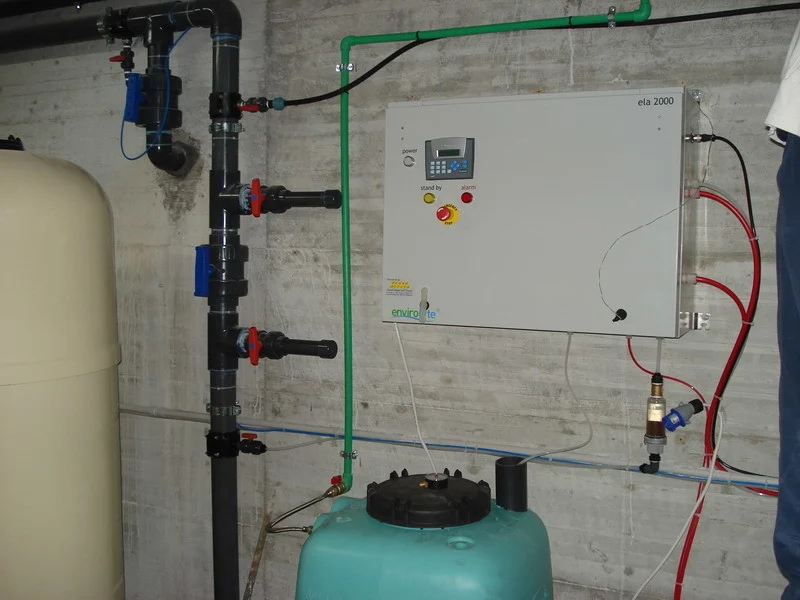
Envirolyte ELA-2000 anolyte generator installed in the technical room of a swimming pool in Italy
Envirolyte ELA-2000 anolyte generator installed at a swimming-pool facility in Italy.

How an Envirolyte Swimming Pool System Works

Conditioned water and sodium chloride brine are supplied to the Envirolyte generator. The generated anolyte is transferred to a suitable storage tank and then metered into the pool-water recirculation line.

A free available chlorine probe and controller can adjust the dosing pump according to the measured residual. The complete control arrangement should include appropriate flow interlocks, alarm limits, calibration procedures and manual verification.
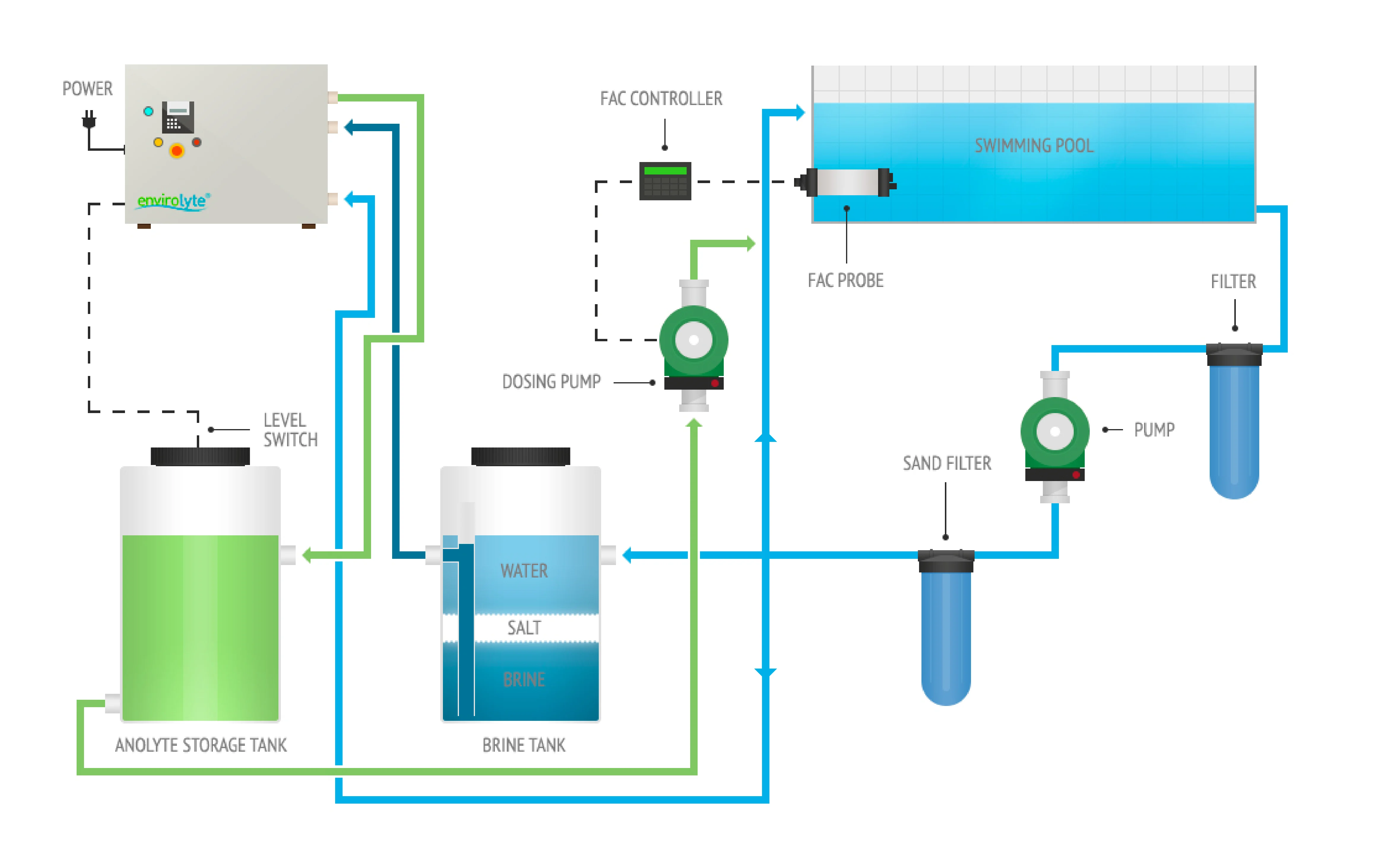
Diagram of an Envirolyte swimming pool disinfection system with anolyte generator, brine tank, storage tank, dosing pump, FAC controller, pool pump and filters
Typical Envirolyte swimming-pool water disinfection system with on-site anolyte generation and automated FAC-controlled dosing.

Typical System Components

  • Envirolyte anolyte generator selected for the required daily production
  • Incoming-water filtration, pressure control and softening where required
  • Brine preparation or sodium chloride solution tank
  • Anolyte storage tank with level monitoring
  • Dosing pump selected for the required rate and injection pressure
  • FAC probe, controller and appropriate sampling arrangement
  • Flow signal or interlock from the pool recirculation system
  • Injection point providing suitable mixing before water returns to the pool
  • Alarm outputs and connection to the facility control system where required

Potential Operational Advantages

Depending on the existing treatment method, water chemistry and validated project results, an on-site generation system may provide the following operational advantages:

  • Production of active solution close to the point of use
  • Reduced dependence on deliveries of concentrated hypochlorite or chlorine-gas cylinders
  • Automated production and FAC-controlled dosing
  • Integration with existing pool filtration and recirculation systems
  • Reduced operator contact with concentrated disinfectant products
  • Project-specific opportunities to reduce odour, deposits or chemical consumption
  • Scalable configurations for small commercial pools and larger aquatic facilities

Claims concerning eye irritation, chlorine odour, corrosion, biofilm, disinfection by-products or operating costs must be supported by measurements from the relevant installation. Supporting information is available under microbiological testing and disinfection by-products testing.

Commissioning and Routine Verification

The commissioning process should establish safe operating settings and demonstrate that disinfectant residual and pH remain within the required limits throughout the pool under representative operating conditions.

  • Calibrate the FAC and pH instruments using appropriate reference methods
  • Verify dosing-pump output and anolyte production parameters
  • Check automatic shutdown during loss of recirculation flow
  • Measure residual and pH at representative pool locations
  • Confirm filtration performance, turnover and water clarity
  • Evaluate operation during peak bather load
  • Monitor combined chlorine and other locally required parameters
  • Document alarm response, maintenance and sampling procedures
  • Review microbiological results according to applicable regulations

Swimming Pool Project Videos

The videos below document Envirolyte swimming-pool water disinfection installations in Turkey and Colombia. 

Swimming pools water disinfection in Turkey

Swimming pools water disinfection in Columbia

Swimming Pool Water Disinfection Case Studies

The following PDF documents describe Envirolyte installations at hotels, sports centres, universities, children’s pools and other aquatic facilities. They include pool volume, equipment configuration, dosing information, photographs and reported operating experience.

View swimming-pool installation documents
Envirolyte swimming-pool water disinfection projects
Country or region Facility and project data PDF document
Colombia InterContinental Cali hotel, 450 m³ pool, ELA-400HD; reported FAC residual 1.5–1.7 ppm. Cali swimming-pool project PDF
Germany Kreishallenbad Lauingen, 500 m³ indoor pool, ELA-4000 installation; reported FAC residual 0.3–0.6 ppm. Lauingen swimming-pool project PDF
Italy Athlon Sports Center, Rome, two pools of 420 m³ and 100 m³, ELA-6000 installation; reported FAC residual 0.8 ppm. Athlon Sports Center project PDF
Morocco Sofitel Hotels & Resorts, Marrakesh, 80 m³ outdoor pool, ELA-900; reported FAC residual 1.3 ppm. Marrakesh swimming-pool project PDF
Cook Islands Rarotonga, 50 m³ outdoor pool, ELA-900; the project document reports control using an ORP target above 650 mV. Rarotonga swimming-pool project PDF
South Korea NeoKids facility, Gwangju, 150 m³ indoor pool, ELA-900ANW installation; reported FAC residual 1.0 ppm. NeoKids swimming-pool project PDF
South Korea Additional swimming-pool installation documented in 2020. South Korea 2020 project PDF
Taiwan Taipei University, 525 m³ indoor pool, ELA-3000ANW installation; reported FAC residual 0.5 ppm. Taipei University project PDF

Case-study note: These documents describe particular installations and their reported operating conditions. Their FAC, ORP, dosing, cost and performance figures are not universal setpoints. Current regulations, product names, equipment availability and technical parameters must be confirmed for every proposal or new project.

Selecting an Envirolyte System for a Swimming Pool

Generator selection should be based on disinfectant demand and the complete recirculation process rather than only the static pool volume.
  • Installation country and applicable public-health regulations
  • Indoor or outdoor pool type and intended use
  • Total water volume and balance-tank volume
  • Recirculation rate and turnover time
  • Average and peak bather load
  • Water temperature and hours of operation
  • Existing disinfectant and pH-control method
  • Current FAC, combined chlorine, pH and microbiological results
  • Use and concentration of cyanuric acid where applicable
  • Filter type, number, flow and backwashing arrangement
  • Available injection, mixing and sampling points
  • Water hardness, conductivity and relevant source-water analysis
  • Available electrical supply, water pressure and installation space
  • Required solution storage, generator capacity and redundancy
  • Required alarms, remote monitoring and control-system integration
Depending on required capacity and generated-solution parameters, projects can be evaluated with equipment from the ELA, ANW or HD anolyte generator ranges.

Frequently Asked Questions

Is anolyte a chlorine-free swimming-pool treatment?

No. Anolyte contains free available chlorine and may contain a substantial hypochlorous-acid fraction under suitable pH conditions. It should be dosed, monitored and regulated as an active chlorine-based disinfectant.

Can one dosing ratio be used for every swimming pool?

No. Disinfectant demand varies with pool volume, recirculation, bather load, temperature, pH, contamination, stabiliser use and water chemistry. Dosing must be commissioned for the individual installation.

Can ORP replace direct FAC measurement?

ORP can support automated process control, but it does not always provide a direct measurement of disinfectant concentration. Local regulations or the project control plan may require direct FAC testing and independent manual verification.

Does anolyte automatically prevent chlorine odour and eye irritation?

No universal claim should be made. Odour and irritation can be influenced by combined chlorine, swimmer contamination, pH, ventilation, disinfectant concentration and operating conditions. Results should be verified at the individual facility.

Can the existing filtration system remain in use?

Often the generator and dosing equipment can be integrated with an existing recirculation plant, but filter capacity, hydraulics, injection points, controls and materials compatibility must first be reviewed.

Does automated dosing remove the need for pool operators?

No. Automated equipment still requires inspection, calibration, testing, maintenance, record keeping and trained response to alarms or water-quality deviations.

Discuss a Swimming Pool Water Disinfection Project

Provide the Envirolyte technical team with the pool volume, recirculation flow, bather load, water temperature, current treatment method, recent water-test results, equipment-room layout and applicable regulatory requirements.

  • Products
  • Technology
  • Performance
  • Applications