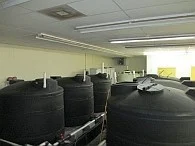
Oil and gas water treatment programmes may require microbial control in source water, frac water, flowback water, produced water, water-flood injection systems, storage facilities and transmission infrastructure. Microbial activity can contribute to biofilm formation, process disruption, reservoir souring and microbiologically influenced corrosion.
Envirolyte systems generate anolyte and, in selected configurations, catholyte from water, sodium chloride and electricity. Anolyte is an oxidising solution containing free available chlorine species, while catholyte is an alkaline reducing solution that may be evaluated for washing, cleaning and process-support applications.
Equipment selection and dosing must be based on representative water analysis, oxidant demand, microbial data, process chemistry, materials compatibility, contact time, flow conditions, monitoring requirements and the regulations applicable to the installation. Reported application values must not be used as universal operating instructions without laboratory testing and field validation.
Microbial Control in Oil and Gas Water Systems
Microorganisms can enter oil and gas operations through source water, recycled water, drilling and completion fluids, produced water and contaminated equipment. Planktonic microorganisms suspended in a water sample represent only part of the microbial population because sessile organisms may remain attached to pipework, tanks, deposits, corrosion products and other surfaces.
Anolyte may be evaluated as one component of a microbial-control programme. A reduction in culturable bacteria in bulk water does not by itself demonstrate biofilm removal, corrosion control, elimination of reservoir souring or improved hydrocarbon recovery.
Swipe horizontally to view the full table.
| Control factor | Why it matters | Recommended project response |
|---|---|---|
| Water chemistry | Salinity, pH, alkalinity, iron, sulfides, reducing compounds, hydrocarbons and organic matter can affect oxidant demand and residual stability. | Analyse representative samples and repeat testing when the water source, blend or operating conditions change. |
| Suspended solids | Solids and deposits can consume oxidant, obstruct equipment and shelter microorganisms from treatment. | Review filtration, separation, tank cleaning and deposit-control requirements before establishing a dosing programme. |
| Microbial population | Aerobic and anaerobic microorganisms may be present in the bulk water, deposits and attached biofilms. | Define suitable planktonic and sessile sampling methods, locations, frequencies and acceptance criteria. |
| Biofilm and deposits | Attached microbial growth can respond differently from organisms measured in a routine water sample. | Include representative surface sampling, corrosion coupons, deposit analysis or another validated biofilm-monitoring method. |
| Process-chemical compatibility | Oxidising solutions can interact with friction reducers, polymers, gels, crosslinkers, corrosion inhibitors, scale inhibitors and demulsifiers. | Conduct compatibility and performance testing with the actual water and complete process-chemical programme. |
| Materials compatibility | Solution concentration, pH, chlorides, temperature and exposure time can affect metals, seals, elastomers, coatings and injection equipment. | Review every wetted material and confirm acceptable continuous, batch and cleaning concentrations. |
| Contact time and residual | The applied dose does not show how much active solution remains after the water’s oxidant demand has been satisfied. | Measure residual decay and establish the required conditions at defined process and monitoring points. |
| Flow and mixing | Variable flow, short-circuiting and dead legs can create uneven treatment and unrepresentative sampling results. | Confirm the injection point, mixing method, flow range, residence time and representative sampling locations. |
| Corrosion indicators | Microbial counts alone cannot establish the cause, location or rate of corrosion. | Combine microbiological evidence with water chemistry, corrosion coupons, probes, deposits, inspection findings and operational data. |
| Hydrogen sulfide | Hydrogen sulfide is a toxic and flammable gas that may be present or generated in oil and gas operations. | Maintain appropriate gas detection, ventilation, training, emergency planning and exposure controls independently of the water-treatment programme. |
| Reuse and disposal | Produced water, flowback water and treatment residuals may be subject to reuse, injection, discharge or disposal restrictions. | Evaluate the complete treatment programme against applicable environmental permits and operating requirements. |
Technical note: Microbiologically influenced corrosion should be investigated using biological, chemical, metallurgical and operational evidence. The presence or absence of culturable microorganisms in one sample is not a complete MIC assessment.
How an Envirolyte Oil and Gas System Works
Conditioned water and sodium chloride brine are supplied to an electrochemical generator. Depending on the selected configuration, the equipment can produce anolyte alone or separate anolyte and catholyte streams. The generated solution can be transferred to a suitable buffer tank and introduced through a controlled continuous-dosing or batch-treatment arrangement.
Generator capacity should be calculated from the treatment volume, minimum and peak flow, required solution output, measured oxidant demand, operating schedule, storage allowance and redundancy requirements. Technical background is available on the electrochemical activation technology and anolyte and catholyte solutions pages.
Typical system components
- source-water filtration and conditioning where required;
- sodium chloride brine preparation and level monitoring;
- anolyte or anolyte-and-catholyte generator;
- compatible solution-storage or buffer tanks;
- dosing pumps or a controlled batch-transfer system;
- flow measurement and dosing interlocks;
- FAC, ORP or other process instrumentation where technically appropriate;
- representative water, deposit and surface-sampling points;
- secondary containment, drainage and ventilation;
- alarms, shutdown logic and facility-control-system connections;
- independent corrosion, microbial and hydrogen-sulfide monitoring appropriate to the process.
Depending on the required capacity and solution type, projects may be evaluated using ELA anolyte generators, HD anolyte generators or CG catholyte generators. Current model availability, output and technical specifications must be confirmed during project review.
Oil and Gas Water Treatment Applications
Frac and completion water
Anolyte may be evaluated for controlling microorganisms in source water or prepared frac water. Testing should establish whether the treatment achieves the required microbial result without adversely affecting friction reducers, polymers, gels, crosslinkers or other completion-fluid components.
Produced and flowback water
Produced and flowback water may contain high salinity, suspended solids, iron, sulfides, hydrocarbons and other oxidant-demanding constituents. The treatment programme should be based on representative analysis and the intended reuse, reinjection, processing or disposal route.
Water-flood injection systems
Microbial control in injection water may form part of a wider programme addressing filtration, suspended solids, dissolved oxygen, scale, corrosion, biofilm and reservoir souring. Treatment should be evaluated against the injection-water specification and reservoir-management requirements.
Pipelines and transmission lines
Anolyte may be evaluated for continuous or batch treatment of a water phase where microbial slime and sessile organisms are a concern. Chemical treatment should be coordinated with pigging, deposit removal, corrosion monitoring and the facility’s other treatment chemicals.
Sour wells and water-containing process equipment
Water-treatment programmes may target microorganisms associated with sulfide generation in wellbores, heater treaters, tanks and other water-containing equipment. The treatment does not replace hydrogen-sulfide detection, ventilation, respiratory protection, emergency procedures or other process-safety controls.
Catholyte for cleaning and process support
Catholyte is an alkaline solution that may be evaluated for cleaning drill bits, tools and selected process equipment or for conditioning water used in operational processes. Any substitution for diesel, detergents or other cleaning chemicals requires comparative cleaning tests, materials-compatibility assessment and confirmation of waste-handling requirements.
Application Dosing Reference Data
The following figures were reported for specific oil and gas applications. They are application-specific reference data rather than standard setpoints. Actual dosing depends on water quality, contamination, oxidant demand, starting solution concentration, mixing, contact time, treatment objective and the required free available chlorine residual.
View application dosing reference data
Swipe horizontally to view the full table.
| Application | Reported dosing data | Required verification before use |
|---|---|---|
| Frac water | 5 L of anolyte per 1,000 L of frac water, described as providing approximately 2.5 mg/L FAC. | Confirm solution concentration, water demand, target residual, contact time, product authorisation and compatibility with every frac-fluid component. |
| Sour wells | Approximately 600–650 L of anolyte at 500 mg/L FAC introduced into the wellbore on a daily or weekly basis. | Confirm well volume, water phase, microbial and H2S data, frequency, materials compatibility, well integrity and permitted product use. |
| Produced water | Approximately 21 L of anolyte per 1,000 L of produced water, described as providing approximately 10.5 mg/L FAC. | Test representative water for oxidant demand, residual decay, sulfides, solids, hydrocarbon interactions, corrosion and reuse or disposal requirements. |
| Heater treaters, hydrocarbon storage facilities and gas-storage wells | Approximately 500–550 L of anolyte at 500 mg/L FAC introduced into the water phase. A corresponding treated-water volume is not specified. | The figure cannot be interpreted as a complete dosing instruction without the treated volume, target residual, contact time and operating basis. |
| Water-flood injection water | 21 L of anolyte per 1,000 L of injection water, described as providing approximately 10.5 mg/L FAC. | Confirm injection-water chemistry, formation compatibility, oxidant demand, corrosion programme, reservoir constraints and regulatory requirements. |
| Oil and gas transmission lines | Approximately 1,650–1,700 L of anolyte at 500 mg/L FAC applied as a daily or weekly slug dose. | Confirm line volume, water holdup, flow, deposits, pigging programme, microbial results, corrosion data, compatibility and permitted product use. |
United States regulatory note: EPA Registration No. 87636-1 was included in a federal cancellation order effective 14 March 2019 and must not be represented as a current EPA registration. Any pesticidal use in the United States must be based on a currently registered product, its approved label and applicable state requirements.
Potential Operational Advantages
Subject to technical evaluation and validation under representative conditions, on-site generation may provide operational advantages such as:
- production of active solution close to the treatment point;
- reduced dependence on deliveries of selected ready-to-use biocides or cleaning products;
- controlled generation and dosing according to operating demand;
- integration with storage tanks, injection skids and water-treatment equipment;
- separate production of anolyte and catholyte where both streams are required;
- scalable configurations for different treatment volumes and flow rates;
- reduced operator contact with some concentrated delivered chemical products.
Claims concerning increased production, enhanced recovery, lower operating cost, corrosion reduction, environmental impact, chemical replacement or longer equipment life must be supported by documented measurements from the relevant installation.
Regulatory, Safety and Performance Verification
Biocidal use must comply with the current product authorisation and permitted application in the country of installation. Review Envirolyte’s approvals and compliance information, but do not infer that a company registration, manufacturing-establishment number or authorisation in one market permits every oil and gas application.
The cancellation status of EPA Registration No. 87636-1 is documented in the official EPA product-cancellation order.
The AMPP technical overview of microbiologically influenced corrosion explains why biological, chemical, metallurgical and operational evidence should be considered together when assessing suspected MIC.
Hydrogen sulfide remains an independent occupational and process hazard. The OSHA oil and gas health-hazard guidance identifies active gas monitoring, planning and worker training as important controls.
- verify current product authorisation and label requirements;
- complete process-hazard and chemical-compatibility reviews;
- define safe storage, containment, ventilation and transfer procedures;
- confirm personal protective equipment and emergency arrangements;
- assess incompatible chemical mixing and chlorine-containing gas risks;
- validate dose, contact time, residual and microbial-control performance;
- monitor corrosion independently of routine microbial counts;
- maintain calibrated H2S detection where exposure is possible;
- confirm produced-water reuse, injection, discharge and disposal requirements;
- document alarms, shutdowns, maintenance, sampling and corrective actions.
Commissioning and Routine Monitoring
Commissioning should establish whether the treatment can meet the defined project objective under representative operating conditions without adversely affecting equipment, materials, process fluids or other treatment chemicals.
- collect representative water, deposit and biofilm samples;
- analyse pH, salinity, suspended solids, iron, sulfides and relevant organic constituents;
- measure oxidant demand and residual decay over the required contact period;
- test compatibility with polymers, gels, inhibitors, demulsifiers and other additives;
- verify generator output and dosing-pump delivery;
- confirm injection-point mixing and representative sampling locations;
- establish planktonic and sessile microbial monitoring procedures;
- record corrosion-coupon, probe, deposit and inspection data where relevant;
- record H2S measurements independently of microbiological results;
- verify automatic shutdown during loss of flow or another defined alarm condition;
- review performance after changes in water quality, flow or process chemistry.
Houston Anolyte Production and Distribution Installation
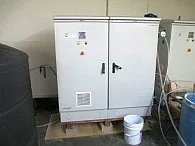
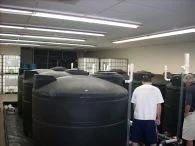
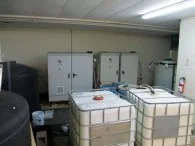
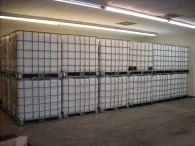
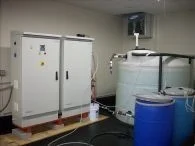
The following photographs document an anolyte production and distribution installation identified as being in Houston, Texas. The available materials do not provide an installation date, commissioning report, production records or verified oilfield performance results.
Offshore Potable Water Treatment
Potable-water treatment on offshore platforms is a separate application from microbial control in frac, produced or injection water. It requires drinking-water-specific equipment selection, dosing, residual monitoring, sampling and regulatory review. See the maritime and offshore water treatment application for the relevant design considerations.
Supporting Testing and Technical Information
General supporting information is available under microbiological testing of anolyte and anolyte by-products testing. These materials can support technical evaluation but do not replace testing with the actual oilfield water, process chemicals, materials and operating conditions.
Information Required for System Selection
- installation country and applicable product-use requirements;
- application type and treatment objective;
- representative source-water and process-water analyses;
- minimum, average and peak flow rates;
- batch volume, storage volume and treatment frequency;
- microbial, biofilm, corrosion and H2S data;
- current biocide, scale and corrosion-control programmes;
- polymers, gels and other process chemicals contacting the treated water;
- required contact time, residual and monitoring point;
- filtration, separation, pigging and cleaning systems;
- materials of construction, seals, coatings and corrosion constraints;
- available water pressure, electrical supply, drainage, ventilation and space;
- required storage, redundancy, alarms and remote monitoring;
- produced-water reuse, injection, discharge or disposal requirements.
Frequently Asked Questions
Anolyte is an oxidising solution that can be evaluated for controlling non-public-health microorganisms in frac water, produced water, injection water and other water phases. Its performance depends on water chemistry, oxidant demand, dose, contact time, mixing and monitoring.
No. Water chemistry, solids, sulfides, organic load, microbial contamination, flow, process chemicals and the treatment objective can substantially change the required dose and residual.
No. Microbial control may form part of an MIC-management programme, but MIC must be assessed using microbiological, chemical, metallurgical, corrosion and operational evidence.
No. FAC and ORP can support process control, but they do not directly demonstrate biofilm removal, sessile-microbial control, corrosion reduction or elimination of reservoir souring.
Catholyte is an alkaline electrochemically generated solution that may be evaluated for washing, cleaning or process support. Any replacement of diesel, detergent or another process chemical requires cleaning-performance and materials-compatibility testing.
No. EPA Registration No. 87636-1 was included in a federal cancellation order effective 14 March 2019. United States applications must be based on a currently registered product and its current federal and state label requirements.
No. Mortality and medicine use depend on herd health, genetics, feed, housing, ventilation, vaccination, veterinary management and many other variables. Any project claim should be based on documented farm results.
Discuss an Oil and Gas Water Treatment Project
Provide the Envirolyte technical team with the water analysis, application, treatment volume, flow, microbial and corrosion data, process-chemical programme, required monitoring, installation conditions and applicable regulatory requirements.