
Supported by Enterprise Estonia Development program

HomeOn-Site Disinfection Applications for Water Treatment and Process HygieneCooling Tower Water Treatment and Biofilm Control with On-Site Anolyte

Cooling Tower Water Treatment and Biofilm Control with On-Site Anolyte

Cooling towers and evaporative cooling systems require coordinated control of microbial growth, biofilm, algae, suspended solids, scale and corrosion. Poorly controlled deposits can foul fill media and heat-transfer surfaces, increase maintenance requirements and create conditions that support Legionella growth.

Envirolyte systems generate anolyte on site from conditioned water, sodium chloride and electricity. Depending on the operating regime, anolyte contains active chlorine species and can be evaluated for controlled microbiological treatment of recirculating cooling water. Learn more about electrochemical activation and on-site anolyte generation.

A complete cooling tower water treatment programme must also address makeup-water chemistry, concentration cycles, blowdown, pH, conductivity, suspended solids, scale and corrosion control, cleaning, Legionella risk management and routine verification. Anolyte dosing does not replace these operational controls or applicable local requirements.

Common Cooling Tower Water-Management Challenges

  • Biofilm and microbial deposits on tower basins, pipework, fill media and heat-transfer surfaces.
  • Algae growth in areas exposed to light.
  • Sludge, suspended solids and organic debris accumulating in the basin.
  • Scale caused by concentrated dissolved minerals, unsuitable pH or inadequate blowdown.
  • Chemical, under-deposit or microbiologically influenced corrosion.
  • Reduced heat-transfer efficiency where deposits accumulate on wetted surfaces.
  • Inconsistent biocide dosing or insufficient monitoring of the recirculating water.
  • Legionella risk in evaporative systems that generate and disperse water droplets.

How an Envirolyte Cooling Tower System Works

An Envirolyte generator produces anolyte from conditioned inlet water and sodium chloride brine. The generated solution can be stored in a dedicated tank and dosed into the recirculating cooling-water circuit at a selected injection point.
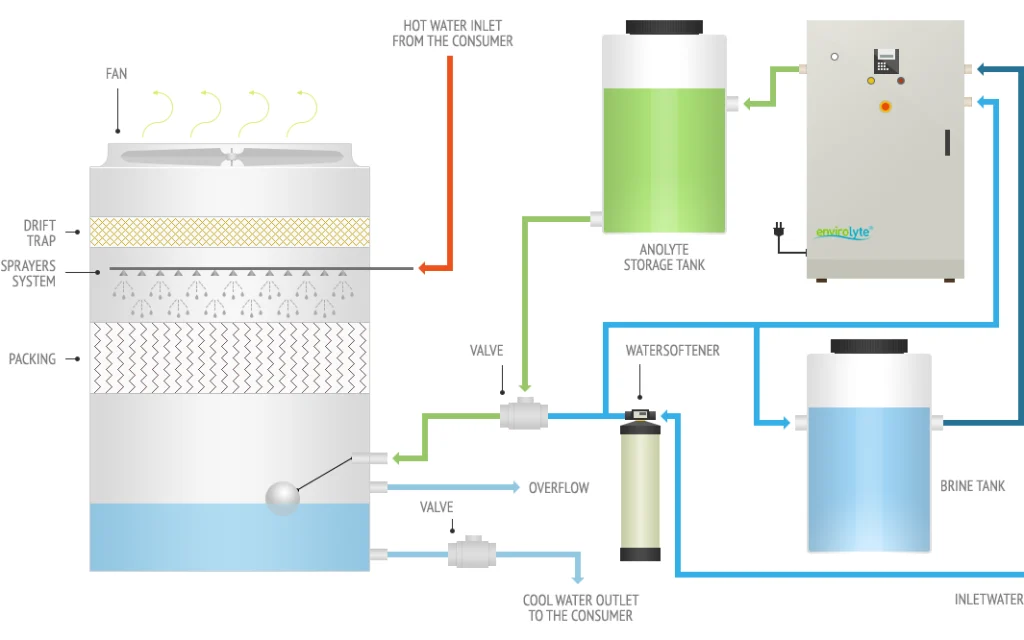
Cooling tower diagram showing an Envirolyte generator, brine tank, water softener, anolyte storage tank, dosing line, basin, fill media, spray system and recirculating water circuit
Typical cooling tower arrangement with on-site anolyte generation, solution storage and controlled dosing into the recirculating-water system.

The final generator capacity, storage volume and dosing arrangement depend on the total system volume, recirculation rate, makeup-water demand, blowdown, contaminant load, required residual and operating schedule. The injection point should allow adequate mixing and representative downstream monitoring.

Project Design and Monitoring Parameters

Swipe horizontally to view the full table.

Parameters to review when designing and validating cooling tower anolyte treatment
Parameter Why it matters Project information required
System volume and recirculation These determine the amount of water requiring treatment and influence mixing and dosing response. Total operating volume, basin volume, circulation rate, operating hours and seasonal load.
Makeup-water quality Minerals, suspended solids and organic matter affect scale, corrosion, disinfectant demand and blowdown. pH, hardness, alkalinity, conductivity, chloride, turbidity, iron, manganese and relevant microbiological results.
Concentration cycles and blowdown Evaporation concentrates dissolved substances, while blowdown controls their accumulation. Makeup volume, evaporation loss, drift loss, blowdown rate, conductivity setpoint and water balance.
Anolyte specification Microbiological performance depends on the generated solution at the point of dosing. FAC, pH, temperature, solution age, production capacity and quality-control method.
Dosing strategy Continuous, proportional or controlled dosing can produce different residual and exposure profiles. Dosing point, pump capacity, flow signal, storage volume, operating sequence and alarm limits.
FAC and ORP monitoring ORP can support trend monitoring but does not directly replace residual measurement or water-chemistry assessment. FAC method, ORP, pH, sampling locations, calibration schedule, control limits and corrective actions.
Scale and corrosion control Microbiological treatment alone does not control mineral scale or every form of corrosion. Materials of construction, corrosion history, deposit analysis, inhibitor programme and corrosion-monitoring method.
Microbiological verification Operating records and sampling are needed to confirm that the programme remains effective. Baseline results, sampling plan, general microbial indicators, Legionella requirements and response procedure.

Legionella control: cooling towers require a documented risk-management and maintenance programme that includes system inspection, cleaning, water treatment, monitoring, record keeping and corrective actions. Applicable guidance may include the HSE guidance for evaporative cooling systems and ANSI/ASHRAE Standard 188, subject to local law and site requirements.

Cooling Tower Treatment Workflow

  1. Establish the baseline: document the cooling system, water balance, operating conditions, treatment programme, deposits, corrosion history and microbiological results.
  2. Inspect and clean the system: remove accessible sludge, debris, algae and established deposits before relying on routine treatment.
  3. Analyse the water: assess makeup and recirculating water chemistry to define blowdown, scale control, corrosion control and disinfectant demand.
  4. Specify the generated solution: establish the required FAC, pH, production capacity, solution storage and quality-control procedure.
  5. Design dosing and monitoring: select the injection point, pump, controls, sampling points, alarm limits and response procedure.
  6. Commission the installation: verify mixing, residual distribution, sensor calibration and compatibility with tower materials and existing treatment products.
  7. Validate performance: compare deposits, microbial results, corrosion indicators, heat-transfer data, water consumption and maintenance requirements against the baseline.

Potential Operational Benefits

  • Controlled on-site production of an active disinfectant solution close to the point of use.
  • Support for managing microbial growth, biofilm and algae where the treatment programme is validated.
  • Potential improvement in heat-transfer performance where biological fouling is reduced.
  • Potential reduction in basin sludge and unplanned cleaning where deposit formation is controlled.
  • Integration with flow signals, dosing pumps, FAC measurement, ORP monitoring and alarm systems.
  • Reduced transport and storage of selected concentrated microbiological-control products.
  • Potential maintenance, water or energy savings when confirmed against measured operating data.

Energy savings, longer operating intervals and reduced chemical use should be presented only after comparison with a defined baseline. Results will depend on tower design, water chemistry, operating load, existing deposits, blowdown, treatment targets and maintenance practices.

Performance Evidence and Compliance

Review the available microbiological testing of Envirolyte anolyte together with the tested concentration, pH, organism, temperature, organic load and contact time. Laboratory test results do not automatically establish performance in a full-scale cooling tower.

Cooling-tower Legionella assessment should also consider the available Legionella prevention evidence. Project design must still account for tower cleanliness, aerosol generation, drift control, water temperature, nutrient load, residual distribution, monitoring and local risk-management requirements.

Before specifying the system, review the applicable BPR and customer compliance requirements. Article 95 supplier status or general efficacy testing does not automatically provide product authorisation for every country or cooling-water application.

Frequently Asked Questions

What is cooling tower water treatment?

Cooling tower water treatment is the coordinated management of microbiological growth, scale, corrosion, suspended solids and water concentration in an evaporative cooling system.

How can anolyte support cooling tower microbiological control?

Anolyte can be dosed into recirculating cooling water as part of a validated programme to control selected microorganisms, biofilm and algae. The programme must define solution quality, dosage, residual, contact conditions and verification.

Can anolyte eliminate all biofilm and algae?

No universal elimination claim can be made. Established deposits may require physical or chemical cleaning, and ongoing control depends on dosing, water chemistry, tower cleanliness, organic load and monitoring.

Does anolyte replace scale and corrosion control?

No. Scale and corrosion require separate assessment of makeup-water chemistry, concentration cycles, blowdown, materials and any inhibitor programme. Microbiological control is only one part of cooling-water management.

Is ORP measurement sufficient for automatic dosing control?

No. ORP can support control and trend monitoring, but it should be interpreted with pH, measured disinfectant residual, conductivity, water chemistry, sensor calibration and defined operating limits.

Can anolyte support Legionella risk management in cooling towers?

Anolyte may support the microbiological-control element of a Legionella risk-management programme. It does not replace risk assessment, cleaning, inspection, drift control, sampling, record keeping or corrective maintenance.

Can on-site anolyte generation reduce cooling tower operating costs?

Potential savings may result from reduced biological fouling, chemical handling, cleaning or energy loss, but they must be demonstrated by comparing verified operating data with a defined baseline.

What information is needed to assess a cooling tower project?

A preliminary assessment requires the system volume, circulation rate, makeup and blowdown volumes, water analysis, tower materials, operating schedule, current treatment, microbiological results, monitoring requirements and country of installation.

Discuss a Cooling Tower Water Treatment Project

Provide the cooling tower type, system volume, circulation rate, makeup-water analysis, blowdown, operating schedule, current treatment programme, monitoring data and country of installation so that the system and validation requirements can be assessed.

  • Products
  • Technology
  • Performance
  • Applications