
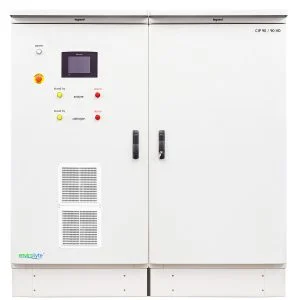
Envirolyte CIP HD equipment is designed for on-site production of stronger anolyte and catholyte solutions for washing, degreasing and disinfection tasks. The CIP/HD series is intended for applications where operators need to clean surfaces, premises, equipment or tools first and then disinfect them with freshly generated electrolyzed water solutions.
CIP HD generators produce both anolyte for disinfection and catholyte as an alkaline washing fluid on the spot and on demand. This makes the systems relevant for food processing, beer and beverage production, hospitality and selected industrial hygiene applications where required solution volume and strength may vary from standard cleaning-in-place requirements.
The CIP/HD series is a further development of standard Envirolyte CIP equipment. Standard CIP generators are generally selected for precisely preset low-salt CIP operations, while CIP HD equipment is selected when stronger anolyte or catholyte may be required for more difficult washing, degreasing and disinfection cases.
What CIP HD Equipment Is Designed For
CIP/HD anolyte/catholyte generators are designed for multiple applications where both an oxidizing disinfectant solution and an alkaline washing fluid are required. Anolyte supports disinfection, while catholyte supports washing, degreasing and selected process-support tasks.
| Function | Generated solution | Typical role |
|---|---|---|
| Disinfection | Anolyte | Oxidizing solution used for microbial control on compatible surfaces, equipment and process areas. |
| Washing and degreasing | Catholyte | Alkaline washing fluid used for selected cleaning, degreasing and soil-removal tasks. |
| On-demand generation | Anolyte and catholyte | Solutions are generated on site from water, salt and electricity, reducing dependence on delivered chemicals. |
| Variable process needs | Stronger anolyte/catholyte options | CIP HD is selected when standard preset CIP parameters may not be strong enough for the application. |
Key Technical Features
The CIP/HD range is positioned as a stronger and more flexible source of washing and disinfecting fluids compared with standard CIP equipment. The systems are designed for simple installation, operation and maintenance, with individual anolyte and catholyte reactor cell technology and remote monitoring options.
| Feature | Specification or project value |
|---|---|
| Anolyte strength | Typically 500–3000 ppm FAC, with optional pH regulation in the range of approximately pH 5–7.5. |
| Higher FAC option | Higher active chlorine concentrations may be possible up to approximately 6000 ppm, depending on configuration and project requirements. |
| Catholyte strength | Typically 1000–3000 ppm NaOH at approximately pH >12.5–13. |
| Reactor design | Individual anolyte and catholyte reactor cell technology for separate production control. |
| Production approach | On-demand production of washing and disinfecting fluids at the required volume and strength. |
| Waste generation | Extremely low waste generation, stated as less than 0.5% of device capacity. |
| Operation | Simplified installation and operation with an easy-to-use interface for consistent solution quality. |
| Components | High-quality components built to European standards. |
| Chloride control | Low-salt / chloride technology intended to help address corrosion concerns. |
| Remote monitoring | Remote monitoring can be specified by GSM or Ethernet. |
Where CIP HD Generators Are Used
CIP HD generators are relevant where standard cleaning-in-place parameters may not be sufficient and where both stronger alkaline washing support and stronger oxidizing disinfection are needed. Typical application areas include CIP solutions for processing equipment, food processing, hospitality and industrial applications.
| Application | How CIP HD equipment can help |
|---|---|
| Food processing | Supports washing, degreasing and disinfection tasks where stronger generated solutions may be required after site validation. |
| Beer and beverage production | Provides on-demand anolyte and catholyte for facilities requiring flexible solution strength and volume. |
| Hospitality and institutions | Can support hygiene-related washing and disinfection operations in hotels, schools, government facilities, military bases, prisons, cruise ships and janitorial services. |
| Industrial hygiene | Can be evaluated where both alkaline cleaning support and oxidizing disinfection are required in one integrated system. |
CIP Equipment vs CIP HD Equipment
Both standard CIP and CIP/HD generators have two independent production platforms that generate anolyte and catholyte either independently or simultaneously. The main difference is the intended strength and flexibility of the generated solutions.
| Requirement | Recommended option |
|---|---|
| Precisely preset low-salt CIP parameters with reduced corrosion risk | Envirolyte CIP equipment. |
| Stronger anolyte and catholyte for difficult washing, degreasing or disinfection tasks | Envirolyte CIP HD equipment. |
| Neutral anolyte only, with low salt consumption and no useful catholyte stream | ANW anolyte generators. |
| Dedicated alkaline catholyte production for selected washing or process-support operations | CG catholyte generators. |
Why Use On-Site Anolyte and Catholyte Generation?
On-site generation allows facilities to produce washing and disinfecting fluids when needed, at the required strength and volume. This can reduce chemical handling, storage and transport concerns while supporting a more controlled approach to cleaning and disinfection.
| Benefit | Practical value |
|---|---|
| On-demand production | Fresh anolyte and catholyte can be generated close to the point of use. |
| Reduced total cost of ownership | Lower dependence on delivered chemical products can support cost optimization after project validation. |
| Minimal maintenance | State-of-the-art reactor cell technology is designed for prolonged operational life. |
| Flexible solution strength | Anolyte and catholyte parameters can be selected according to application requirements. |
| Remote monitoring | GSM or Ethernet monitoring can provide additional operational visibility. |
Frequently Asked Questions
What is Envirolyte CIP HD equipment?
Envirolyte CIP HD equipment is an on-site anolyte/catholyte generation system designed to produce stronger washing and disinfecting fluids for applications where surfaces, premises, equipment or tools need washing, degreasing and disinfection.
What is the difference between CIP and CIP HD equipment?
Standard CIP equipment is generally selected for precisely preset low-salt CIP parameters. CIP HD equipment is selected when stronger anolyte or catholyte may be required for more difficult washing, degreasing or disinfection tasks.
What anolyte concentration can CIP HD equipment produce?
CIP HD generators are described with anolyte output in the range of 500–3000 ppm FAC, with higher FAC concentrations possible up to approximately 6000 ppm depending on configuration and project requirements.
What catholyte concentration can CIP HD equipment produce?
CIP HD generators are described with catholyte output in the range of 1000–3000 ppm NaOH at approximately pH >12.5–13, depending on configuration and operating conditions.
Where is CIP HD equipment typically used?
Typical use cases include food processing, beer and beverage production, hospitality, institutional facilities, cruise ships, janitorial services and selected industrial hygiene applications where both washing and disinfection fluids are required.
Request CIP HD Equipment Support
For technical guidance, application evaluation or model selection, send your enquiry to Envirolyte Industries International Ltd. Envirolyte can help assess the required anolyte FAC concentration, catholyte NaOH concentration, output volume, pH range, washing and degreasing conditions, disinfection requirements, installation layout and integration with food, beverage, hospitality or industrial hygiene systems.