Supported by Enterprise Estonia Development program

HomeOn-Site Disinfection Applications for Water Treatment and Process HygieneDental Unit Waterline Disinfection and Biofilm Control

Dental Unit Waterline Disinfection and Biofilm Control

Envirolyte dental unit waterline disinfection systems generate anolyte on site for controlled treatment of dental chair water circuits. The technology may be evaluated for clinics that need an integrated method of supporting microbial water-quality control across several dental units.

Dental unit waterlines are vulnerable to biofilm formation because they contain narrow-bore tubing, intermittent water flow and periods of stagnation. Source-water quality alone is not sufficient: treatment, maintenance, monitoring and suitable anti-retraction controls must address the complete dental water system.

Anolyte use must follow the dental-unit manufacturer’s instructions, applicable water-quality requirements and local biocidal regulations. Learn about electrochemical activation technology, review available microbiological testing information, and check the relevant ECHA and BPR information before selecting equipment or defining performance claims.

Why Dental Unit Waterline Quality Matters

Dental unit waterlines deliver water to handpieces, ultrasonic scalers and air-water syringes during routine treatment. Their small internal diameter and extended wetted surface can support biofilm development when water remains stagnant or when the waterline treatment programme is inadequate.

Microorganisms released from established biofilm can increase the bacterial concentration in output water even when distilled, deionised or low-microbial water is placed in an independent reservoir. A water bottle or alternative source-water supply therefore does not remove the need to treat and monitor the connected tubing.

Retraction of oral fluids is a separate contamination risk. Dental equipment should use suitable anti-retraction mechanisms, and those mechanisms should be inspected and maintained according to the equipment manufacturer’s instructions.

Scroll horizontally to view the complete table.

Important dental unit water-quality requirements and control measures
Control area Water-quality or operating objective Required approach
Routine non-surgical dental procedures In the United States, CDC guidance specifies output water containing no more than 500 CFU/mL of heterotrophic water bacteria. Use an appropriate waterline treatment programme, follow manufacturer instructions and monitor output water at the recommended frequency.
Surgical dental procedures Sterile saline or sterile water is required as the coolant or irrigant. Use a sterile delivery system that bypasses conventional dental unit waterlines, with sterile single-use or sterilizable tubing as applicable.
Biofilm control Prevent excessive microbial accumulation on the internal surfaces of dental tubing. Use a manufacturer-compatible treatment method, including periodic shock treatment where specified, followed by the approved maintenance programme.
Routine monitoring Confirm that the treatment programme continues to provide water meeting the selected limit. Follow the monitoring instructions of the dental-unit and treatment-product manufacturers and document results and corrective actions.
Anti-retraction protection Limit the entry of oral fluids and microorganisms into the water circuit. Inspect and maintain anti-retraction valves or other mechanisms according to the dental equipment manufacturer’s instructions.
Flushing between patients Help remove material that may have entered handpieces or waterlines during treatment. Follow the dental-unit manufacturer’s flushing procedure. Flushing alone should not be presented as a method for removing established biofilm.
Response to a failed water test Restore output water to the applicable microbiological limit. Stop relying on routine maintenance alone, investigate the cause, apply the prescribed corrective treatment and retest before returning to normal operation.

How an Envirolyte Dental Waterline System Can Be Integrated

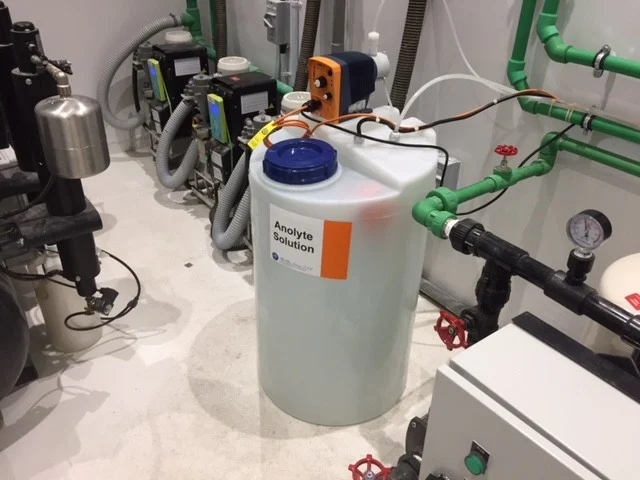
A central Envirolyte installation can generate anolyte for controlled supply to several dental units. The final system may include conditioned water, sodium chloride brine, an anolyte generator, solution storage, dosing equipment, flow monitoring and distribution pipework.

  1. Dental-system assessment: document the dental units, water sources, tubing, independent bottles, anti-retraction devices, existing treatment products and current water-test results.
  2. Water preparation: filter, regulate or soften the incoming water where required by the selected Envirolyte generator.
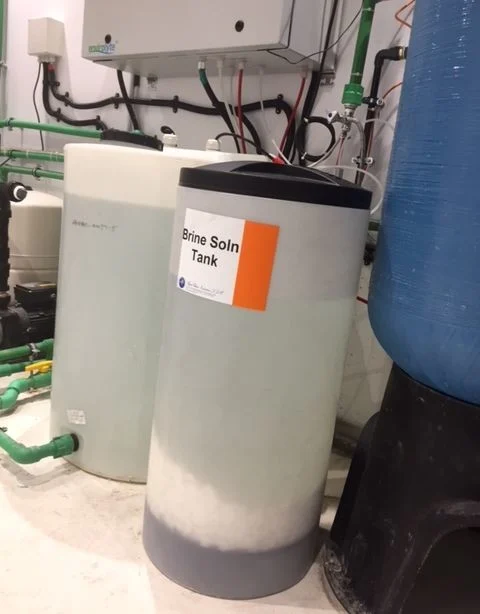
  3. Brine preparation: prepare and monitor the sodium chloride solution used by the electrochemical generator.
  4. On-site generation: produce anolyte under controlled flow, electrical and solution-quality conditions.
  5. Solution storage: transfer the generated solution to a compatible tank equipped with appropriate level controls.
  6. Controlled dosing: meter anolyte into the dental water supply according to the validated concentration and operating programme.
  7. Distribution: supply the treated water to compatible dental units while maintaining appropriate flow and avoiding stagnant branches.
  8. Monitoring: verify generated-solution parameters and dental unit output-water quality using suitable test methods.
  9. Corrective action: define procedures for failed microbiological tests, prolonged shutdowns, new equipment, maintenance work and suspected contamination.

Possible System Components

  • Envirolyte anolyte generator selected for the clinic’s required output
  • Incoming-water filtration, pressure regulation or softening
  • Brine preparation or sodium chloride solution tank
  • Anolyte storage tank manufactured from compatible material
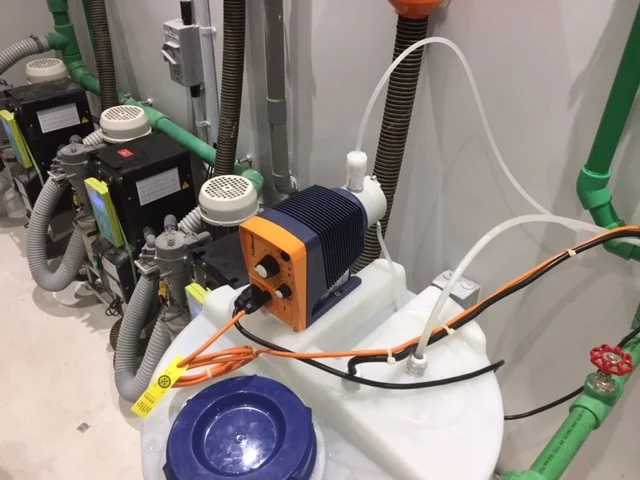
  • Dosing pump with calibrated output
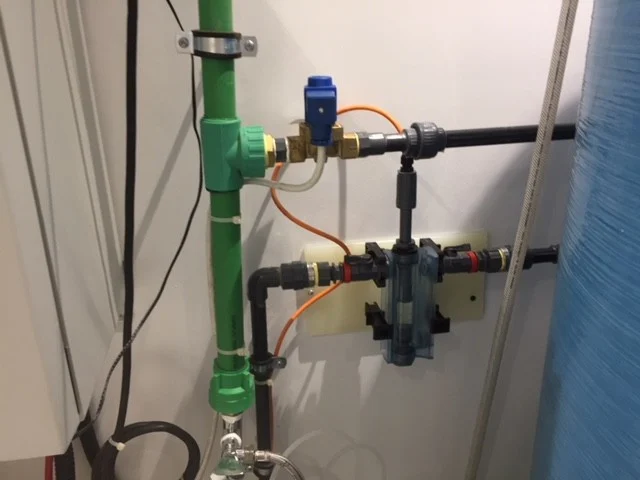
  • Flow sensor and dosing interlock
  • Distribution manifold serving compatible dental units
  • Solution and output-water sampling points
  • Alarm, shutdown and optional remote-monitoring functions

Depending on the required capacity and generated-solution parameters, a project may be evaluated with equipment from the ELA anolyte generator range or the ANW anolyte generator range

Dental Clinic Installation in Abu Dhabi

The photographs below document a central Envirolyte installation at a dental clinic in Abu Dhabi. They show the clinic, generator cabinet, solution tanks, dosing equipment, flow sensor and water-distribution pipework.
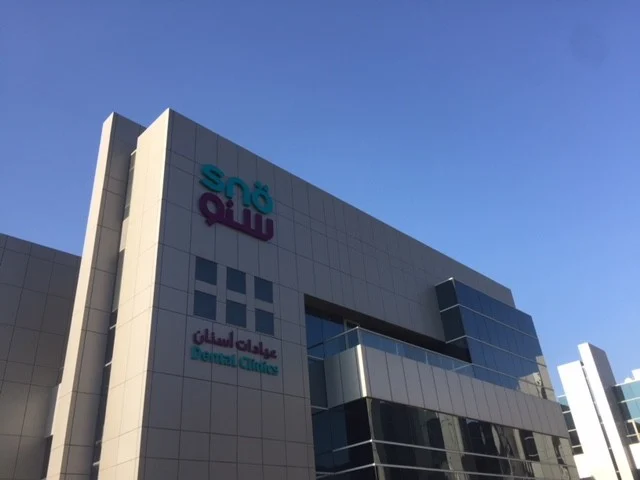
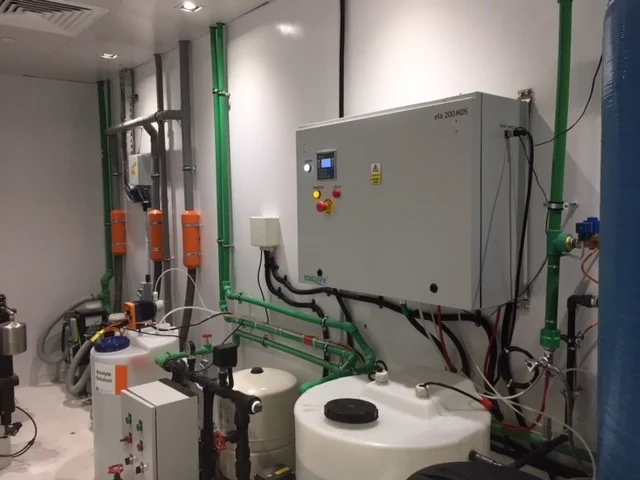
Dental clinic building in Abu Dhabi with an Envirolyte dental waterline disinfection installation
Dental clinic in Abu Dhabi where a central Envirolyte dental waterline treatment system was installed.

Disinfection of Dental Unit Waterlines with Anolyte at a Dental Clinic in Abu Dhabi

Treatment Validation and Routine Monitoring

Installation of a generator does not by itself demonstrate that dental output water meets the applicable microbiological target. The clinic should establish a documented treatment and monitoring programme covering commissioning, routine operation and corrective action.

  • Identify the applicable national or local dental procedural-water limit
  • Confirm compatibility with every connected dental-unit model
  • Define the required anolyte concentration, pH and dosing rate
  • Document initial cleaning or shock-treatment requirements
  • Calibrate dosing pumps and flow sensors
  • Select representative water-sampling outlets
  • Define microbiological test methods and test frequency
  • Record results, equipment maintenance and corrective actions
  • Revalidate after extended shutdowns, repairs or changes to the water system
  • Maintain a separate sterile irrigation procedure for surgical treatment

Envirolyte laboratory information can support technical evaluation of the generated solution, but suspension-test results do not prove performance inside a particular dental unit waterline. The solution concentration, contact time, organic load, tubing materials, biofilm condition and operating procedure must reflect the actual dental installation. Current test summaries and original laboratory reports are available through the microbiological testing section.

Regulatory and Equipment Compatibility

Dental waterline treatment may be subject to drinking-water, biocidal-product, medical-device, occupational-exposure and dental infection-control requirements. Regulatory status depends on the country, generated solution, intended claim, application method and equipment configuration.

Envirolyte’s Article 95 and active-substance information does not by itself authorise every dental application. Product authorisation and permitted uses must be verified for the installation country. See the ECHA and BPR information and quality-control and certification information.

Information Required for System Selection

  • Installation country and applicable dental water-quality requirements
  • Number, manufacturer and model of connected dental units
  • Number of operatories used simultaneously
  • Municipal, distilled, deionised or independent-bottle water source
  • Water pressure, hardness, conductivity, pH and other relevant analytical data
  • Current waterline treatment product and operating procedure
  • Existing microbiological test results and sampling locations
  • Water consumption and periods of stagnation
  • Pipework and dental tubing materials
  • Condition and maintenance requirements of anti-retraction mechanisms
  • Available equipment-room space, drainage and electrical supply
  • Required monitoring, alarms and record keeping

For related clinical facility applications, review the broader healthcare disinfection application.

Frequently Asked Questions

Does anolyte guarantee sterile dental unit water?

No. A dental waterline treatment system should be validated against the applicable procedural-water limit. Water that meets a routine microbiological limit is not necessarily sterile.

Can treated dental unit water be used during oral surgery?

Conventional dental unit waterlines should not be relied upon for sterile surgical irrigation. Surgical procedures require sterile saline or sterile water delivered through an appropriate sterile system that bypasses the conventional waterline.

Does filling an independent bottle with distilled water prevent biofilm?

No. Distilled or low-microbial source water can become contaminated if biofilm remains in the bottle, control block or connected tubing. The complete water pathway still requires treatment and monitoring.

Can flushing alone remove dental waterline biofilm?

No. Flushing may help remove material that has entered the system and reduce temporarily suspended microorganisms, but it should not be presented as an effective standalone method for removing established biofilm.

Can one Envirolyte generator serve several dental units?

A central installation may serve multiple compatible dental units, subject to an engineering review of total flow, simultaneous demand, distribution layout, dosing control and dental-unit manufacturer requirements.

Is a zero CFU/mL guarantee appropriate?

No general guarantee should be made. The clinic should define an applicable microbiological limit, sampling method and monitoring programme and report the measured results rather than promise permanent zero contamination.

Discuss a Dental Waterline Disinfection Project

Provide the Envirolyte technical team with the clinic location, dental-unit models, water source, existing treatment method, water analysis, microbiological results and applicable regulatory requirements.

  • Products
  • Technology
  • Performance
  • Applications